
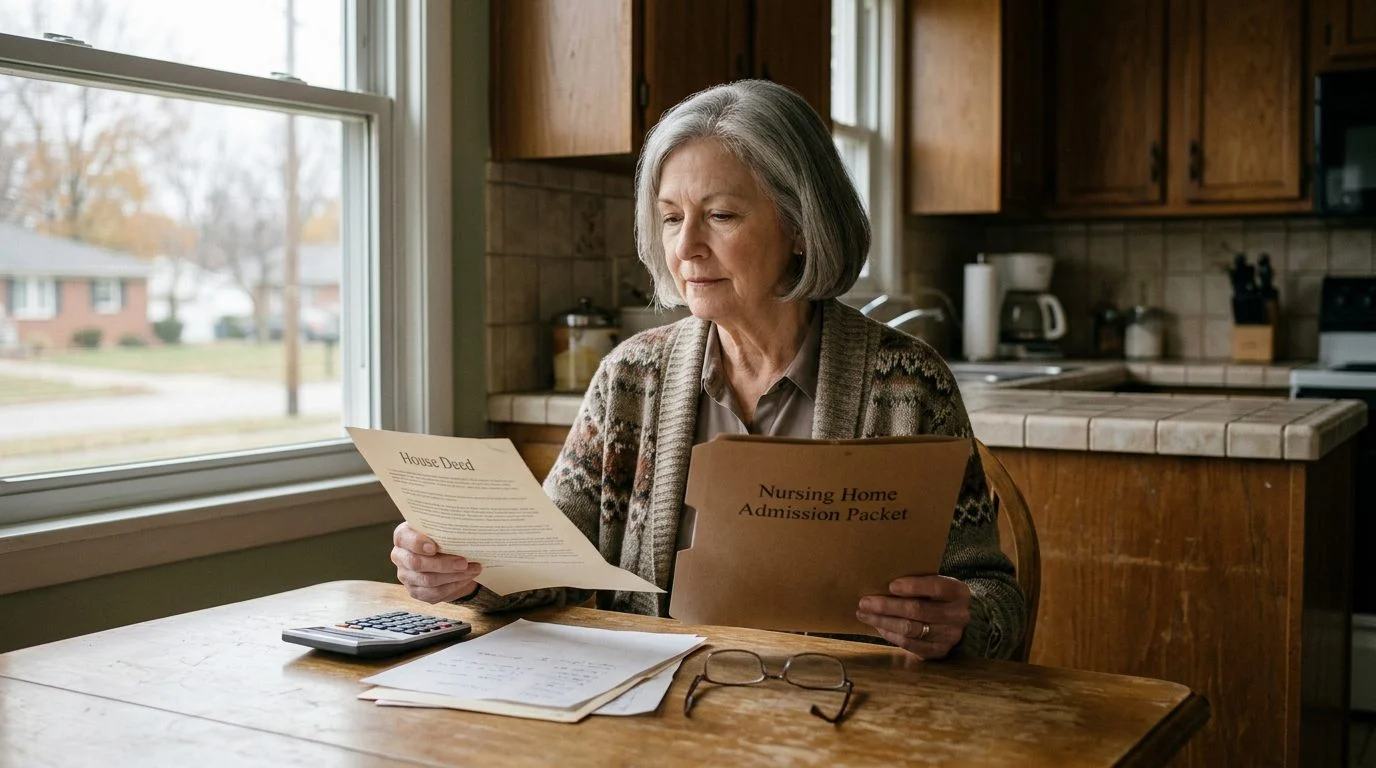
Medicaid and long-term care planning | Ohio
A Parent's IRA and Pension When Nursing Care Begins
When a parent needs nursing care, retirement accounts can be drawn into the bills. Our team helps your family see the options and take each step in order, so you are not left to sort out the rules alone.
By Timothy Jarvis · Published November 24, 2026
Your parent’s savings may sit mostly in an IRA, a 401(k) or a pension, and a nursing home stay may now be on the table. You may be the one carrying the paperwork and the worry.
This page explains how those accounts can come into view when nursing care begins in Ohio. Retirement accounts often matter when Medicaid helps pay for a nursing home stay, and planning can often protect part of them while keeping the at-home spouse secure. The details depend on the type of account and your family’s facts.
Who this planning is for, and what it covers
This page is for the adult child who carries a parent’s money questions while juggling work, their own children and their parent’s care. You do not have to figure out these rules alone. Staying on top of them is the firm’s job, and we guide your family one step at a time.
For example, imagine Karen, an adult daughter in Newark. Her father, Walt, has an IRA and a pension that make up most of his savings, and her mother, Ruth, still lives at home. When Walt’s health declines and a nursing home is recommended, Karen fears the bills will leave her mother with nothing. A planning meeting helps the family see which questions to ask about each account and what their options could look like. Every family’s facts are different, and results vary.
Our focus here is narrow: retirement accounts, pensions, the at-home spouse’s income and savings, and the Medicaid steps that come with paying for care. The detailed treatment of each account is something we walk through with you on a free discovery call.
If your parent's IRA or pension may need protecting before a nursing home stay, you do not have to sort it out alone, so reach out for a free discovery call. Talk it through with Jarvis Law Office — the first discovery call is free, confidential, and carries no obligation.

How retirement accounts come into view when nursing care begins
Retirement accounts come into view because Medicaid looks at the savings and income a family has, and an IRA or pension is often a large part of that picture. Two questions shape the answer: can the account be turned into cash, and can a regular payment be taken from it?
A retirement fund is a countable resource when the individual or the individual’s spouse owns it, can legally convert it to cash, and cannot legally receive regular, periodic payments from it (Ohio Adm.Code 5160:1-3-03.10).
A retirement fund that the individual has the legal ability to receive as regular, periodic payments, or guaranteed lifetime payments, is treated as unearned income; if a lump sum is also offered, the individual must choose the regular, periodic payments, and if the fund requires RMDs, the individual must take them in accordance with IRS rules. A retirement fund cannot be both income and a resource at the same time (Ohio Adm.Code 5160:1-3-03.10).
Your questions will likely include whether the account counts, how a monthly pension affects the at-home spouse’s income, and what your parent’s own care costs look like. We walk through each account with you, and we review the look-back period as part of that work.
Federal guidance from the CMS guide to nursing home costs explains how nursing home costs and Medicaid coverage fit together.
What planning can look like for your parent and the at-home spouse
Planning can often help the at-home spouse stay financially secure and keep a good quality of life at home. Planning done well before care is needed usually leaves more options. Even after care starts, a significant part of the spend-down, meaning the savings used for care before Medicaid helps, can often still be protected.
Here is how the rules look at a couple’s savings. When the institutionalized spouse is subject to a resource limit, the couple’s combined countable resources must be equal to or less than the community spouse resource allowance plus two thousand dollars before financial eligibility can be approved (Ohio Adm.Code 5160:1-6-04).
Imagine a couple, Ray and Linda, living in a small town in Fairfield County. Ray moves into a nursing home, and Linda stays in their house. Our example uses the 2026 maximum community spouse resource standard of $162,660, from Medicaid’s 2026 standards. Planning can then look at how their savings and both IRAs fit that picture, and what could help Linda keep her home and her income secure. Ray and Linda are only an example, and results vary with each family’s own facts.
In our plans, the financial power of attorney is a key tool for protecting a family’s assets, so it works alongside how accounts are titled.
How the planning process works, step by step
The process runs from a first conversation to ongoing help, and each step builds on the one before. First, we meet to understand your family’s situation and your parent’s wishes. Next, a strategy meeting helps the family choose a plan. Then we prepare the plan documents and fund and coordinate the assets to match, which takes more than paperwork.
Every plan we prepare includes a general durable power of attorney for finances, a health care power of attorney, a living will and a HIPAA release. Ohio’s Attorney General offers senior scam and exploitation guidance, which helps when a family manages a parent’s money.
When Medicaid pays for care, we also prepare the Medicaid application with the family. After the plan is in place, our guidance continues as needs change. Assets titled and coordinated correctly with the plan can help a family skip probate later, which is why this step matters so much.
Ohio Medicaid care settings and the care decisions ahead
Ohio Medicaid can help pay for nursing homes, many assisted living and memory care settings, and care at home. Not every setting accepts Medicaid, so confirm the setting before you choose it. The Ohio Medicaid coverage page is a useful starting point for the basic requirements.
Many families prefer to stay home longer, and that is often possible. If your parent stays home for now, a move to a care setting later can still be an option.
Care decisions can feel overwhelming when the health care system is fragmented and hard to follow. Our Care Navigators can help families find their way through that system on your parent’s behalf when that help is needed. They are not lawyers and do not give legal advice; the legal planning stays with the firm.
Common questions about a parent’s IRA and pension
Planning often works best when it starts early, though families can still find useful options after care begins.
Will a nursing home stay always use up a parent’s IRA?
No single answer fits every family, and planning can often protect part of the savings.
What happens to the at-home spouse’s income?
During any month the institutionalized spouse is eligible for long-term care services in a medical institution, HCBS waiver, or PACE, no income of the community spouse is considered available to the institutionalized spouse (Ohio Adm.Code 5160:1-6-04). Planning looks at that income as part of the whole picture.
Should we act before care starts?
Earlier planning usually leaves more options, and later planning can still protect part of the savings.
Does this mean we have to sell the house?
Not necessarily. Planning can often help the at-home spouse stay in the home, and we review that with each family.
What does planning cost?
The firm charges a flat fee with no recurring insurance-style fees, and we confirm the cost of your plan on the discovery call.
Not sure what your next step is?
Talk it through with Jarvis Law Office — the first discovery call is free, confidential, and carries no obligation.

Why plan with Jarvis Law Office, and your next step
We help families plan for care costs, and our team guides you step by step so you do not have to work out these rules alone. Jarvis Law Office concentrates its practice in elder law, Medicaid planning and estate planning, with offices in Lancaster, Dublin and St. Clairsville. We serve families in every Ohio county. Timothy Jarvis is the responsible lawyer for this page.
Most families planning for a parent want the same few things: the parent’s wishes honored, the home and savings protected as far as the law allows, good care when it’s needed, and fewer costly mistakes along the way. Those goals shape every step we take with you.
If your parent’s IRA or pension may need protecting before a nursing home stay, you do not have to sort it out alone. Book a free discovery call and we will walk through the options with you. The first discovery call is free, confidential and carries no obligation to continue.
How Jarvis Law Office helps with a parent's retirement accounts
Start before the bills pile up
Many families first hear about nursing care costs in the middle of a crisis. An early conversation gives your family more time to weigh the choices calmly.
The right documents in place
Our plans include a durable financial power of attorney, a health care power of attorney, a living will and a HIPAA release, so someone you trust can act for your parent if needed.
The whole family in the picture
A parent's savings affect a spouse at home and the adult children who may be helping. We look at the household as a whole and plan with everyone who needs to understand it.
Care Navigators along the way
When the health care system feels fragmented, our Care Navigators can help your family find their way through it on your parent's behalf. They do not give legal advice.
Decisions about retirement money can't wait for a crisis
Moving money out of a parent's IRA or changing a pension choice can shape what is left for the family and what is available for care. Talk with us before the next statement or the next nursing home bill forces the question.
Questions families ask about a parent's IRA and pension
Will a nursing home stay always use up my parent's IRA?
No single answer fits every family. Planning can often protect a meaningful part of the savings, and we will walk through your parent's situation with you.
What happens to the spouse who stays at home?
The at-home spouse's finances are part of the plan too. We look at the whole household so the spouse at home is not left to face the bills alone.
Who handles the paperwork and the phone calls?
Our team keeps track of the rules and the steps, and our Care Navigators can help with the health care side, so your family can focus on your parent.
Where do we start?
A free discovery call is the first step. It is confidential, with no obligation to continue, and it gives you a clear picture of what to do next.