
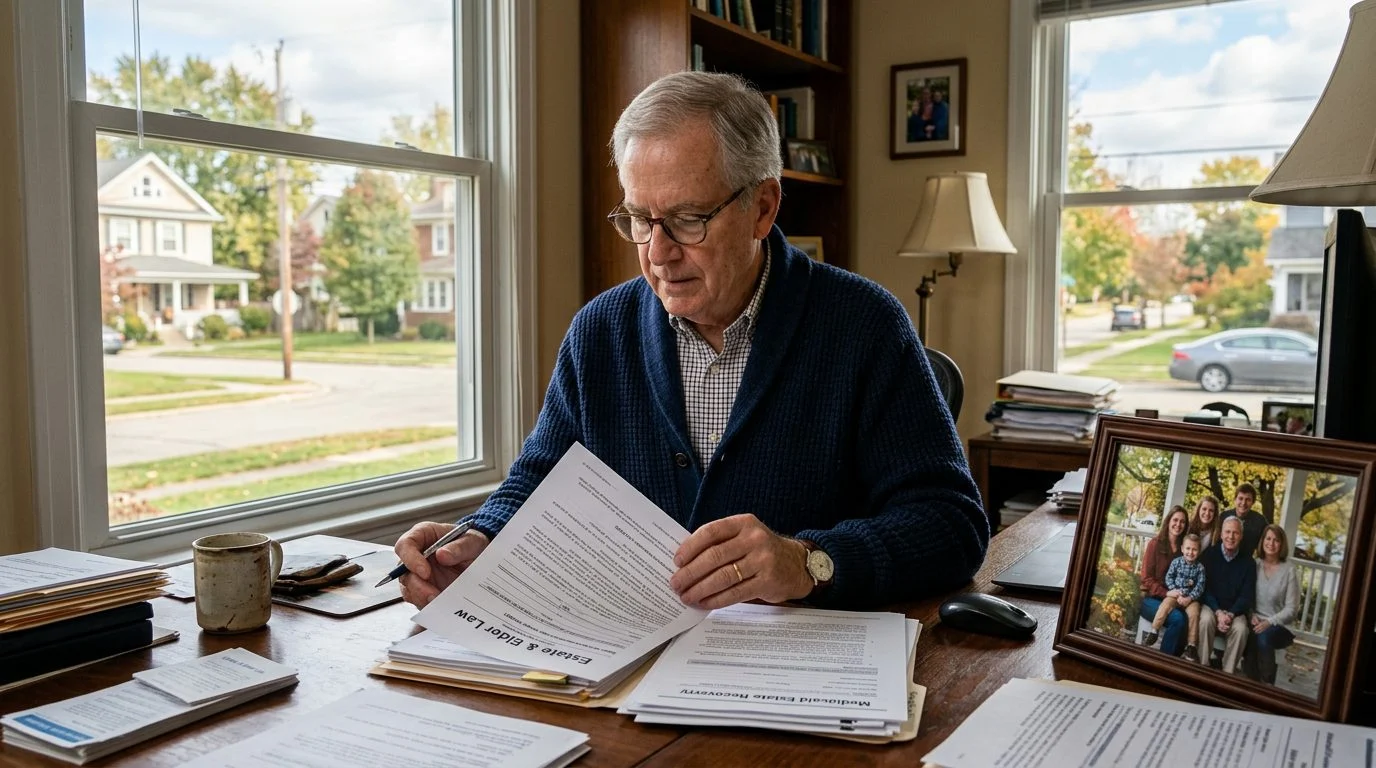
Ohio Transfer-on-Death Deed and Medicaid Estate Recovery
By Timothy Jarvis · Published November 24, 2026
If your home and a parcel of family land are most of what you own, you may be asking whether a transfer on death deed in Ohio can pass them to your children without probate. Short answer: it is one tool that can help real estate pass at death without probate, but it does not settle, by itself, what Medicaid estate recovery can reach.
You do not have to work through these rules alone. This page explains the two worries that usually come up first, and what planning can look like for a home and land.
Is a transfer-on-death deed right for your home and land?
For many families, a transfer on death designation is one useful piece of a plan for the home, not the whole plan. In Ohio, the official name is a transfer on death designation affidavit, and people often call it a transfer-on-death deed. Timing matters with this tool. A transfer on death designation affidavit is effective only if it is recorded with the county recorder before the death of the person who signed it (R.C. 5302.22).
Families usually consider it for three goals: keeping property in the family, avoiding probate, and giving the children one clear plan they all understand. Whether it fits depends on the property, the family and the care picture, and we work through those details with you. If your children would inherit this way, Ohio Legal Help explains how heirs receive a home under this designation.

For example: a couple, a farm and a plan for care in Licking County
A planning conversation helps a couple see their options before a health change forces a choice.
For example, imagine a couple, Carol and Walt, who live in a farmhouse outside Newark. Walt’s memory has started to slip, and Carol worries that a nursing home would use up the house and the field beside it, which are nearly all they own. Their two children both want the land kept in the family, and Carol fears they will argue over it. Carol wonders whether a transfer on death designation would protect the land, and whether she could keep the house if Walt needs care. At a discovery call, the attorneys walk them through how each tool works, which documents belong with it, and what to bring to a strategy meeting. Every family’s facts are different, so results vary with each family’s own situation.
Probate and estate recovery: the two worries behind most questions
Probate is the court process for settling a death, and estate recovery is the state’s claim after a Medicaid recipient dies.
Probate can be slow, costly and stressful for children who are grieving. Careful planning is how a family can skip probate later, by titling the home and coordinating assets before anyone dies.
Estate recovery is the harder worry. For Medicaid estate recovery, Ohio’s estate includes real and personal property in which a person had any legal title or interest at death, to the extent of that interest, including assets passed to a survivor through joint tenancy, survivorship, life estate, living trust, or other arrangement (R.C. 5162.21). So a designation alone may not end the state’s claim. Ohio Legal Help notes that the state’s claim may affect, or take priority over, a transfer-on-death beneficiary’s claim.
Spouses get some protection: Ohio may not seek estate recovery from a permanently institutionalized person’s estate while that person’s spouse is alive (R.C. 5162.21). Ohio may not seek estate recovery from a permanently institutionalized person’s estate while that person’s spouse is alive (R.C. 5162.21). That matters if you are the spouse who stays at home.
What planning can look like for your home and family land
Planning that starts well before care is needed gives a family the most room to choose.
Timing is the key question for a home. For an institutionalized individual, a transfer of assets for less than fair market value on or after the look-back date, which is sixty months (five years) before the individual’s baseline date, is presumed improper and will result in a restricted Medicaid coverage period (Ohio Adm.Code 5160:1-6-06). That is why a plan made early can look very different from one made in a crisis.
Planning can often protect assets from the spend-down when transfers are made before the look-back date, which is sixty months (five years) before the individual’s baseline date, per Ohio Adm.Code 5160:1-6-06. If care is needed now, a significant part of what a family might spend down can often still be protected, and options remain well before everything is spent. A home transferred to a child who provided care that let you live at home instead of in a long-term care facility may be treated differently when Medicaid looks at a transfer, and whether that exception fits your family depends on the facts, which we will walk through with you. We walk through those conditions with each family, and Justice in Aging offers background on the topic.
Whether a home is counted depends on who lives in it and on the other facts of the case. The value of your home is one more piece of that picture, and we look at it with you during your conversation.
Ohio Medicaid can help pay for nursing home care, many assisted living and memory care settings, and care at home. Not every setting qualifies, so we check each one. Staying home longer is often possible, and a move later stays an option. If your spouse stays home, planning can often keep that spouse in the house, financially secure, with quality of life intact.
How the process works, step by step
The process runs in six steps, from the first call to ongoing help.
It starts with a free discovery call. Our first discovery call is free, confidential and comes with no obligation to continue.
Next is a strategy meeting to choose a plan. We look at whether a transfer on death designation belongs in it, and how it fits with the rest of your property.
Then the plan documents are set up. In our plans, we include a general durable power of attorney for finances, a health care power of attorney, a living will and a HIPAA release. The financial power of attorney is a key asset-protection tool in our planning, because it names someone you trust to handle money matters.
Your assets come next. We title and coordinate them to match the plan. This is more than paperwork. It is what lets a family skip probate later.
If care is needed, we help with the Medicaid application. Ongoing guidance follows as your needs change.
Our Care Navigators can also help you find your way through the health care system when you need that help. They are not lawyers and do not give legal advice.
Why families bring their plan to Jarvis Law Office
Families who plan with us want to stay in control of their own decisions, protect what they have built, and leave something for their children.
Jarvis Law Office concentrates its practice in elder law, Medicaid planning and estate planning. We have offices in Lancaster, Dublin and St. Clairsville, and we serve families in every Ohio county.
We work on a flat fee, with no recurring insurance-style fees. We explain how it applies to your plan on the discovery call.
You do not have to figure all of this out yourself. Staying on top of the rules is our job, and we guide you one step at a time.

Questions families ask before they call
Will a transfer on death designation be enough on its own?
Usually not. It works best as one piece of a plan that is set up and funded correctly.
Can Medicaid take a home that passes at death?
Possibly. For Medicaid estate recovery, Ohio’s estate includes real and personal property in which a person had any legal title or interest at death, to the extent of that interest, including assets passed to a survivor through joint tenancy, survivorship, life estate, living trust, or other arrangement. Whether it applies to your home is a question we answer based on your facts.
Will our children have to go to court?
Careful planning can help a home pass without probate, but no one can promise how a family will settle things.
What if one of our children disagrees about the land?
Planning early and putting it in writing gives everyone the same information. It cannot control how people feel, but it can reduce surprises.
Can the spouse at home keep the house?
Planning can often help the spouse at home stay in the home and financially secure.
If you are weighing your home and land against the cost of care, you do not have to decide anything today. When you are ready, a free discovery call with Jarvis Law Office is a calm place to start.
Timothy Jarvis is the lawyer responsible for this page.