
Elder law for Ohio families
Wondering whether your parent's care bills are yours to pay?
Here is a plain-language way to think through the question, and a calm first step for your family.
By Timothy Jarvis · Published November 16, 2026
You’re probably asking this because your mom or dad is still at home, a few things have started to change, and no plan is in place yet. If your parent is slowing down while you are raising your own children and working, you may already be carrying more than you planned for.
Why you are asking this question now
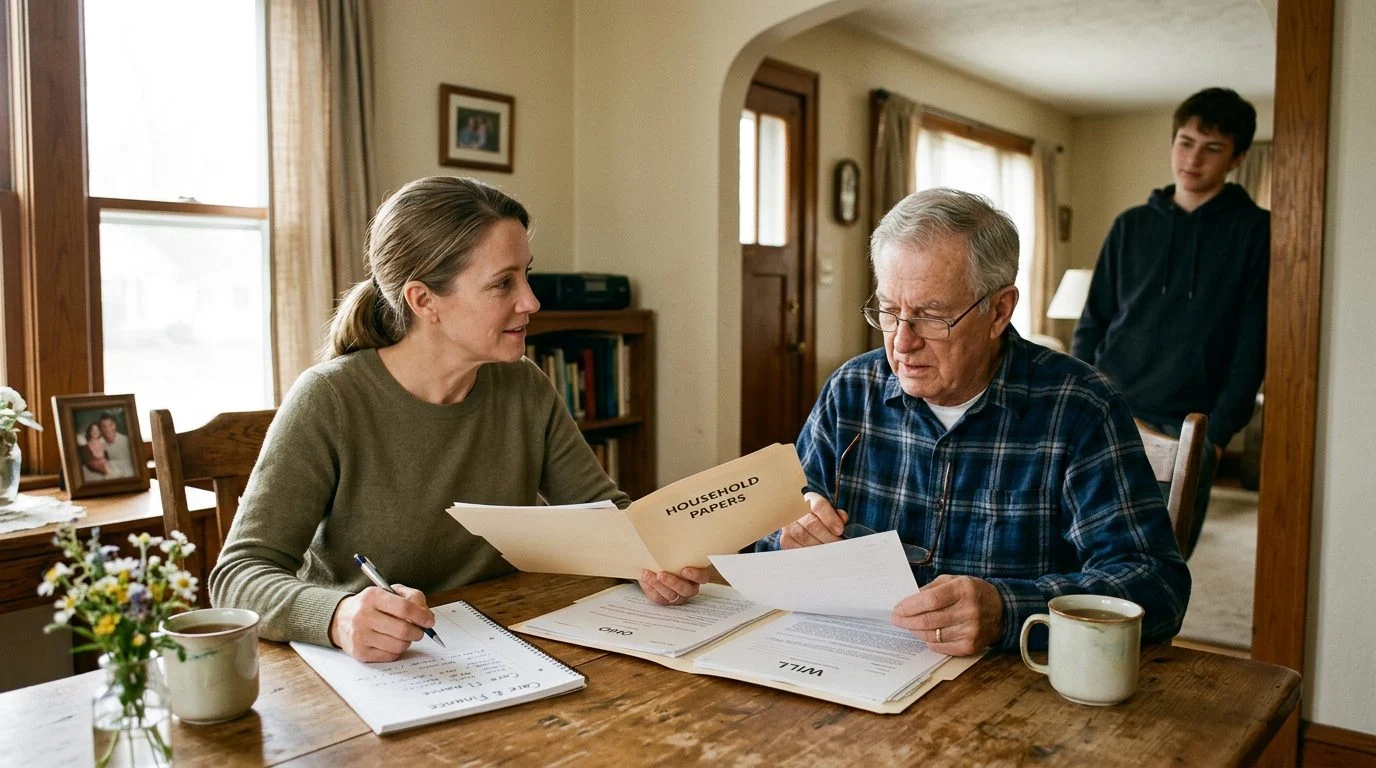
You’re in your 40s or 50s, raising your own kids, working, and noticing that your parent’s world is getting smaller. Maybe they missed a bill, stopped driving, or needed a hand on the stairs. Each change pulls you in a little further, and it’s easy to feel that everything is landing on you at once.
Many families in this spot have no power of attorney, no written wishes and no idea what care would cost. That’s normal.
You don’t have to work all of this out alone. We keep track of the rules so you do not have to, and we walk through each step with you at a pace you can follow.
If your parent may need care and no plan is in place yet, you don't have to figure this out alone. We're here to talk it through with you. Talk it through with Jarvis Law Office — the first discovery call is free, confidential, and carries no obligation.

What families most often fear, and what to do about it
Most families worry about the same four things: a nursing home bill, losing the family home, being the one who has to provide or pay for care, and siblings who see the situation differently. Each fear is real, and each one has a practical answer.
Care costs can be heavy, and a house is often the biggest thing a parent owns. Planning can sometimes protect that home, but the possibilities turn on timing and money. We look at both with you before anyone makes a move.
If you’re the child who has been caring for a parent at home, one Ohio rule may apply to you. Ohio’s rules include an exception for a home transferred to a child who provided care at home, and the requirements for it are something we walk through with you in your first conversation (Ohio’s rules on transferring a home to a caregiving child). The paperwork is specific, so we would go through it with you step by step before anything is signed.
When the health care system feels like a maze, our Care Navigators can help your family find their way through it on your parent’s behalf. They are not lawyers, and they do not give legal advice.
Siblings often disagree because they don’t have the same information. A written plan the whole family understands gives everyone one starting point before a crisis hits. That can cut down on arguments when the stakes are high.
Who can make decisions for a parent who cannot
Written documents are how a parent names the person they trust to act for them. That matters most when they can no longer manage on their own.
In our plans, we include four documents: a general durable power of attorney for finances, a health care power of attorney, a living will and a HIPAA release. The financial power of attorney is also one of the key tools in our planning for protecting a family’s assets.
That same power is why it needs care. The National Adult Protective Services Association notes that financial exploitation can involve misuse of a power of attorney. The Ohio Attorney General seniors page lists reporting resources for older Ohioans and their families.
In our plans, the health care power of attorney and the living will serve as the advance directives. The financial power of attorney and the HIPAA release are separate documents, and we keep them that way. Your parent’s wishes, written in plain words, give the family something to follow when no one wants to guess.
How Ohio Medicaid and asset protection fit into the picture
Ohio Medicaid can help pay for nursing homes, many assisted living and memory care settings, and care at home. Not every facility accepts Medicaid, so we check each setting before a family plans around it. The National Consumer Voice explains that Medicaid funds long-term care and home and community based services.
Ohio Medicaid can help pay for care at home, and many families prefer it because it lets a parent stay in familiar surroundings longer. Many families want to stay home longer, and that is often possible. A move to a facility later stays an option.
Medicaid also looks at transfers made before care begins. Ohio looks back five years at transfers of assets made for less than fair market value when a person needs Medicaid for long-term care, and a gift or sale in that window can trigger a period when Medicaid will not pay for care (Ohio’s rule on transfers of assets). Planning done well ahead can often shield some assets from the spend-down, the stretch when savings go toward care first. When care is needed sooner, a significant part of the spend-down may still be protected.
Ohio’s estate recovery program can seek repayment from the estate of a person who received Medicaid after turning fifty-five or while permanently institutionalized, and when that applies to a particular family is something we walk through with you (Ohio’s estate recovery rule). Planning can help the family understand what is possible for the home in that situation.
An example: a daughter, her father and a plan that came together
Here is how one plan can change a family’s options, shown through a made-up example. For example, imagine Karen, a daughter in Newark, and her father, Walt.
Walt, a retired machinist, had started missing bills and repeating himself. Karen was raising two teenagers and had no power of attorney for him. Her brother and sister disagreed about whether Walt should stay alone or move in with one of them. Karen feared a nursing home bill would drain the house Walt had worked so hard for, and that she would end up paying for his care. A first conversation with a firm helped the family see their options. Walt’s wishes were written down, the key documents were put in place, and everyone learned the next steps together. Every family’s facts are different, so results vary, and a plan that helps one family may look different for another.
Keeping the home and the family out of probate
Careful planning can help a family avoid probate, the court process that settles a person’s estate after death. The ACTEC probate explainer describes probate as the court-supervised validation of a will and the handling of a person’s assets, debts, taxes and gifts.
Probate is often expensive, drawn out and stressful for a grieving family. A plan set up and funded correctly can help a family skip it later. That means the right documents are in place, and assets are titled and coordinated to match the plan. Our part is to get the planning right, so that when the time comes your family may be able to avoid probate.
Keeping your parent’s home protected is part of this conversation too. We look at how the home is titled and what would happen to it, always with your family’s goals in mind. We cannot promise any particular result, but we can raise the important questions early, while there is still time to act.
Not sure what your next step is?
Talk it through with Jarvis Law Office — the first discovery call is free, confidential, and carries no obligation.
How Jarvis Law Office helps you
You don’t have to do this alone, and the first step is a conversation about your parent’s situation. We start there so we understand what your family is facing and what matters most to them. Next comes a strategy meeting, where we help you choose a plan that fits.
After that, we prepare the plan documents and coordinate your parent’s assets so they match the plan. That work is more than paperwork. Where Medicaid is part of the picture, we also help with the Medicaid application. As your parent’s needs change, we keep guiding you. Our fee is a flat fee, with no recurring insurance-style fees. Our first step is a free discovery call, which is confidential and carries no obligation to continue.
Our Care Navigators can also help with the health care system. That help is separate from our legal work.
Quick answers to common questions
Do I need a power of attorney for my parent?
Many families ask this question once a parent starts to slow down. In our plans, we include a financial power of attorney and a health care power of attorney, so that a trusted person is ready to help if your parent can no longer manage alone.
Can my parent’s home be protected if they need nursing home care?
Planning can often help protect a home, but the possibilities turn on timing and each family’s finances.
Where should I start?
Start with a first conversation about your parent’s situation and what your family wants for them.

Take the next step toward a plan your family understands
You may be reading this because a parent’s needs have changed, and you aren’t ready to hire anyone yet. That’s okay. Many families start by simply learning what’s possible. Our long-term care and memory care planning pages cover the bigger picture of paying for care.
If your parent may need care and no documents are in place yet, a calm first conversation is a good place to start. The first discovery call is free, confidential and with no obligation to continue. You can book your free discovery call whenever you’re ready.
Four things to gather before you talk with us
Your parent's current papers
Bring any existing will, trust, power of attorney or health care documents, even if you are not sure they are still current.
The care and cost picture
Note where your parent lives or may move, what care is needed now, and what the bills look like today.
Any admission or contract forms
If a care facility has asked anyone in the family to sign something, keep a copy and bring it with you.
Who is helping now
List the family members, friends or Care Navigators already involved, so we know who to include in the conversation.
Pause before you sign
Care facilities often ask a family member to sign admission papers quickly. Please ask us to review any document with you first, so you understand what you are agreeing to before you sign.
How Jarvis Law Office guides your family
You do not have to sort this out alone
Our team walks your family through each question step by step, so the hard moment does not become a harder one.
Plain words, clear options
We explain the rules that matter to your decision in everyday language, and we show you what each choice could mean for your family.
Care Navigators when you need them
Our Care Navigators can help your family find a way through the health care system on your parent's behalf.
Planning that protects what your parent built
We focus on helping families protect the home and savings they worked for, and on keeping a family out of probate when planning allows.
A flat fee, not a surprise bill
We charge a flat fee for our planning work, with no recurring insurance-style fees, so your family knows the cost up front.
Serving families across Ohio
We serve families in every Ohio county from our offices in Lancaster, Dublin and St. Clairsville.