
Ohio health care planning
Signing a health care power of attorney the right way
Questions about witnesses, notaries and dates can stand between a family and the care they need. Our first call is free and confidential, with no obligation to continue.
By Timothy Jarvis · Published November 16, 2026
You are probably looking at this because a parent has slowed down, and no one has clear authority to speak for them yet. Ohio gives two ways to make a health care power of attorney valid, and notarizing it is only one of them.
Those details matter more than most families expect. Here is the answer in plain words, and what it means for your family.
Why this question comes up when a parent has not planned ahead
Most families do not think about this until a phone call from a hospital or a doctor’s office. A parent who once handled everything now needs help with medicines, appointments and hard choices. Without a signed document, adult children often find that no one can speak for their parent with real authority.
The fear is understandable. You may be the one who has to act in an emergency, while a brother or sister sees things differently. A signed health care power of attorney names one trusted person to make those choices, so the family can act with less confusion when it counts.
For example, imagine a daughter named Carla in Circleville. Her father, Walt, is admitted to the hospital with pneumonia and cannot answer the doctors’ questions. Nothing on file names Carla, and her brother lives out of state and wants a say. Carla spends the first night calling relatives and searching for an old form her father once half-finished. Every family’s facts are different, and results vary with each family’s own situation.

What a health care power of attorney does, in plain words
A health care power of attorney names a trusted person, called the agent, to make health care decisions for a parent only if the parent’s attending physician determines that the parent has lost the capacity to make informed health care decisions. The parent chooses the agent while they can still say what they want.
The health care power of attorney and the living will are two documents that many families use to put their wishes for medical care in writing. A living will records what your parent wants about life-sustaining treatment. The two documents work together, so they are best signed in the same planning conversation.
Other papers often come up at the same time, and they do different jobs. A financial power of attorney covers money and property, not medical choices. Ohio Legal Help’s financial POA guide explains how that document works. A HIPAA release is a separate form about sharing health information. ACTEC video on diminishing capacity notes that financial and health care powers of attorney are different documents. In our plans, the financial power of attorney is also one of the tools we use to protect a family’s assets.
So, does Ohio require a notary?
Not always. Ohio accepts two valid paths, and a notary is one of them.
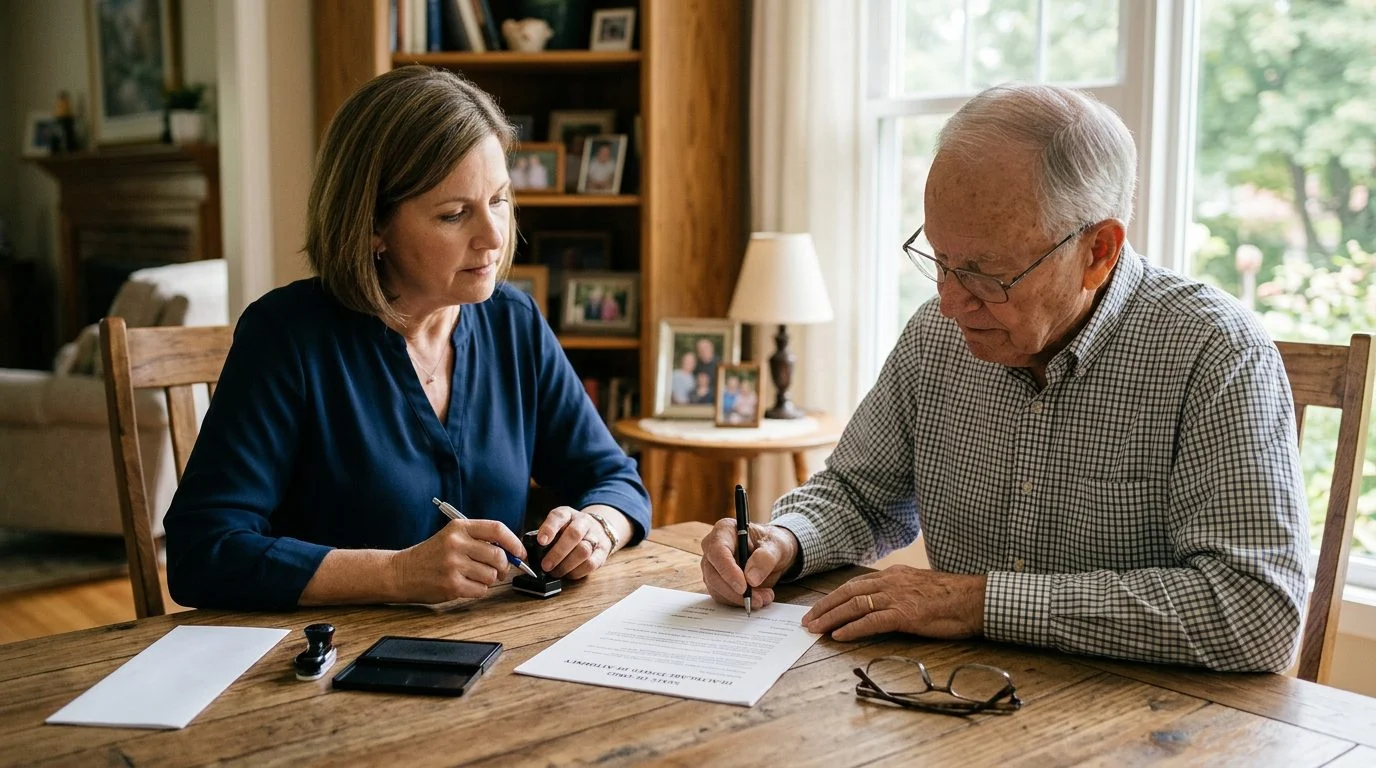
In Ohio, a health care power of attorney must be signed at the end by the person making it and must state the date it was signed. It can then be made valid either by two adult witnesses or by acknowledgment before a notary public (R.C. 1337.12). Witnesses cannot be relatives by blood, marriage or adoption, the person named as agent or alternate agent, the attending physician, or the administrator of the nursing home where the person is receiving care.
Each path has exact steps, and a form that looks finished can still fail when it matters most. A common mistake is signing at the kitchen table and assuming the job is done.
We walk families through the signing step when we prepare the documents. You do not have to sort out the requirements alone, and you are not left guessing about the details.
Why the signing details matter when a parent is already in the hospital
A gap in the paperwork is most painful on the day the family needs answers. That is why timing matters so much.
An agent can make health care decisions for the person only if the document substantially complies with Ohio’s requirements, specifically authorizes the agent to make those decisions, and the person’s attending physician determines that the person has lost the capacity to make informed health care decisions for themselves (R.C. 1337.13).
So the document has to be ready before the crisis, not during it. Signing while your parent can still say what they want is the safer path. Hospitals may ask for proof of your authority, and a missing step can slow things down while the family searches for papers.
Name a backup agent too, in case the first person you choose cannot serve. That way your parent’s wishes are written down, and no one is left scrambling to prove they can speak for them.
Naming the right person and getting the family on the same page
The right agent is someone your parent trusts, who is willing and able to act under pressure. Choose that person with your parent, not for them, and talk it through with the whole family before a crisis.
Siblings often disagree once a parent is sick. A short family meeting can settle who serves, who backs them up, and what your parent has said they want. Putting those choices in writing gives everyone the same starting point. The living will sits alongside the agent in the same plan, so your parent’s wishes and the person who speaks for them line up.
Our Care Navigators can also help your family find a way through the health care system when care decisions come up. They are not lawyers and do not give legal advice. Their job is to help you move through appointments, providers and hard transitions, while the firm handles the legal documents.

How Jarvis Law Office helps families put this in place
The first step is a conversation about your parent’s situation and your family’s worries. The free discovery call is confidential and carries no obligation to continue.
Our plans include a general durable financial power of attorney, a health care power of attorney, a living will and a HIPAA release. We prepare them together, so the documents match each other and your parent’s wishes. Our fee is a flat fee, with no recurring insurance-style charges. We also offer ongoing guidance as your family’s needs change. The firm focuses on elder law and estate planning, and our powers of attorney and guardianship work covers these documents in more depth.
Common questions
Does a healthcare POA need to be notarized in Ohio?
To be valid in Ohio, a health care power of attorney must be signed at the end by the person making it, must state the date it was signed, and must either be witnessed by at least two adults or be acknowledged before a notary public.
A notary or two adult witnesses can make it valid, and the limits on who may serve as a witness are one of the details we walk through with you on your free discovery call.
Is a HIPAA release the same as a health care power of attorney?
No. A HIPAA release is a separate form about sharing health information, while the health care power of attorney names a person to make decisions.
If you are still researching, you may be doing this for a parent you love. You do not have to face the signing rules alone. Timothy Jarvis, the responsible lawyer for this page, can walk your family through the choices on a free discovery call.
What we check with you before the signing
Who signs and who witnesses
We walk through who may serve as a witness or notary, and who should stay out of the room, so the signing does not have to be done twice.
The details that make it complete
Dates, signatures and the final pages are easy to miss on a busy day. We review each one with you so nothing is left for later.
The papers that go with it
A health care power of attorney works alongside a living will and a HIPAA release. We explain how each one fits so your wishes are clear to your doctors and family.
Keeping the plan current
Life changes, and so can the people you trust most. We help you review your documents as your family and health needs shift.
Keep the signed original where people can find it
A signed document only helps when the people who need it can reach it. We talk through where copies should go, including your doctors, your hospital and the person you name to make decisions for you.