
Ohio estate planning
Does a Surviving Spouse Automatically Inherit Everything in Ohio?
The answer depends on how your plan is set up, and you do not have to work it out alone. Our team walks you through it step by step.
Serving Ohio families from three offices
3
Ohio offices: Lancaster, Dublin and St. Clairsville
Every county
We serve families across Ohio
By Timothy Jarvis · Published November 17, 2026
If your spouse has moved into a nursing home, you may be asking whether everything will simply pass to you. A surviving spouse does not automatically inherit everything in Ohio in every case. What passes depends on whether there is a will, how each asset is titled, and who is named on accounts and policies.
The short answer: not automatically, in every case
Three things usually decide what a surviving spouse receives: the will, how each asset is titled, and who is named on accounts, retirement plans and life insurance.
Some assets skip the will entirely. A house held in both names can also work differently from a bank account, so the deed itself is worth reading. Many families learn these details only after a death, when the choices can no longer be changed.
Reviewing these choices while both spouses are living is far easier than sorting them out later. You do not have to work through this alone. Staying on top of the rules for your family is our job, and we walk through each piece with you, one step at a time.
If your spouse is in a nursing home and you are wondering what stays with you and the house, our team can walk through your family's titles and documents with you. Talk it through with Jarvis Law Office — the first discovery call is free, confidential, and carries no obligation.
For example: a spouse at home and a plan that was never made
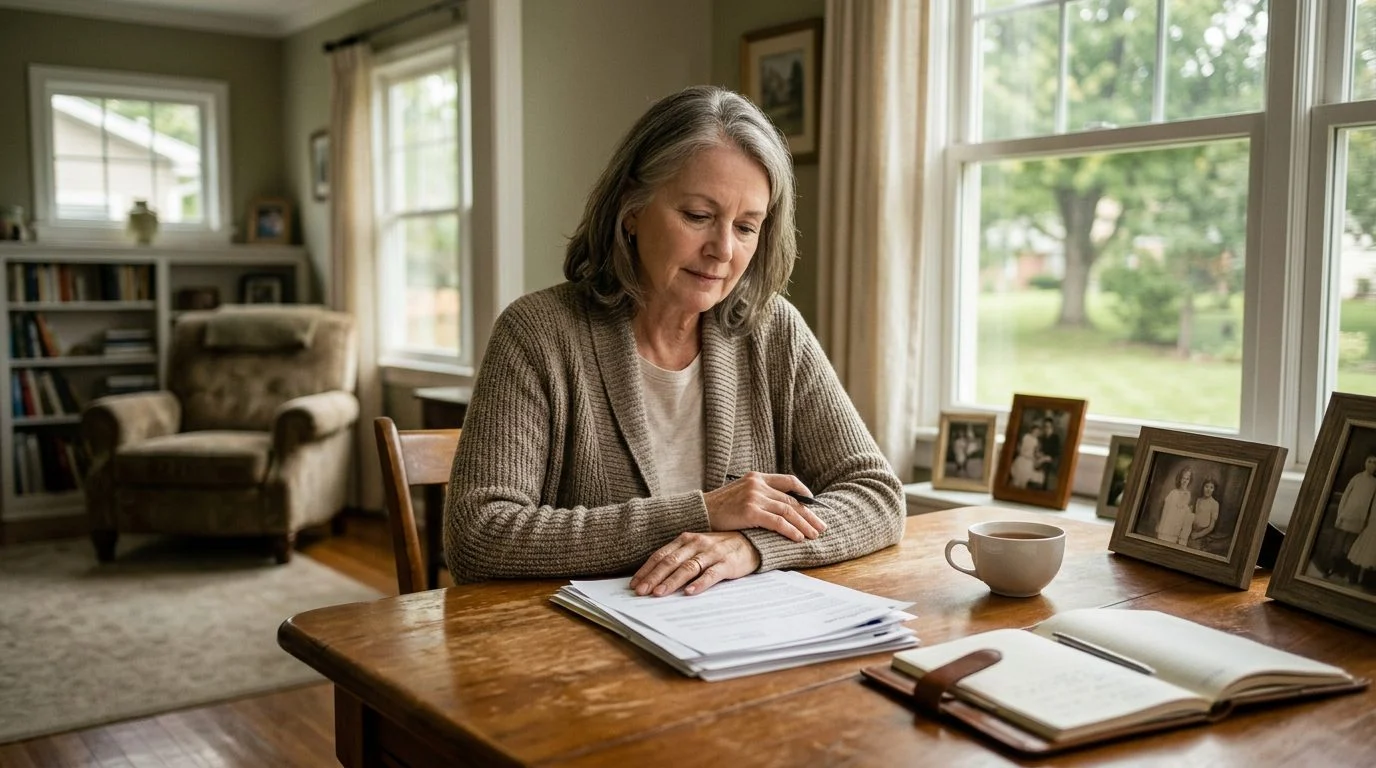
For example, imagine a couple, Ruth and Walt, in a small town in Perry County. Walt developed memory loss and moved into a memory care setting, while Ruth stayed in the family home. Their will left everything to Walt, and most of their savings sat in his name alone, so Ruth was not sure what would be hers to live on. She feared the bills would drain the savings and force a sale of the house. A review of their titles, beneficiary forms and will, done while Walt could still take part in decisions, would have shown Ruth which assets would reach her directly and where the gaps were.
This is only an illustration, not a client or a result. Every family’s facts are different, and what happens to yours depends on your own titles, forms and documents.
What decides who receives what
Without a will, the sharing rules for a spouse and children work like this:
If a person dies without a will leaving a spouse and one or more children, and all of those children are also children of the surviving spouse, the whole estate goes to the surviving spouse (R.C. 2105.06).
If the children come from more than one relationship, the picture changes.
If a person dies without a will leaving a spouse and more than one child, and the spouse is the parent of one but not all of the children, the spouse first receives sixty thousand dollars plus one-third of the balance, and the remainder goes to the children equally (R.C. 2105.06).
Which of these applies to your family depends on who the children are and what the papers say, so we check both together.
Do beneficiary forms override a will?
Check those forms alongside the will, not after it.
How a nursing home stay changes the picture
When one spouse needs nursing home care, Medicaid and estate recovery can change what the at-home spouse keeps. Ohio Medicaid can help pay for nursing homes, many (not all) assisted living and memory care settings, and care at home. Medicaid’s role in long-term care gives the basic picture.
Timing matters a great deal.
If an institutionalized person or their spouse gives away assets for less than fair market value on or after the look-back date, the transfer is presumed improper and results in a restricted Medicaid coverage period, and the look-back date is sixty months (five years) before the individual’s baseline date (Ohio Adm.Code 5160:1-6-06).
When care is needed now, a significant part of the spend-down amount can often still be protected, and options often remain well before all savings are spent.
This is the Medicaid mistake many spouses fear: a transfer made in a hurry, without a plan. Each move of a title or a gift should be reviewed first.
For a permanently institutionalized person, the state may not seek estate recovery from that person’s estate while the person’s spouse is alive (R.C. 5162.21).
Many families prefer staying home longer, and planning can make that choice more workable. Ohio’s partnership insurance program, LTC4Me, is a long-term care insurance partnership.
Can the spouse at home keep the house?
Planning can often help the spouse at home stay in the home, but whether that works depends on the family’s facts and the timing.
Why avoiding probate is part of the plan
Probate is the court process for settling a death. It can be expensive, drawn out and stressful for a family that is grieving. A plan set up and funded correctly can help a family skip probate later.
Helping families avoid probate is a big part of our work. The right documents need to be in place, and each asset needs to be titled and coordinated to match the plan. A single account or deed titled in one name can be enough to bring an asset into probate. Careful planning can make a different path possible, but no plan can be certain until it is reviewed against your family’s own facts.
Start with what you can check now: how your spouse’s accounts are titled and who is named on each beneficiary form.
The documents in our plans, including a strong financial power of attorney
Every plan we prepare includes a general durable power of attorney for finances, a health care power of attorney, a living will and a HIPAA release. In our planning, a strong financial power of attorney is a key asset protection tool. It names a trusted person to manage money if you or your spouse can no longer do it alone.
A living will records your wishes for end-of-life care, and a health care power of attorney names the person who speaks for you about medical care.
When care decisions come up, our Care Navigators can help your family find a way through a complicated health care system. They are not lawyers and do not give legal advice.
Not sure what your next step is?
Talk it through with Jarvis Law Office — the first discovery call is free, confidential, and carries no obligation.
How Jarvis Law Office helps families in this position
We help the spouse at home see the whole picture and move through it in order. The first step is a conversation about your family’s home, your savings, your spouse’s care and what you want to protect.
From there, we meet to choose a plan that fits, set up the plan documents, and title and coordinate the assets so they match the plan. That last step takes more than paperwork. We explain each part in plain words, so you know what is being done and why.
When the plan involves paying for nursing home care, we also handle the Medicaid application and stay involved as needs change. Our fee is a flat fee with no recurring insurance-style fees.
Next step: a free discovery call about your family’s situation
If your spouse is in a nursing home and you’re wondering what stays with you and the house, you are not behind. Many families are still gathering facts at this stage, and that is a good place to begin.
Bring the will, the deed, the account statements and the beneficiary forms, if you have them. You do not need answers ready. We cannot predict what your documents will show until we review them, but we can show you what to check.
Book a free discovery call to review your family’s titles and documents with our team. The free discovery call is confidential and carries no obligation to continue.

Frequently Asked Questions
Does a surviving spouse automatically inherit everything in Ohio?
Not always. What a surviving spouse receives depends on whether there is a will, how each asset is titled, and whether the deceased had children who are not also the spouse’s children.
What happens if my spouse dies without a will in Ohio?
Ohio law then decides who receives the estate, and the spouse may receive less than everything, especially when the deceased had children from another relationship. Our team can walk through how these rules apply to your family’s specific facts on a free discovery call.
Can a surviving spouse choose a different share than the one a will gives?
Every will and every family’s facts are different, so we would talk through your own situation on a free discovery call, which is confidential and carries no obligation to continue.
Do a house or bank account held jointly with my spouse pass to me without probate?
Often they do, when the account or home is owned with survivorship rights or has a payable-on-death or transfer-on-death designation. Assets held in one name alone usually pass under the will or Ohio’s default rules, which may require probate, so it is worth reviewing how each asset is titled.
How Jarvis Law Office helps you find your answer
We listen first
We start with your family's situation: who you love, what you have built, and what you want to happen. Nothing needs to be settled before that first conversation.
We review the plan you have
If you already have a will, a trust or beneficiary forms, we look at how they fit together with the way your home and accounts are titled.
We align the pieces
A plan works when the documents and the titling match. We coordinate both so your intentions are clear to your spouse, your children and the court.
We keep guiding you
As health, family and finances change, we stay with you. Our Care Navigators can also help you find your way through the health care system when you need that support.
A common assumption worth checking
Many couples assume everything will pass to the surviving spouse without a second thought. How each asset is titled and whether there is a will can change that, so it is worth checking your own plan rather than assuming.
What to gather before we talk
Your will, if you have one
Bring any will, trust or power of attorney you have signed, even if you are not sure it is current.
How your home and accounts are titled
Deeds, bank and investment account registrations, and beneficiary forms show us how assets will move.
Your family picture
Note your spouse, your children, any children from earlier marriages, and anyone who depends on you.