
Medicaid and long-term care planning | Ohio
Your spouse needs nursing home care. You don't have to work out the plan alone.
A calm, step-by-step way for the husband or wife who stays at home to understand the options for paying for care and protecting the life you share.
Where we work
3
Ohio offices: Clairsville
Ohio
We serve families in every Ohio county
By Timothy Jarvis · Published November 13, 2026
If your spouse has just moved into a nursing home, the new bills may feel like they could empty your savings, and the house you share may suddenly feel uncertain. Many spouses at home ask these same questions.
Ohio Medicaid can help pay for nursing home care. The spouse at home has separate protections, and careful planning can often keep the savings and the home you need in place.
If your spouse has just moved into a nursing home
Your spouse’s care and your own future run on two tracks. The first track is how Medicaid can help pay for the nursing home. The second is how you, the spouse at home, may keep enough income to live on. In some situations the amount of resources the at-home spouse keeps can be increased to produce more income, but only after a hearing and only when specific conditions are met, and we would walk through those conditions with you. Each track has its own rules, and they meet in the middle, which is why the questions feel so tangled.
You may be asking whether the savings will run out, whether you will have to sell the house, and whether one paperwork mistake could cost you months of care. Those are fair worries, and they are the right place to start.
You do not have to work out Medicaid, the savings and the house by yourself. Staying on top of the rules is the firm’s job. Our team guides you step by step, starting with what your family has today. Once every number is laid out in order, a bill that looked impossible often becomes a set of questions you can answer.
If your spouse has just moved into a nursing home, you do not have to sort out Medicaid, the savings and the house alone; we invite you to a free discovery call. Talk it through with Jarvis Law Office — the first discovery call is free, confidential, and carries no obligation.

An example of one spouse at home
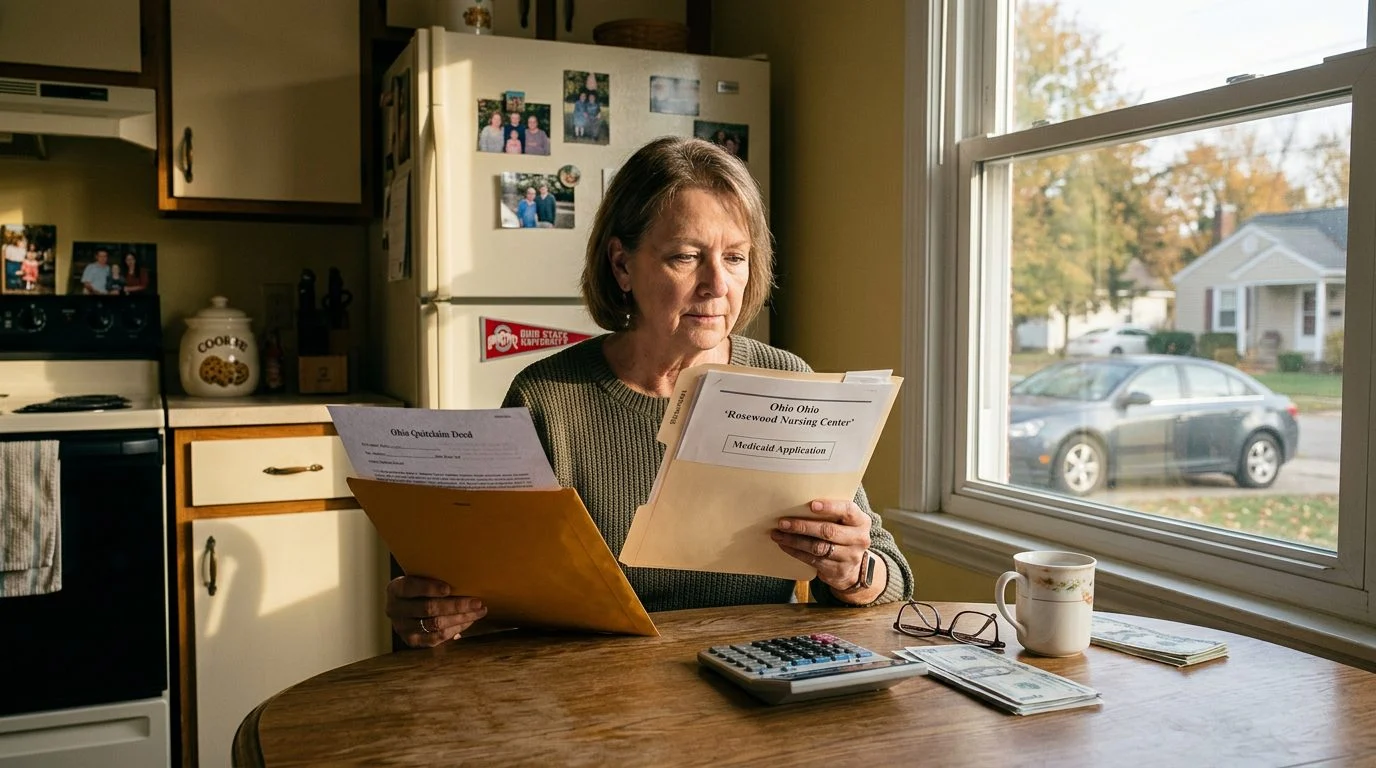
For example, imagine a couple, Carol and Dale, who live in a small town outside Chillicothe. Dale’s memory had been slipping for two years, and after a hospital stay he could no longer stay home safely. He moved into a nursing home, and Carol stayed in the house they had lived in for decades. Each monthly bill made her feel she was watching their savings drain away, and she wondered whether she would have to sell the house.
When Carol and Dale sat down with our team, we walked through their savings, their income and their home one piece at a time. The 2026 maximum community spouse resource standard is $162,660, a federal figure from CMS, and the amount for any couple depends on their facts. Carol found that the numbers she had feared were not the whole picture. She did not have to decide everything at the kitchen table. Her options came into view one step at a time.
Carol and Dale’s story is only an illustration. Every family’s facts are different, so results vary.
How Ohio Medicaid can help pay for nursing home care
Ohio Medicaid can help pay for nursing home care. It can also help pay for many assisted living and memory care settings, and for care at home. Not every facility qualifies, so the setting is part of the planning.
Many families want to stay home longer, and that is often possible for a time. A move to a facility later stays an option, and good planning keeps that door open.
In any month the nursing home spouse is eligible for long-term care services in a medical institution, the at-home spouse’s income is not counted as available to the nursing home spouse (Ohio Adm.Code 5160:1-6-04).
This is one reason the at-home spouse’s income is planned separately from the nursing home bill. Almost 70 percent of people turning 65 are likely to need some long-term care, according to the Administration for Community Living. Many spouses will face this question at some point.
The application is the step where paperwork and timing decide when coverage starts. Medicaid asks for documents about income, savings and property, and a small gap can slow approval. You can read the Ohio Medicaid application steps for the basics. Our team walks through the details with you.
Protecting the savings you will live on at home
Planning can often protect the savings the spouse at home needs to live on. Medicaid looks at the savings the couple holds together. The spend-down is the process of reducing countable savings before Medicaid begins to pay.
The at-home spouse, called the community spouse, is permitted to keep a certain amount of the couple’s combined countable resources, called the community spouse resource allowance (CSRA) (Ohio Adm.Code 5160:1-6-04).
After the month in which the nursing home spouse is determined eligible for medical assistance, the at-home spouse’s resources are no longer treated as available to the nursing home spouse, as long as eligibility continues without a break in coverage (Ohio Adm.Code 5160:1-6-04).
Planning can often keep the at-home spouse in the home, financially secure, with quality of life intact. That is a common goal for couples, and it is one we plan toward with you.
Even when care is needed now, a significant part of the spend-down amount can often still be protected. Waiting does not close every door. Options can remain, and a couple can often qualify for Medicaid-paid care well before spending everything. Every couple’s numbers are different, so the details matter.
The house, estate recovery and what you may leave your children
The house is often the first question spouses ask, and the timing of planning matters most. Here is the key point about estate recovery.
Ohio may seek estate recovery only after the death of the individual’s surviving spouse, if there is one, and only when the other conditions in the rule are also met (Ohio Adm.Code 5160:1-2-07).
Ohio’s home equity limit is one more figure families ask about. For 2026, Ohio’s home equity limit is $752,000, and it rises every January. It is one piece of the picture, not the whole story.
Earlier conversations give a family more time to weigh their options before a care decision has to be made. A plan set up and funded correctly can also help your family avoid probate later. Probate is expensive, drawn out and stressful for a grieving family. The right documents, with assets titled to match, are the key. For many couples, the hope is that what they built goes to their children and grandchildren, not to nursing home costs.
Avoiding a Medicaid application mistake
A Medicaid application that is not prepared carefully can slow the process, and that delay can drain savings while care is already underway.
Moving money to a child, retitling the home or giving away a car can create a problem if no one has planned for it. Transfers and gifts are where planning details matter most.
Other mistakes are quieter. Missing bank statements, an outdated deed or an unsigned power of attorney can slow the process. Each delay means another month of bills while you wait. Start early, and keep records of every deposit and withdrawal from the day your spouse enters the nursing home.
The exceptions to these rules are detailed. We walk through the ones that fit your family once we know your facts, so you are not left guessing.
Not sure what your next step is?
Talk it through with Jarvis Law Office — the first discovery call is free, confidential, and carries no obligation.
Hospice, care decisions and Care Navigators
Hospice is one of the care decisions families may face while a spouse is in a nursing home. It often brings money questions too. Our firm does not give medical advice. Your spouse’s doctors and care team guide those choices.
Our Care Navigators can help you find your way through the complicated, fragmented health care system when you need that help. They work on your behalf to connect appointments, providers and the next step after hard news. Care Navigators are not lawyers and do not give legal advice. Their help and our planning work side by side.
Care decisions and the money plan should fit together. If your spouse’s care changes, the Medicaid plan may need to change with it. That is why we treat care and money as one conversation, not two separate problems.
The documents to have in place now
In our plans, we include a general durable power of attorney for finances, a health care power of attorney, a living will and a HIPAA release. Each one has a job, and together they help your family act with less confusion when decisions must be made.
A strong financial power of attorney is a key asset-protection tool in our planning. If your spouse can no longer manage money, a trusted person can handle the bills, bank accounts and paperwork under that document. In our plans we include a health care power of attorney, a living will and a HIPAA release, so you can name the people you trust to speak for you about health care.
Scams can target older adults, so watch for requests for money or account access. The Ohio Attorney General seniors resources explain how families can spot elder abuse and financial exploitation. Keep the list of documents short, and keep copies where a trusted person can find them.

How Jarvis Law Office helps you take the next step
Jarvis Law Office helps you move from worry to a plan, one step at a time, starting with a conversation about your family’s situation. The first conversation focuses on where your spouse, your savings and your home stand today.
A strategy meeting follows, where you choose a plan that fits your family. Our team then sets up the plan documents. The assets are funded and coordinated to match the plan, which is more than paperwork. When that step is done carefully, it is the part of the plan that can help your family avoid probate later. When Medicaid is part of the picture, we prepare the application, and as needs change, we keep giving ongoing guidance.
Our fee is a flat fee, with no recurring insurance-style fees.
Common questions
Will the spouse at home have to sell the house?
Not automatically. What happens to the home depends on who lives there and how it is titled, and we review those facts with you.
Can the state take the house after my spouse dies?
Ohio may seek estate recovery only after the death of the individual’s surviving spouse, if there is one, and only when the other conditions in the rule are also met.
Is Medicaid planning the same as avoiding probate?
No, they are different goals. Planning can often help a family avoid probate, and we look at both together.
You don’t have to face this alone. If your spouse has just moved into a nursing home and you’re worried about the savings and the house, we invite you to a free discovery call. It is confidential and has no obligation to continue. Bring your questions and your numbers, and we’ll take it from there.
Why families who stay at home plan with us
Your spouse's wishes come first
We listen to how your spouse wants care to look and build the plan around those wishes, not around a form.
Protecting the home you share
We look at how the home and savings are titled and whether the plan can help you stay in your home and financially steady.
Plain words, no pressure
We explain each rule in everyday language and tell you what it means for your household before you decide anything.
Help beyond the paperwork
When you need it, our Care Navigators can help you find your way through the health care system on your spouse's behalf. They do not give legal advice.
Before you move money or sign anything
Transferring the house, retitling accounts or giving money to family can change how Medicaid looks at your savings. Please talk with us before you sign or move anything.
What the at-home spouse can do next
Gather the basics
Pull together the deeds, bank and retirement statements, and your spouse's current care bills. A short list of what you have is enough to start.
Tell us your household's story
Share who lives in the home, what your spouse needs day to day, and what you hope the next few years look like.
Review the options together
We walk through the choices for paying for care and what each one could mean for you, your spouse and your family.
Put a plan in place
We prepare your documents, including a financial power of attorney, and coordinate your assets so the plan fits how you actually live.