
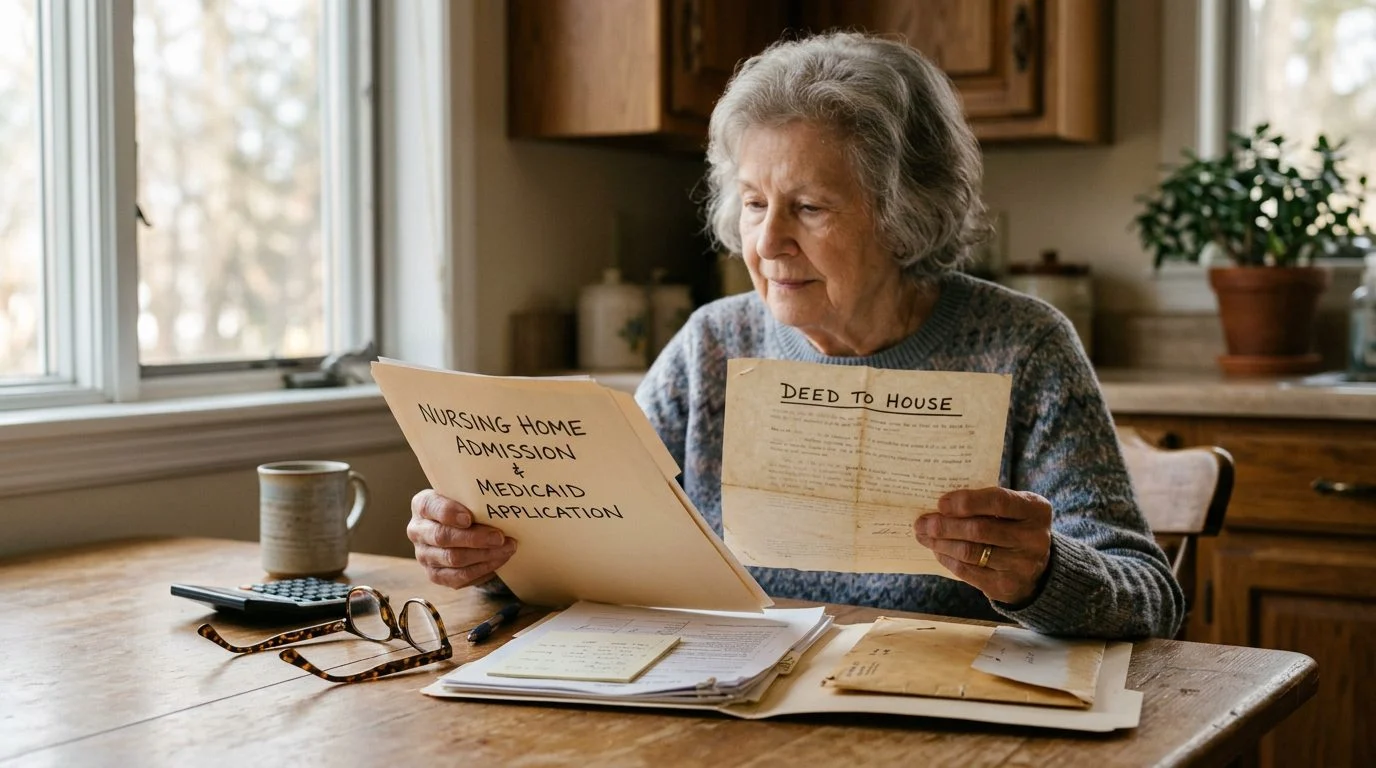
Medicaid and nursing home care in Ohio
Waiting on a Medicaid decision for a parent in a nursing home? You do not have to track it alone.
Here is how the wait works in Ohio, what a pending application means for your family, and how our team keeps the details moving while you focus on your parent.
By Timothy Jarvis · Published November 15, 2026
Your spouse has just moved into a nursing home, and the bills and Medicaid paperwork are piling up. You want to know how long approval will take and what you can do while you wait.
There is no single day count for Medicaid approval of a nursing home stay in Ohio. The wait depends on your family’s facts and on how complete and accurate the application is.
Why the answer to “how long” depends on your family’s facts
Imagine a couple, Ruth and Dale, who lived in a small town south of Columbus. After a slow decline at home, Dale moved into a nursing home, and Ruth stayed in their house, afraid the savings would run out before the application was decided. Ruth wanted two answers: how long the wait would take, and whether the house was at risk. Once their paperwork and money were sorted out, they could see their options clearly. Every family’s facts are different, so results vary with each family’s own situation.
Missing paperwork and unexplained money moves can slow an application down. Our job is to help get both right the first time, so the file moves with fewer questions. The exact timing depends on your family’s facts, and we will work through it with you on a call rather than guess from a web page.

What happens while the application is pending
While the application is pending, the nursing home bill keeps arriving. You need a clear picture of what is paid, by whom, and from which account. Ohio Medicaid can help pay for nursing home care, and its applications and renewals follow published Ohio Medicaid procedures.
A pending application is not a denial. Keep every statement, receipt and notice in one folder. Note the date each request from the county Job and Family Services office arrives, and answer it promptly so the file keeps moving.
If the health care system feels like a maze, our Care Navigators can help you find your way through it on your spouse’s behalf. They help with care and coordination, not legal advice. The legal side stays with the firm.
We guide you step by step through the application, and we help you respond when the county asks for more information. You don’t have to track every rule yourself.
Why past money moves can cause a denial or penalty
Before approving care, Medicaid reviews money moves your family made earlier.
Transfers of assets for less than fair market value made on or after the look-back date, which is sixty months (five years) before the baseline date, are presumed improper and result in a restricted medicaid coverage period, unless the family makes a satisfactory showing to the agency that the transfer was for fair market value or was made for a purpose other than to qualify for medical assistance (Ohio Adm.Code 5160:1-6-06).
In plain words, gifts to children, retitled accounts or a changed deed for less than fair market value made on or after the look-back date can create a penalty period, unless an exception applies. During that period, a restricted medicaid coverage period (RMCP) applies, which restricts Medicaid coverage. Please don’t move money or sign new titles until you’ve talked with us.
When the look-back was missed or care is needed now, a significant part of the money spent on care can often still be protected, depending on your facts. The details, including how a family can show a transfer was made exclusively for some purpose other than to qualify for medical assistance, are something we will walk through with you.
Protecting the at-home spouse’s home and income
Your spouse’s care does not automatically mean you give up everything. The spouse at home has protections, and planning is how you put them to work.
When one spouse enters a nursing home, the couple’s countable resources are added together, and the spouse at home may keep a share called the community spouse resource allowance (Ohio Adm.Code 5160:1-6-04).
Ohio also sets a home equity limit, and it rises each year. For 2026, Ohio’s home equity limit is $752,000, and it rises every January.
That is why the home where the at-home spouse lives sits at the center of the plan we build with you.
For example, imagine a couple, Carl and Linda. Carl needs nursing home care, and Linda stays in their home. Planning helps Linda keep the house and a steady income, and the CMS 2026 community spouse figures set the 2026 community spouse maximum resource standard at $162,660. Results vary with each family’s own facts.
Planning can often keep the at-home spouse in the home, financially secure and with quality of life intact. Whether it fits your family is something we will look at with you.
After your spouse’s death: estate recovery and avoiding probate
After a Medicaid recipient dies, the home can become a concern for the family.
Ohio’s estate recovery may be sought only after the death of the surviving spouse, if there is one, and only under the other conditions the rule sets out (Ohio Adm.Code 5160:1-2-07).
Regardless of actual hardship, an undue hardship waiver will not be granted when the individual created the hardship by using estate planning methods under which the individual divested, transferred, or otherwise encumbered assets in whole or in part to avoid estate recovery.
Probate is expensive, drawn-out and stressful for a grieving family. A plan set up and funded correctly, with the right documents and assets titled to match, can help a family skip probate later, but assets passing through joint tenancy, survivorship, life estate, living trust, or other arrangement can still be part of the estate subject to recovery. Helping families avoid probate is one reason we plan with them, and planning is the part we can do now.
How Jarvis Law Office helps you through the wait and beyond
You do not have to figure out these rules alone. Our team keeps track of them while you care for your spouse. The first conversation is where we learn your situation: the nursing home bill, the savings, the house and where your spouse’s care is today.
From there, we meet to choose a plan that fits, and we set up the planning documents. Every plan includes a general durable power of attorney for finances, a health care power of attorney, a living will and a HIPAA release. In our plans, the financial power of attorney is one of the tools we use to protect a family’s assets.
We then fund and coordinate your assets to match the plan, which takes more than paperwork. For your spouse’s Medicaid application, we prepare the file with your facts in mind and keep guiding you as your needs change.
We charge a flat fee with no recurring insurance-style fees. The first call is a free discovery call, confidential and with no obligation to continue.

Take the next step with a free discovery call
If your spouse is in a nursing home, the application is still pending, and you’re worried about the savings and the house, the next step is a conversation about your own facts. Book a free discovery call with Jarvis Law Office to talk through where your family stands.
You want your spouse’s care covered by Medicaid. You want to keep the house and enough income to live at home. You want the application to move forward without avoidable delays. We can talk through how those goals fit your situation, though we cannot predict the result ahead of time.
Common questions about the wait
Is there a set number of days for Medicaid approval of a nursing home in Ohio?
No. The wait turns on your family’s facts and on how complete the application is.
Does a pending application mean Medicaid has said no?
No. A pending application is still under review, and it is not a denial.
Can I give money to my children while the application is pending?
Please talk with us first. Past money moves can lead to a penalty period.
Can I keep the house if my spouse is in a nursing home on Medicaid?
Often the spouse at home can keep the house, and planning can help. The details turn on your family’s own facts.
How Jarvis Law Office helps while you wait
We review the application before it goes in
Missing pages or unclear records can slow a file down, so we go through the forms and papers with you before anything is sent.
We help with the follow-up requests
Reviewers often ask for more information during a decision. We help you gather what is needed and keep track of each request.
Care Navigators help with day-to-day care
When your family needs help finding its way through the health care system, our Care Navigators can help. They are not lawyers and do not give legal advice.
We keep the plan current
If your parent's needs or living situation change while the application is pending, we update the plan with you. Our plans also include a financial power of attorney, which helps a trusted person manage money if your parent can no longer do so.
A pending application is not a denial
A file that is still under review has not been turned down. Answering requests promptly helps keep it moving.
What can shape the wait
How complete the file is
Missing forms, unclear income records or a gap in the paperwork can send a file back for more information.
Your family's own facts
Each person's income, assets, living arrangements and care needs are different, so no single timeline fits every family.
Requests for more information
Follow-up questions are a normal part of review. Answering them quickly keeps the file moving.
Changes during review
If your parent's health or living situation changes while the application is pending, tell us so the plan can be updated.
Talk with us about your parent's care plan. Our free discovery call is confidential and carries no obligation to continue.
Related practice areas
- Long-Term Care and Memory Care Planning in Ohio
- My Mom Has Early Dementia
- Ohio Power of Attorney: Can an Agent Pay a Parent’s Bills?