
Medicaid and long-term care planning in Ohio
A Nursing Home Decision Is Here. Can Your Savings Still Be Protected?
Many Ohio families ask this question in the middle of a hard week. Our firm walks you through the options one step at a time, so you can decide with a clear picture in front of you.
Where we work with families
3
Offices: Lancaster, Dublin and St. Clairsville
All Ohio
We serve families in every Ohio county
By Timothy Jarvis · Published November 16, 2026
If your husband needs a nursing home now, you may be wondering whether it is already too late to protect your savings and your home. In many cases it is not too late to have options, though timing makes a real difference in what can be protected.
This page explains the main rules in plain words, what planning can look like, and how Jarvis Law Office guides families through it. You do not have to work out these rules on your own.
The short answer: it is often not too late to have options
Yes, it is often still possible to have options, even when care is needed now. A husband who needs nursing home care today does not automatically mean the savings and home are lost. What can be protected depends on when planning starts and on your family’s own facts.
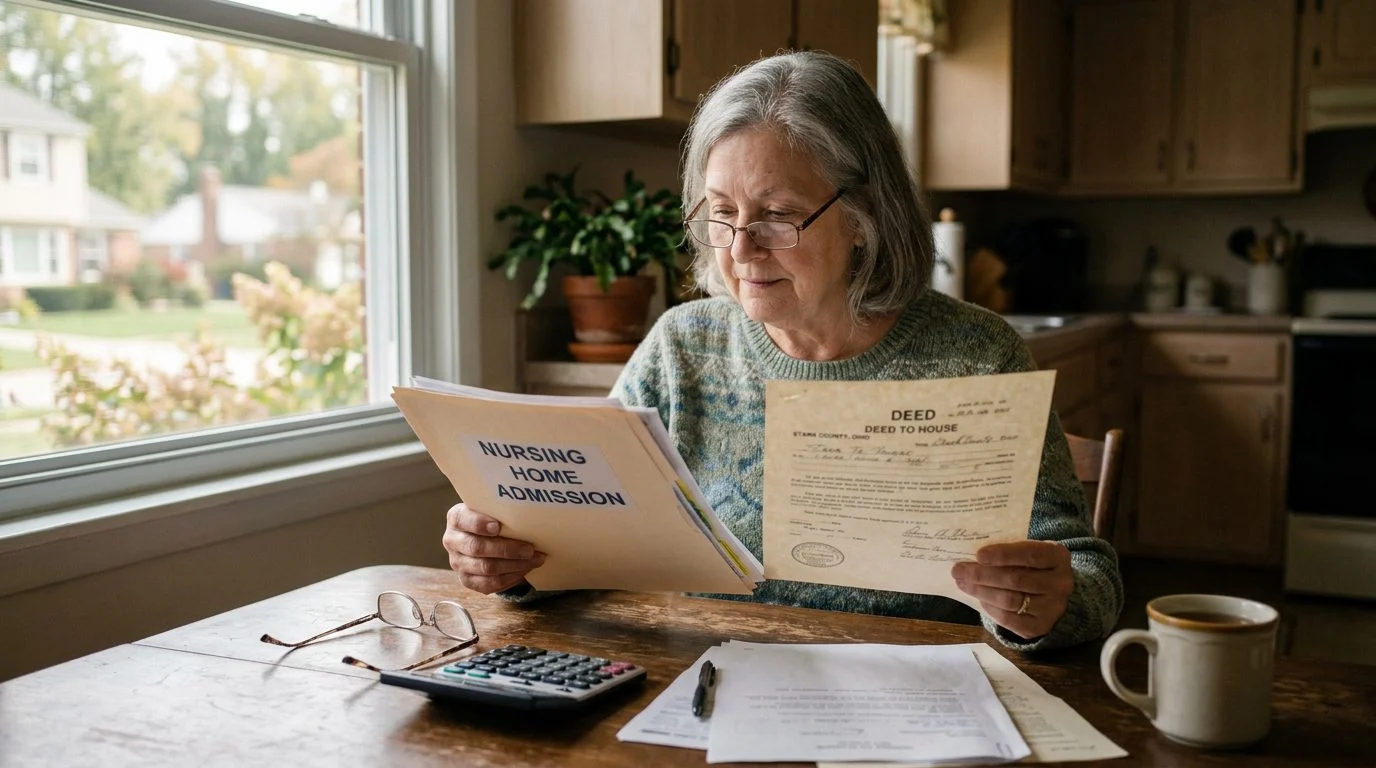
For example, imagine a couple in a small town in Perry County, Ohio. Ruth’s husband, Dale, had a slow decline at home, and within months he needed more care than Ruth could give him alone. Ruth was frightened. She had heard that the house would have to be sold and the savings would be gone. When a lawyer laid out each option step by step, she could see which choices were still open to them. Every family’s facts are different, so results vary, and this story is only an illustration.
Most spouses in your position want the same few things: your husband’s wishes honored, the home and savings protected, good care for him, and no costly mistakes. You are probably feeling overwhelmed right now, and that is understandable.
Not sure what your next step is?
Talk it through with Jarvis Law Office — the first discovery call is free, confidential, and carries no obligation.

What the look-back period means for your husband’s past transfers
Ohio’s rule on transfers of assets treats a transfer for less than fair market value made within sixty months (five years) before the individual’s baseline date as presumed improper, which may lead to a restricted Medicaid coverage period. That presumption can be rebutted, and the rule has exemptions, which we walk through with each family.
Because of this, gifts and transfers your couple made in the past deserve a close look before any application. Keep any papers about past gifts, transfers and account changes, because they help us see the whole picture.
Assets transferred between the institutionalized individual and his or her spouse are not considered improper transfers (Ohio Adm.Code 5160:1-6-06).
This is one reason each family’s past transfers need a careful, one-by-one review.
If care is needed now, the options change, but they do not necessarily disappear. In some situations, planning can often help protect part of the amount that would otherwise need to be spent down, depending on the family’s facts. It is not too late to ask what remains open for your family.
How the spend-down works and what planning can look like
Paying for long-term care can use up a family’s savings faster than most people expect, and we can walk you through what that could mean for your husband and for you. When care costs begin, bills often arrive faster than decisions can be made. Planning ahead gives you room to think.
Planning looks different for each couple. Some possibilities, which always depend on your family’s situation, include reviewing how savings, income and property are titled, keeping the at-home spouse’s finances secure, and setting up documents so someone can manage money and health decisions if your husband cannot.
In the example above, careful planning helped Ruth see which money could be kept for her own needs at home. A written plan also gives your family a calm place to start when the nursing home asks for paperwork. No plan can ensure a particular result, but a clear picture makes the next step easier.
Protecting the at-home spouse and the family home
Ohio’s rules include protections for the spouse who stays at home, and planning can often help that spouse stay in the home, financially secure.
Once the institutionalized spouse is determined eligible for medical assistance, none of the community spouse’s resources are considered available to the institutionalized spouse, for as long as eligibility continues without a break in coverage (Ohio’s rule on community spouse resources).
That protection is one reason the at-home spouse’s money matters so much in planning. Many spouses worry that the bills will leave nothing to live on. Planning looks at the at-home spouse’s income and needs as well as the nursing home bill.
For 2026, Ohio’s home equity limit is $752,000, and it rises every January.
How a home is titled, what it is worth and who lives in it all shape what planning can do. We walk through those details with you one at a time. If the house is where you raised your children, the fear of losing it is understandable. Careful planning can help keep the home part of your family’s plan rather than something lost.
Estate recovery after your husband’s death
Estate recovery is how the state seeks repayment for Medicaid care from certain estate assets, and for a person who was 55 or older when receiving that care, only for certain types of medical assistance.
The state may seek estate recovery only after the death of the individual’s surviving spouse, if there is one (federal estate recovery law).
Many families are surprised to learn that a home treated one way when Medicaid begins can still come up later for estate recovery. For that reason, we look at timing and titling together when we plan with a family. The home’s title is the first thing we look at, because it shapes how the house is handled after death.
Probate is the court process for settling a person’s estate. It can be expensive, drawn out and stressful for a grieving family.
Our part is getting the planning right: the right documents, and assets titled and coordinated to match the plan.
How Ohio Medicaid can help pay for care, and staying home longer
Ohio Medicaid can help pay for nursing home care, and for many, though not all, assisted living and memory care settings, as well as care at home. Not every setting qualifies, so the specific setting is something we review with you.
Many families prefer to stay home longer, and that is often possible. Staying home with support can be a real option. A move to a facility later remains an option if your husband’s needs change.
Care Navigators on our team can help your family find their way through a complicated health care system, on your husband’s behalf, when that help is needed. They are not lawyers and do not give legal advice.
Not sure what your next step is?
Talk it through with Jarvis Law Office — the first discovery call is free, confidential, and carries no obligation.
Why a strong financial power of attorney matters in planning
A financial power of attorney lets a trusted person handle money matters if your husband cannot. In our plans, a strong financial power of attorney is one of the key tools we use to protect a family’s assets, and it is part of every plan we prepare.
Every plan includes a general durable power of attorney for finances, a health care power of attorney, a living will and a HIPAA release. These documents help your family stay in control of decisions if your husband cannot make them himself, and we coordinate them with the rest of the plan.
Because a financial power of attorney gives someone authority over money, the choice of that person matters. If you are the one who will carry these tasks, it helps to know what they involve before you need them.
How Jarvis Law Office guides your family through this
Our team guides your family step by step, so you do not have to track every rule on your own. We start with a first conversation to understand your family’s situation. Together, we choose a plan at a strategy meeting. Then we set up the plan documents and coordinate your assets so they match the plan, which takes more than paperwork. Where Medicaid is needed, we handle the application, and we keep giving guidance as needs change.
The firm works on a flat fee, and we explain the basis of that fee at the start. Timothy Jarvis is the responsible attorney for this page. Staying on top of the rules is our job, so you can focus on your husband.
Common questions
Is it too late if my husband is already in a nursing home?
Not always. Options can remain even when care is needed now, though how much is protected varies by family.
What is the look-back period in Ohio?
A transfer of assets for less than fair market value made on or after the look-back date, which is sixty months (five years) before the individual’s baseline date, is presumed improper and will result in a restricted medicaid coverage period.
Can I lose my home if my husband goes into a nursing home?
Whether the home is at risk depends on how it is owned, its value and the plan. We review those details with you.

Take the next step: a free discovery call about your husband’s care
If your husband needs nursing home care now, questions about past gifts, the house and the savings can arrive together. You do not have to answer them alone, and a calm first step can make the road ahead clearer. Bring your questions about the look-back, the home and your savings, and we will start there.
Reach out to Jarvis Law Office to book a free discovery call. The call is confidential, with no obligation to continue.
How Jarvis Law Office guides your family
A conversation first
We start by listening to your family's situation: the person who needs care, the home, the savings and what your loved one wants. There is no pressure to decide anything on the first call.
Documents put in order
Our plans include a general durable financial power of attorney, a health care power of attorney, a living will and a HIPAA release, so that someone you trust can act for your family if a health crisis arrives.
Assets reviewed with care
We look at how the home, bank accounts and other assets are titled, and we explain which options may still be open for your family. Results depend on each family's own facts.
Care Navigators on your side
When the health care system feels fragmented, our Care Navigators can help your family find their way through it on your behalf. They do not give legal advice; our attorneys handle the legal side.
A flat fee, not a maze
We work on a flat fee, with no recurring insurance-style fees. We will explain what the fee covers before you commit to anything.
Ongoing guidance
Care needs change. We stay with you as your family's situation changes, so the plan keeps pace with it.
Asking early keeps more of your options open
If a nursing home stay is already on the horizon, or has already started, do not assume the door has closed. Options can remain even when care is needed now. The details depend on your family's facts, and we will walk you through them.
What the first steps look like with us
Tell us where things stand
Share your family's situation in your own words. We listen, ask the questions that matter, and tell you honestly what we see.
Choose a plan together
At a strategy meeting we explain the possible paths in plain language, including what each one might mean for the home and savings.
Put the documents and assets in line
We prepare the plan documents and coordinate your accounts and property so they match the plan. This is more than paperwork.
Keep the plan current
When care needs shift, we help you adjust. If Medicaid is part of your path, we also guide the application and what follows it.