
Medicaid Planning · Ohio Families
When One Spouse Moves to a Nursing Home, the Medicaid Rules Shift Too
Paperwork, income and home questions can all change at once. Jarvis Law Office helps the spouse who stays home see what to do next, one step at a time.
Planning with Jarvis Law Office
3
Offices in Lancaster, Dublin and St. Clairsville
Every
Ohio county served by the firm
Free
First discovery call, with no obligation to continue
By Timothy Jarvis · Published November 14, 2026
The facts about both of you have to stay accurate and current, and that reporting is the first real step in protecting your spouse’s care and your own home and income.
You may be asking whether the savings will run out, or whether you could lose the house. Those are the right questions. You do not have to work out Ohio’s rules on your own, and keeping on top of them is our job.
Medicaid needs an accurate picture of both spouses, and you can start gathering it now
Medicaid needs a complete picture of both spouses’ income, savings and property, and you can begin pulling those records together today.
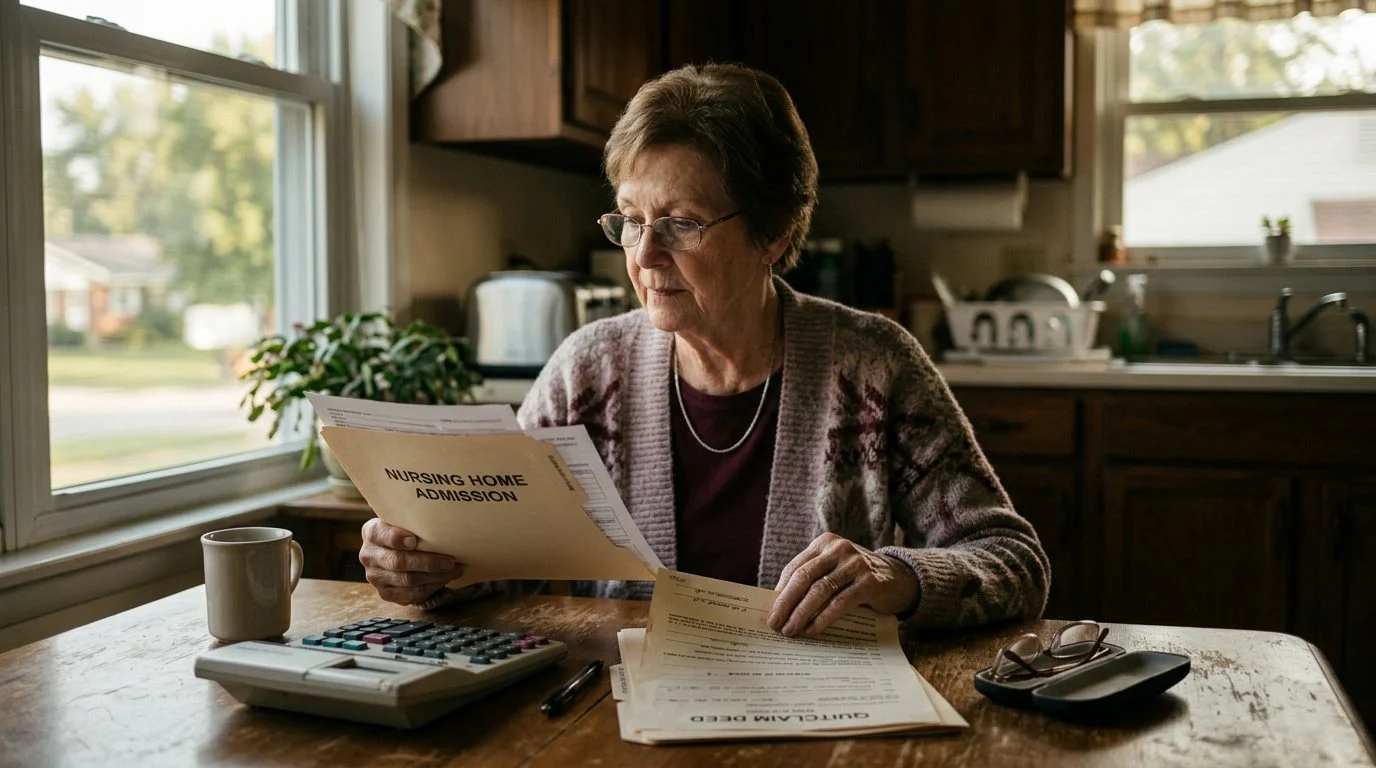
For example, imagine a couple, Raymond and Ellen, in a small town in Hocking County. Raymond moved into a nursing home after a slow decline that made living alone unsafe, and the first monthly bill arrived before the family had any plan. Ellen stayed in their house, afraid the savings would disappear and that she would have to sell the home they had kept for decades. Their attorney reviewed their savings, income and property and listed every fact the agency would ask about. Ellen said the picture became clearer, and she could finally see which steps came first. Every family’s facts are different, so results depend on each family’s own situation.
If your spouse has just moved into a nursing home, you don't have to sort out Medicaid's rules alone, and we can talk through your savings and your home with you. Talk it through with Jarvis Law Office — the first discovery call is free, confidential, and carries no obligation.

What Ohio Medicaid can help pay for when your spouse needs nursing home care
Ohio Medicaid can help pay for nursing home care, and it can also help with some other settings. Those other settings are not all covered, so the details matter.
Ohio Medicaid can help pay for nursing homes, many but not all assisted living and memory care settings, and care at home. Staying at home longer is possible, and most families prefer that. A move to a care setting later remains an option, so you don’t have to decide everything today.
Whether a setting is covered depends on the setting itself and on your family’s facts. We check those details with you rather than assuming them. Care Navigators can also help you find your way through a complicated health care system when care decisions get hard. They do not give legal advice, but they can work alongside the planning we do together.
How savings are counted, and what the at-home spouse can keep
The at-home spouse keeps a protected share of the couple’s savings, and the rest is reviewed toward Medicaid’s limits.
When one spouse needs nursing home care and is subject to a resource limit as described in the eligibility rules for the applicable medical assistance category, Medicaid looks at the couple’s countable assets together.
The spouse at home may keep a community spouse resource allowance, which is the greatest of several amounts Ohio’s rule lists, including one half of the couple’s combined countable resources or the federal maximum standard, whichever is less, and the federal minimum standard (Ohio Adm.Code 5160:1-6-04).
For 2026, the federal maximum community spouse resource standard is $162,660, according to CMS’s 2026 Medicaid guidance. The amount that applies to your couple depends on your savings and your facts, so we work through it with you rather than guessing.
While your spouse is in the nursing home, the income of the spouse at home is generally not counted as available to the spouse in the nursing home, except in the situations the law separately addresses (42 U.S.C. § 1396r-5).
Income is reviewed with care, and the at-home spouse’s own needs are part of that picture. Bring current bank statements, income letters and a list of what you pay each month. Accurate numbers at the start prevent delays later.
Your home: the home equity limit and estate recovery
Your home can be protected while you live in it, but estate recovery is a separate question that comes later.
The home equity limit does not apply to the spouse in the nursing home when the other spouse is lawfully living in the home (Ohio Adm.Code 5160:1-6-02.1).
For 2026, Ohio’s home equity limit is $752,000, and it rises every January.
Estate recovery is the state’s right to seek repayment from an estate after a Medicaid recipient dies. If your spouse is a permanently institutionalized individual, Ohio cannot seek estate recovery from your spouse’s estate while you are alive (R.C. 5162.21). Your spouse’s estate is the question here, and the timing matters.
Justice in Aging’s estate recovery guide explains that a home can be excluded when Medicaid checks eligibility, yet still be a concern for estate recovery later.
Planning done well before care is needed can sometimes help protect what you have built, and we will walk you through what that could look like for your family. Even when care is needed now, a significant part of the spend-down amount can often still be protected. Planning can also often keep the at-home spouse in the home, financially secure, with quality of life intact. These are possibilities that depend on your facts, not promises.
Telling Medicaid about the move and keeping the application on track
Tell the county agency about the move, and keep every income, savings and property fact accurate and up to date.
Gaps and errors are a common reason applications stall, so keep your records in one place. Gather the nursing home’s admission papers, deeds, account statements and income letters before you begin. Keep copies of everything you send.
Ask before you move money or property between accounts or people. Transfers can change how the application is reviewed, and a short conversation first can save a lot of trouble later. The exact reports the county agency requires, and when they are due, depend on your facts. We confirm those with you rather than guessing.
You do not have to handle the sudden changes alone. When the application needs follow-up, we help you track each step and keep the paperwork moving.
Planning documents that keep the picture together
The plan documents work together, so the application and your home fit one coordinated picture.
In our plans we include a general durable power of attorney for finances, a health care power of attorney, a living will and a HIPAA release. A strong financial power of attorney is one of the tools our planning uses to protect a family’s assets. It lets someone you trust handle money matters if you cannot.
Careful planning also helps a family avoid probate later. Probate can be expensive, drawn out and stressful for a grieving family. When the right documents are in place and assets are titled and coordinated to match, a family can often skip it. That is the firm’s part: getting the planning right before it is needed.
Not sure what your next step is?
Talk it through with Jarvis Law Office — the first discovery call is free, confidential, and carries no obligation.
How Jarvis Law Office helps you and your spouse through this
The family does not have to do this alone. Our first step is a conversation that helps us understand your spouse’s care, your savings and your home.
From there, we meet to choose a plan that fits your goals. Next, we set up the plan documents, then we coordinate your assets so they match the plan. This is more than paperwork. When the Medicaid application is needed, we walk you through it step by step, and we keep guiding you as needs change.
We work for a flat fee, with no recurring insurance-style fees. Each step is explained in plain words, so you know what is happening and why.
Take the next step: a free discovery call about your spouse’s Medicaid and your home
If your spouse has just moved into a nursing home, you want the care covered, the home kept and enough income to live at home. You also want the application to move forward without avoidable delays. Those goals are worth raising with someone who can look at your full picture.
The free discovery call is confidential and carries no obligation to continue. It is a calm way to talk through your spouse’s move, your savings and your home. Book your free discovery call and let us guide you through the next steps.
Frequently Asked Questions
What changes do I need to report to Medicaid after my spouse enters a nursing home?
Ask the county agency handling the case which forms it requires, and keep a record of each report.
What happens if I don’t report a change to Medicaid?
Reporting on time and keeping copies helps protect you and your spouse.
Does reporting the change mean I will lose the house and savings?
Reporting a change does not by itself decide what you keep. Ohio has rules that can protect a spouse who remains at home, but what is kept depends on your family’s own facts, and we will walk through those facts with you. Planning can help you understand which protections may apply to your situation, and you can start with a free discovery call with our firm.
How the firm guides your family
We listen first
We start by hearing what has changed at home and what worries you most, so the plan fits your spouse's care and your household.
We track the paperwork
Reporting forms, bank statements and income letters are easy to lose in a hard season. We help you know which ones matter and keep them organized.
We look at what you can protect
Where it fits your situation, we explain how planning may help the at-home spouse keep the home and savings on a steadier footing.
We stay with you as things change
Care needs and rules both move over time. Our team keeps guiding you, and our Care Navigators can help with the health care system when you need that support.
Keep a copy of everything
When a spouse moves into a nursing home, ask the county agency handling the case which forms it needs from you, and keep a dated copy of each one you send. A short list of questions to bring to your discovery call can make the next conversation much easier.
Four things to keep on track
Ask which forms are needed
Each county agency may ask for different information. Confirm what it needs from your family and in what format.
Report income and bank changes
Write down the date and what you told the agency.
Keep the at-home spouse in mind
Rules about the home, savings and income differ for the spouse who stays home. Planning early gives you more choices.
Let the firm help organize it
We help you sort the records, check what has been filed and plan the next steps so you are not doing it all alone.
Your family does not have to sort this out alone
Related practice areas
- Long-Term Care and Memory Care Planning in Ohio
- No Medicaid Bed in an Ohio Nursing Home? Your Options