
Medicaid planning | Serving families in every Ohio county
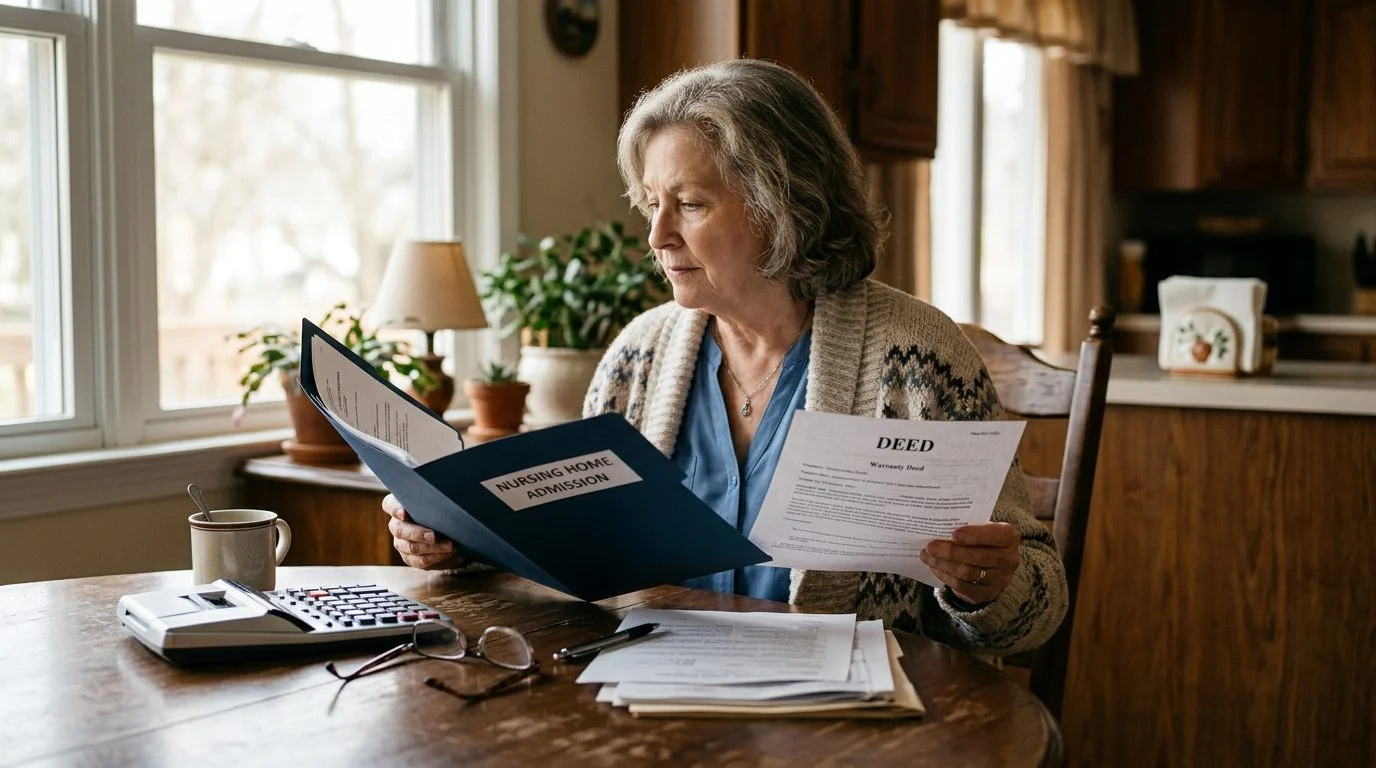
Old bills, a pending application, and a family trying to keep track of it all
We help you sort out which bills may still matter for your parent's care and what to do next, one step at a time.
By Timothy Jarvis · Published November 15, 2026
Can Medicaid pay for the months before you applied?
If your spouse has just moved into a nursing home, those earlier bills can feel like a threat to everything you have saved. Whether it works for your family turns on your family’s facts, and no one can predict the result ahead of time. You don’t have to sort this out alone. Our team walks you through each step, one question at a time.

How retroactive coverage works for a nursing home bill
During any month in which the spouse who needs nursing home care is eligible for long-term care services, no income of the spouse at home is considered available to that spouse (Ohio Adm.Code 5160:1-6-04). The rules on how far back coverage can reach can change, so we confirm the current rule with you rather than relying on memory. Ohio Medicaid applicants must meet citizenship, Social Security number, residency and financial requirements, and benefits are renewed each year. Ohio Medicaid coverage and renewal Original Medicare generally does not pay for long-term nursing home stays, so Medicaid is often the question families face next. Medicare’s nursing home payment guide Ohio Medicaid can help pay for nursing home care, and for many, though not all, assisted living and memory care settings. Start collecting records early, because the months before an application are often the hardest to document. Gather bank and income statements, bills and payment records for those months. We walk through exactly which records matter for your family.
For example, imagine a spouse at home facing the same bills
For example, imagine a couple, Dorothy and Ray, in a small town near Zanesville. Ray had been slowing down for two years, and when the stairs became unsafe, he moved into a nursing home. Dorothy stayed in their house, and the first monthly bills frightened her. She worried the savings would be gone within a year and that she would have to sell the house to pay. Her biggest question was whether Medicaid could help with the months before Ray’s application, so they met with a team that listed every account and bill and explained which questions came first. Every family’s facts are different, so the outcome for Dorothy and Ray would reflect their own circumstances, not this example.
Keeping the home and income for the spouse at home
Planning can often protect part of what a couple has built, even when nursing home bills have already started. Medicaid reviews what the couple owns and earns, a review often called the spend-down. When one spouse needs nursing home care, the couple’s combined countable resources are measured in a specific way. To see whether the spouse in the nursing home is resource eligible, the community spouse resource allowance is subtracted from the couple’s combined countable resources, and the spouse is resource eligible when the remainder is two thousand dollars or less (Ohio Adm.Code 5160:1-6-04). For 2026, the maximum community spouse resource standard is $162,660, according to CMS Medicaid policy guidance. In Dorothy and Ray’s example, their savings were above that figure, so the planning looked at which assets counted and which could be protected. These are possibilities, not promises. Planning that starts before care is needed often leaves more options open. Even when care is needed now, a significant part of the spend-down amount can often still be protected. Careful planning can also often keep the at-home spouse in the house, financially secure, with quality of life intact. That is the goal we work toward with you, though no one can promise a particular result.
Estate recovery after your spouse dies
Estate recovery is the process of seeking repayment from a person’s estate after death, and many spouses at home worry it could reach the house. The home equity limit is part of qualifying for Medicaid help with long-term care, but it does not count against your husband or wife while you are still living in the home (Ohio’s rule on home equity and Medicaid). For 2026, Ohio’s home equity limit is $752,000, and it rises every January.
Careful planning is what can help here. When the documents are set up and the home and accounts are titled to match the plan, a family can often avoid probate later and can often shield more assets from estate recovery. Probate is expensive, drawn out and stressful for a grieving family, and planning aims to keep your family from facing it. Don’t wait until after a death to ask these questions. The time to plan is while you and your spouse can still make decisions together. For most spouses at home, the goals are simple: keep the house, and leave something for the children and grandchildren. Those goals are yours to set, and we build the plan around them.
How Jarvis Law Office helps you through the application
You don’t have to figure all of this out yourself, and keeping up with the rules is the firm’s job. Our team guides your family step by step, starting with an initial conversation to understand your situation. At a strategy meeting, you choose a plan together. In the plans we prepare, we include a general durable power of attorney for finances, a health care power of attorney, a living will and a HIPAA release. The financial power of attorney is one of the key asset-protection tools in our planning. Assets are then titled and funded to match the plan, which takes more than paperwork. Where Medicaid applies, we help with the application and stay with you as your needs change.
Our fee is a flat fee, with no recurring insurance-style fees. If your family needs help with care decisions, our Care Navigators can help you find your way through a complicated health care system on your family’s behalf. Care Navigators are not lawyers and do not give legal advice, and the legal work stays with the firm’s attorneys.

Take the next step with a free discovery call
The first step is a conversation, and it is confidential and carries no obligation to continue.
Common questions
Can Medicaid pay for nursing home bills from before you applied?
Sometimes, but only for months when your spouse met the eligibility rules, and your family’s facts decide that.
Does my income count against my spouse’s Medicaid?
During any month in which the spouse who needs nursing home care is eligible for long-term care services, no income of the spouse at home is considered available to that spouse. Bring your income records to the first conversation so we can review them together.
Can planning help keep the house out of estate recovery?
Planning can often help, and the answer turns on who lives in the home and how it is titled.
If your spouse needs nursing home care and you’re worried about the earlier bills, the savings and the house, you don’t have to wait to find out where you stand. Reach out for a free discovery call, and we’ll review your family’s situation with you, one step at a time.
What to gather before your free discovery call
Every bill and statement
Keep the nursing home, hospital and pharmacy bills from the months before the application, along with any payment records. They show what was paid and what is still owed.
The admission and care dates
Write down when your parent moved into the care setting and when the application was filed. Those dates help us see which months are in question.
Income and account records
Gather recent statements for your parent's income and bank or investment accounts, including any spouse's records if you have them.
Any power of attorney or plan papers
Bring any financial power of attorney, will or trust your parent signed. Those documents show who has been handling money and what decisions were already made.
How Jarvis Law Office helps
We read the bills with you
Going through old statements line by line can be exhausting. We take that work on, and we put the results in plain words so your family can see what applies and what does not.
We look at what planning can do
Depending on your family's facts, some amounts may be protectable and some options may still be open. We describe these as possibilities, never promises, and explain the reasons behind each one.
Care Navigators can help with the care itself
Our Care Navigators help families find their way through a complicated health care system. They do not give legal advice, but they can help with the care side while our attorneys handle the legal side.
You do not have to do this alone
From the first call through the application and the months after, the firm guides your family step by step, so you are not left to track every deadline and form on your own.
Keep the papers, even the ones that seem minor
Do not throw away old bills or assume a past charge is settled. Keep every statement and letter from the months before the application. Those papers are how we see the full picture.