
Power of Attorney | Dementia Care | Ohio Families
Help Your Parent with Dementia Stay in Charge of Their Money and Care
Clear, step-by-step guidance for Ohio adult children who want to be ready to act for a parent before the next bank visit, bill or medical decision.
By Timothy Jarvis · Published November 12, 2026
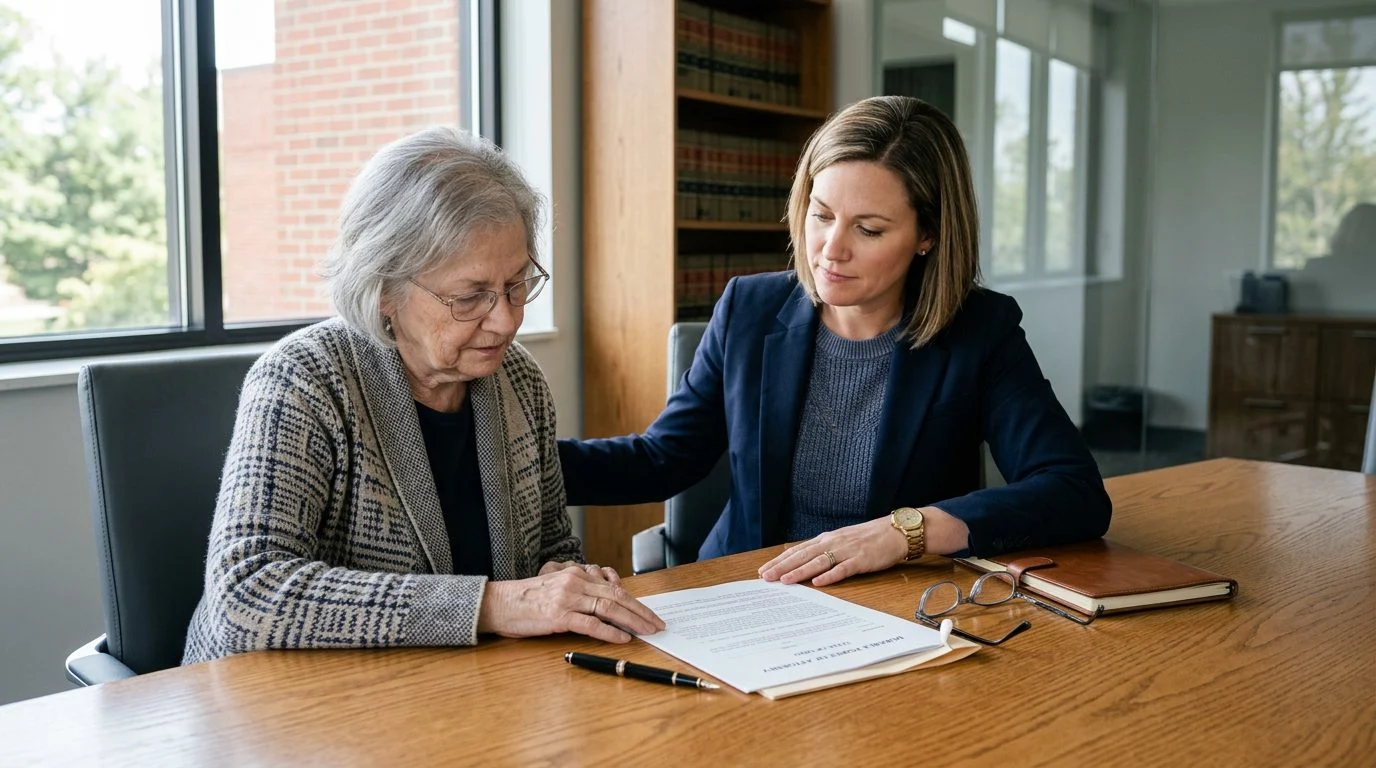
If your mom has dementia and no power of attorney in Ohio, you may be handling her bills, her doctor visits and her future on your own. Without a power of attorney, family members may not be able to sign for her at banks, insurers or care providers. A plan put in place while she can still take part can often open the way forward.
Staying on top of the rules is our job, and we guide families one step at a time.
Your mom has dementia and there is no power of attorney: where things stand
What matters most right now is what your mom can still understand and take part in, because that decides what can still be signed. A diagnosis alone doesn’t answer that question. Her current ability does, and we review it with you rather than guess.
For example, imagine a daughter, Karen, and her father, Walt, who lives outside Zanesville. Walt was diagnosed with Alzheimer’s two years ago and still lives alone. Karen works full time and drives out most evenings to pay his bills from his checkbook. When his bank asked for a power of attorney, she realized none was on file. She feared a delay would leave his bills and care in limbo. An elder law firm helped her see her options step by step while Walt could still join the conversation. Every family’s facts are different, and results vary with each family’s own situation.
A useful first move is to find out what papers already exist and what your mom can still take part in. We help you sort through that list, so you aren’t doing it alone.

Why a power of attorney matters for your mom’s care and money
A power of attorney matters because it names the person who can act for your mom when she can’t act for herself. Money and medical decisions are handled by different documents.
In the plans we prepare, the financial power of attorney is the document your parent can use to choose someone they trust to help with everyday money matters, such as paying bills. Every family’s situation is different, so we do not assume a standard form will fit your mother’s situation, and we start with her own facts.
In every plan we prepare, we include a general durable power of attorney for finances, a health care power of attorney, a living will and a HIPAA release. The financial power of attorney is one of the tools our planning uses to protect a family’s assets.
Two details matter for the living will.
An adult who is of sound mind can voluntarily sign a declaration about the use, continuation, withholding, or withdrawal of life-sustaining treatment at any time (R.C. 2133.02).
If a declaration is witnessed rather than notarized, it must be witnessed by two individuals, and each witness must be an adult who is not related to the declarant by blood, marriage, or adoption, who is not the attending physician, and who is not the administrator of any nursing home where the declarant is receiving care (R.C. 2133.02).
In our plans, the health care power of attorney and the living will are the advance directives; a living will governs the use or continuation, or the withholding or withdrawal, of life-sustaining treatment. We walk you through the witnessing details so the papers are signed the right way.
What you can do now: gather your mom’s existing papers, list her bank, retirement and insurance accounts, and note her doctors and medications.
Answering your biggest worries about your mom’s safety, money and home
Your biggest worries are her safety, her money and her home, and each one has practical steps you can start now.
Wandering and falls. Care decisions are easier when the right people can act for her. Our Care Navigators can help you find your way through the health care system when you need that help. They guide families on care, but they aren’t lawyers and don’t give legal advice.
Running out of money. Planning can look at how her savings and home are titled, and at what Ohio Medicaid can help pay for, as possibilities that depend on her facts.
Guilt about moving her out of her home. That feeling is common and understandable. Moving her is only one choice among several. Staying home longer is often possible, and a later move stays an option, so the decision can be made step by step.
Fear of a costly mistake. We walk you through each step, so decisions are made on purpose, not in a rush.
How Ohio Medicaid can help pay for your mom’s care
Ohio Medicaid can help pay for nursing home care, many (not all) assisted living and memory care settings, and care at home.
Timing matters here because of the look-back. Here is the rule in plain terms:
For an institutionalized individual seeking Medicaid payment for long-term care, the look-back date is sixty months (five years) before the individual’s baseline date, and a transfer of assets for less than fair market value on or after that date is presumed improper (Ohio Adm.Code 5160:1-6-06).
That look-back is why earlier planning usually leaves more room. Planning can often do the following, as possibilities that depend on your family’s facts:
- When planning begins well before care is needed, a family usually has more room to choose how its assets are handled.
- Even if care is needed now, options often remain, and we can talk through what planning might still protect for your family.
- Options often remain well before all savings are used, so waiting isn’t always a dead end.
Our planning work is a flat fee, with no recurring insurance-style fees.
How the process works, step by step
The process has six steps, and it starts with a free discovery call that is confidential and carries no obligation to continue.
Each step builds on the one before, and we move at a pace your family can manage.
- Free discovery call. We listen to your mom’s situation and your family’s goals.
- Strategy meeting. We choose a plan that fits her health, her home and her finances.
- Plan documents. We prepare and sign the documents while she can still take part.
- Assets funded. We title and coordinate her assets to match the plan, which takes more than paperwork.
- Medicaid application. We file one only where paying for care is part of the plan.
- Ongoing guidance. We stay with you as her needs change.
Planning now can also help your family avoid probate later
Planning now can help your family skip probate later. Probate can be expensive, drawn-out and stressful for a grieving family, and careful planning can help a family avoid it. For many grieving families, it can be expensive, drawn out and stressful.
A plan set up with the right documents, with assets titled and coordinated to match, can help a family avoid probate. This is what careful planning can do, not a guarantee. Getting that planning right now is our part, so your family has less to untangle later.
How Jarvis Law Office helps families in your situation
Jarvis Law Office helps families like yours by guiding them step by step, so you don’t have to do this alone. Our practice concentrates in elder law, Medicaid planning and estate planning. We have offices in Lancaster, Dublin and St. Clairsville, and we serve families in every Ohio county.
Our support staff keep the paperwork and scheduling moving. Our Care Navigators help families find their way through the health care system when that help is needed. They guide care, not the legal planning, and they aren’t lawyers.
For you, that means one clear path: understand where your mom stands, choose the plan that fits, and get the papers and accounts lined up before you’re pressed for time. That steady guidance is what we aim to provide.

Common questions about a parent with dementia and no power of attorney
Below are short answers to the questions families ask most. Your mom’s own situation shapes each one.
Can we still act for my mom without a power of attorney?
Sometimes, but family members may not be able to sign for her at banks, insurers or care providers. The answer turns on her current situation and the documents involved.
Can my mom still sign a power of attorney if she has dementia?
A diagnosis alone doesn’t settle that. Her current ability to understand and take part does, and we review it with you at the start.
Will we lose the house if my mom needs care?
Not necessarily. Planning can often help protect a home, and the outcome depends on your family’s facts.
Do we have to decide on a nursing home right away?
Often you don’t have to decide that now, and the move can wait.
You’re still researching, and that’s a reasonable place to be. You don’t need to hire anyone today. When you’re ready, book your free discovery call, and we’ll talk through where your mom stands.
Don't wait for a crisis to start the conversation
Planning while your parent can still take part in the decisions gives them a voice in how their affairs are handled. The sooner the family talks with us, the more room there is to shape the plan around your parent's wishes.
Four things to sort out now
Know who can sign for your parent
Banks, insurers and care providers each ask for different paperwork. We help you see where your family stands today and what gaps to close first.
Gather your parent's documents
Account statements, insurance policies, the deed to the home and any existing estate papers help us understand what your parent owns and how it is held.
Talk with your parent while they can take part
Your parent's values, preferences and choice of trusted helper matter. We can guide the family through that conversation in a calm, respectful way.
Plan for the care decisions ahead
When your parent's needs change, our Care Navigators can help your family find a way through a complicated health care system, while the firm handles the legal side.
Why families choose to plan with us
Your parent's wishes at the center
We work to keep your parent's own goals and dignity in view, with their family involved at every step.
Documents that work when they are needed
In our plans we include a financial power of attorney, which is a key tool for protecting a family's assets, along with a health care power of attorney, a living will and a HIPAA release.
A plan the whole family can understand
We explain each document in plain words, so adult children, siblings and spouses know their roles before a crisis arrives.
A flat fee
We offer a flat fee for planning work, so your family knows the cost up front.
Offices in Lancaster, Dublin and St. Clairsville
We serve families in every Ohio county, and we meet with clients at our offices and by arrangement.
Guidance that keeps pace with your family
As your parent's needs change, we stay with you to review the plan and adjust it.