

Ohio families | Elder law and family care planning
Paying a Son or Daughter to Care for a Parent: Planning the Pay Part Carefully
Caring for a parent at home is often a family's first and most natural choice. Here is how to make the arrangement fair, clear and easier to live with.
Where Jarvis Law Office works
3
Offices in Lancaster, Dublin and St. Clairsville
Ohio
We serve families in every Ohio county
Free
First discovery call, with no obligation to continue
By Timothy Jarvis · Published November 20, 2026
If your parent is slowing down at home, you may already be doing more than you planned. You may also be asking whether you can be paid for that care, and how to keep the arrangement clear.
Whether any public program might also pay a family member is a separate question, and we can look into it for your parent’s situation.
What a paid family caregiver agreement is, and who it fits
A paid family caregiver agreement is a written agreement between a parent and a family member who provides care. It sets out the care, the schedule and how the family member is paid.
It fits the son or daughter who already drives a parent to appointments, helps with bathing or medicine, and keeps an eye on the house, all while holding a job and raising children of their own.
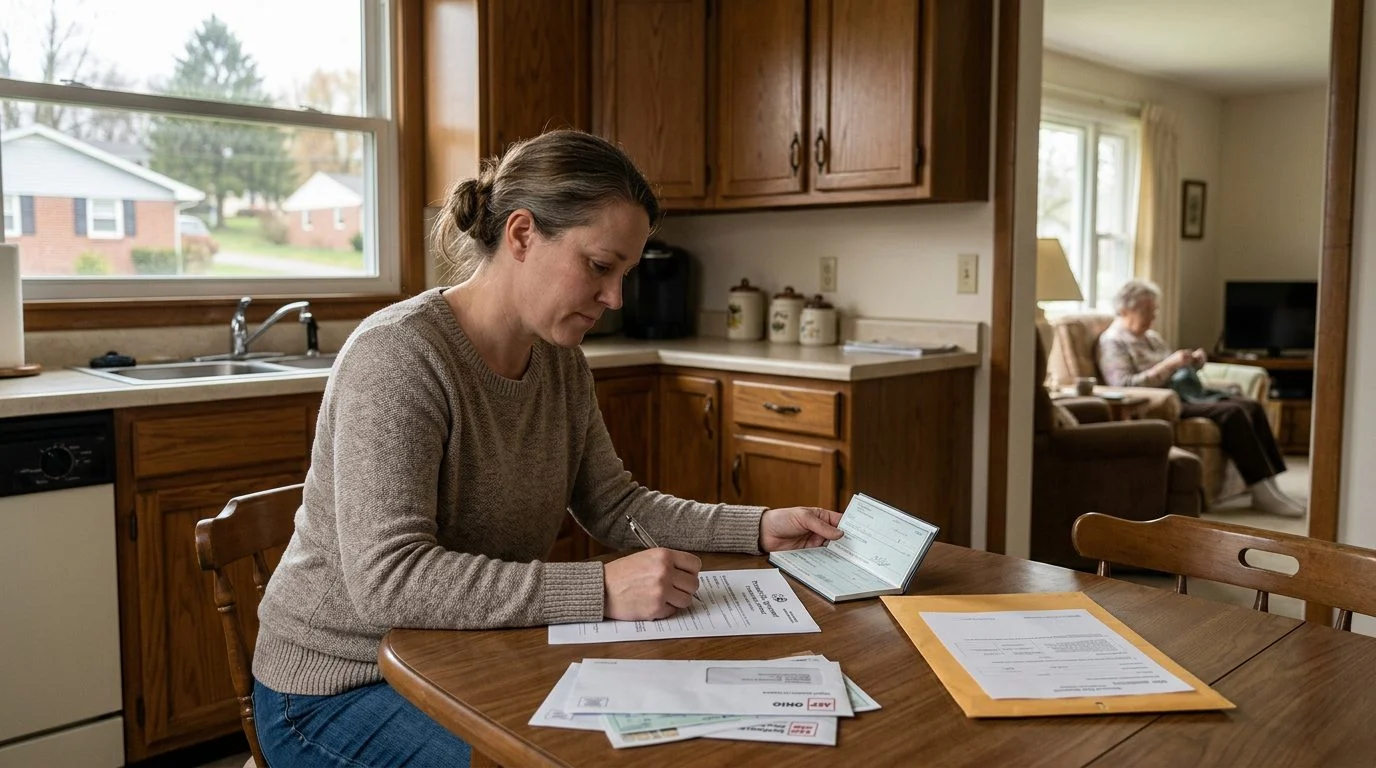
For example, imagine Dana, a daughter in Chillicothe with two teenagers and a full-time job. Her father, Ray, still lives alone in the family home, but he no longer drives and sometimes misses his pills. Dana was giving care every evening and paying for groceries and gas from her own account, with no plan for what came next. Her brother lived out of state and asked questions only after the fact. When Dana and Ray sat down with a planning team, they saw that a written agreement, paired with the right documents, could make the arrangement clear and fair. Every family’s facts are different, so what works for Dana’s family may not work for yours.
If your parent is slowing down at home and you're unsure how to put their wishes in writing, our team can walk through it with you on a free discovery call. Talk it through with Jarvis Law Office — the first discovery call is free, confidential, and carries no obligation.

Why put it in writing before the bills start
Putting the arrangement in writing before anyone needs it is the clearest way to protect your parent, your siblings and yourself.
- Unwritten arrangements invite questions later, from siblings, from a bank or from whoever cares for your parent next.
- Your parent’s wishes are easiest to capture while your parent can still take part and sign.
- Written terms protect you too: what you do, what you are paid and how each payment is recorded.
- A plan the whole family understands answers the fear of being the only one who gives or pays for care.
Families who wait often end up rebuilding the past from memory. A written agreement, made while your parent can still speak for themselves, gives brothers and sisters something to review instead of a debate about who did what.
What a sound agreement should cover
A sound agreement spells out the care, the schedule, the pay, the records and how changes get handled.
- The care tasks, from errands, meals and rides to bathing and medication reminders.
- A weekly schedule with the days and hours you are expected to be there.
- How the pay is set, when it is paid and how each payment is recorded.
- Simple care logs and receipts that show what was done and what was spent.
- How changes in your parent’s needs are handled, and who approves them.
- Scheduled review points, so the agreement keeps pace with the care.
We work out the specific terms with you in a strategy meeting, not from a generic form. A short, plain document is often easier to live with than a long one. Start a notebook or shared file on day one, because dates, hours and receipts matter most if questions come later.
Caring for a parent at home brings many decisions, and we can walk you through them step by step.
The planning documents that come first
The documents that let someone act for your parent should be in place before a crisis, not during one.
In our plans we include a general durable power of attorney for finances, a health care power of attorney, a living will and a HIPAA release. Together, they let the people your parent trusts step in when they are needed.
A strong financial power of attorney matters most in an emergency. It lets the person your parent chose handle banking, bills and insurance if your parent cannot. It is also one of the tools our planning uses to protect a family’s assets.
In the plans we prepare, we include a health care power of attorney and a living will. The financial power of attorney and the HIPAA release complete the set.
Witnesses matter when your parent signs a living will.
A declaration about life-sustaining treatment that is witnessed must be witnessed by two adults who are not related to the declarant by blood, marriage, or adoption, who are not the declarant’s attending physician, and who are not the administrator of a nursing home where the declarant is receiving care (R.C. 2133.02).
We walk through who should witness it, so a small detail does not undo the signing. Talk through whether a child who is also being paid should serve as agent. That choice is one we weigh with your family, so everyone understands why it was made.
Protecting the home and savings while a family member is paid
Careful planning can often keep your parent’s home and savings intact, but no plan can ensure a particular result.
Many families worry that paying a child for care will cost the house later. Payments to a family member are looked at closely if a parent later needs Medicaid-paid care, so we review them before money moves. One rule shapes most of that review.
For a person who is an institutionalized individual, a transfer of assets for less than fair market value made on or after the look-back date, which is sixty months before the person’s baseline date, is presumed improper, though the presumption can be rebutted with a satisfactory showing that the transfer was made for fair market value or other valuable consideration (Ohio Adm.Code 5160:1-6-06).
That is why we look at any payment or transfer to a family member before it happens, not after.
Ohio Medicaid can help pay for nursing home care, many (not all) assisted living and memory care settings, and care at home. Staying home longer is possible, and a move to a facility later stays an option.
Estate recovery is the other piece.
If your parent receives Medicaid help with long-term care, Ohio’s Medicaid estate recovery law lets the state seek repayment from your parent’s estate for those care costs, though there are exceptions and timing rules our team will walk through with you.
For many families, the home is the asset they most want to keep for children or grandchildren. Its place in the plan matters early.
Probate is expensive, slow and hard on a grieving family. Getting the planning right is our part, so your family can avoid probate later.
What to expect: from first call to ongoing guidance
The process starts with a free discovery call and moves step by step, at a pace your family sets.
- The first discovery call is free, confidential and carries no obligation to continue.
- A first conversation about your family: your parent’s health, the care already being given and what your siblings know.
- A strategy meeting to choose the plan and shape the agreement.
- Plan documents set up, then assets funded and coordinated to match the plan, which takes more than paperwork.
- Ongoing guidance as needs change.
We work on a flat fee, with no recurring insurance-style fees.
When the health care system itself is the problem, our Care Navigators can help your family find a way through it. Care Navigators are not lawyers and do not give legal advice.
Not sure what your next step is?
Talk it through with Jarvis Law Office — the first discovery call is free, confidential, and carries no obligation.
Questions families ask before they sign
Most families ask the same few questions before they sign anything.
Can I be paid to care for my own parent?
Many families use a written agreement for this. Whether it fits your situation depends on the facts, so we review it with you.
Do I owe taxes on what I’m paid?
What if a brother or sister objects?
A family meeting built around your parent’s own wishes is a good way to start. The Ohio Attorney General seniors resources also explain how to report elder abuse and financial exploitation.
Does my parent need to be able to sign?
The earlier a family plans, the more of your parent’s own voice ends up in the plan.
What happens when care needs grow?
The review points in the agreement and our ongoing guidance keep the plan in step with your parent’s needs.
How Jarvis Law Office helps, and the next step
Jarvis Law Office works as a trusted guide, so you do not have to work through this alone.
Our offices are in Lancaster, Dublin and St. Clairsville, and we serve families in every Ohio county. The firm concentrates its practice in elder law, Medicaid planning and estate planning.
If your parent is slowing down at home, has no power of attorney yet, and you are wondering who will pay for what, you are not behind. Plenty of families reach this point before they have a plan. We begin with a free discovery call, then a first conversation about your parent’s situation and your family’s. In a strategy meeting, we choose the plan and shape the agreement. Then we set up the documents and coordinate the assets so the plan matches how your family lives. We stay with you as needs change.
When you’re ready to put your parent’s wishes in writing, reach out to schedule a free discovery call with our team.
How Jarvis Law Office helps your family
Sorting out the goals first
We start with what your parent wants for their own care, home and money, so the family's arrangement serves that plan rather than the other way around.
Putting the agreement in writing
We help you draft a written caregiving agreement that describes the work, the pay and the hours, so everyone can see what was agreed and why.
Protecting your parent's assets
Paying a family caregiver can affect how your parent's savings look if care is needed later. We look at that with you before money changes hands.
Guiding you through the care system
When the family needs more support, our Care Navigators can help you find your way through the health care system on your parent's behalf.
Keep a record from the start
Family arrangements made only by word of mouth are hard to prove years later. A simple written agreement and a dated record of payments protect your parent, and you, if questions come up.
Questions to talk through as a family
What does your parent want?
Their wishes come first. A family meeting built around what your parent hopes for their care, home and savings is a good place to begin.
What does the care really involve?
Write down the daily tasks, the hours and any nights or weekends. A clear description makes fair pay and a fair agreement much easier to set.
How does it affect the rest of the family?
Brothers, sisters and other relatives may see the arrangement differently. We can help you plan for those conversations so that no one is left guessing.