
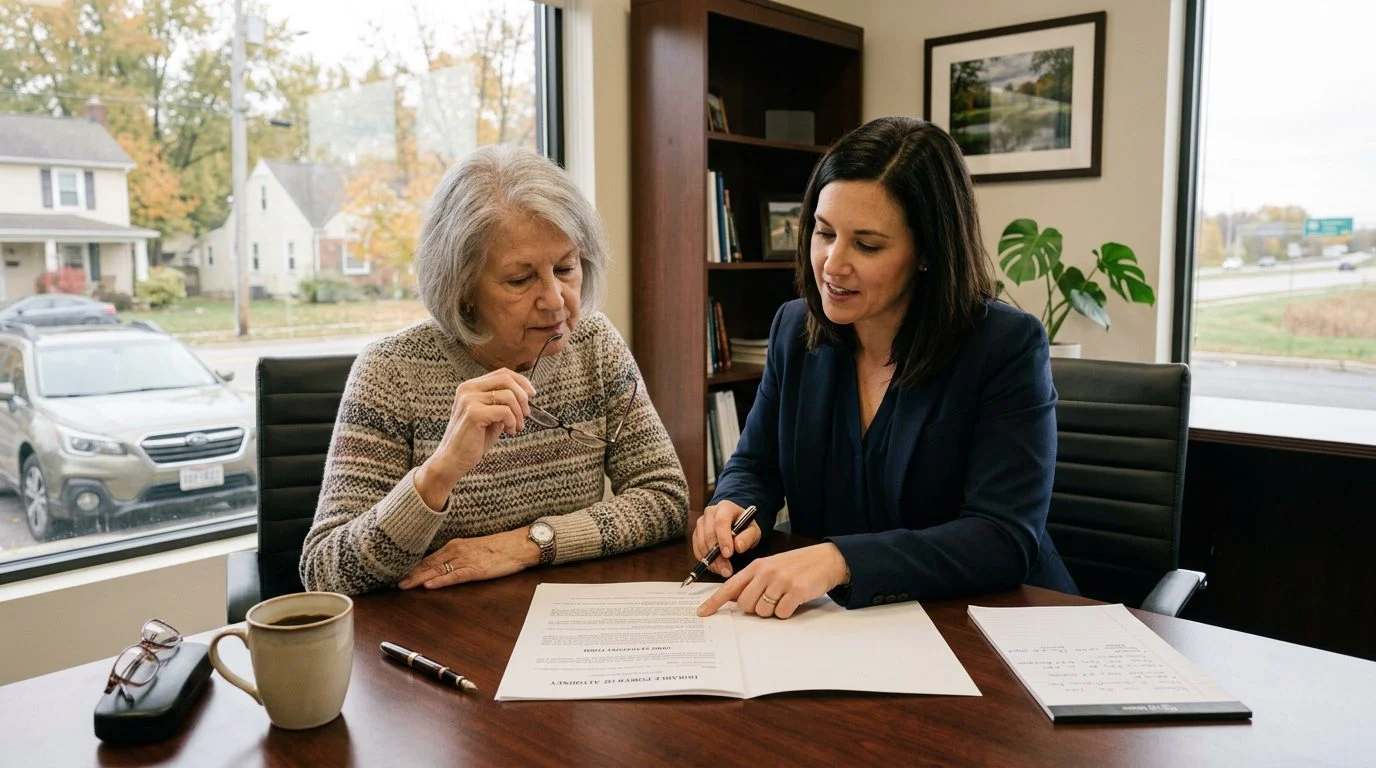
Power of attorney for Ohio families
Plan Ahead While Your Family Still Has Choices
A calm, step-by-step way to make sure your parent's voice still shapes the decisions ahead.
By Timothy Jarvis · Published November 28, 2026
Watching a loved one miss a bill, or hearing the word dementia from a doctor, can leave a family unsure where to begin. A power of attorney put in place before dementia progresses in Ohio lets your loved one name a trusted person to act for them while they can still take part in that choice. This page explains what these documents do, why timing matters, and how Jarvis Law Office guides your family through each step.
Why Planning Ahead Matters When Memory Is Changing
Planning ahead lets your loved one say who they trust and what they want, in their own words. Once memory fades, that same choice can be harder to make.
For example, imagine a daughter named Denise in Circleville and her father, Ray. Ray had started missing bill payments, and Denise worried about his checking account and who would speak for him at the doctor’s office. She feared that if she waited, the family would be left guessing what he wanted. Denise and Ray met with a law office and talked through his choices while he could still share them. Every family’s facts are different, so your family’s path will depend on its own situation.
If you are helping someone you love, you likely want their wishes honored, their home and savings protected, good care when it’s needed, and less burden on the people who care about them. You do not have to work out these rules alone. Staying on top of them is the firm’s job, and we guide your family one step at a time.

What a Power of Attorney Does and Who It Is For
A power of attorney is a written document in which your loved one names a trusted person, called an agent, to act for them.
Families often use two kinds together. A financial power of attorney covers money matters, such as paying bills, handling bank accounts and managing property. A health care power of attorney covers medical decisions, such as choices about treatment and care.
Each financial power of attorney is different, and the details of when it starts and what it covers are something we review with your family in a conversation. The American College of Trust and Estate Counsel also explains how these two kinds differ (ACTEC’s video on diminishing capacity). The National Academy of Elder Law Attorneys describes how incapacity affects these documents and what is expected of an agent (NAELA’s durable power guide).
This planning is for adult children, spouses and other relatives who are preparing for a loved one with dementia or early memory changes.
Why Timing Matters: Planning While Your Loved One Can Take Part
The earlier a family plans, the more your loved one can share their own wishes and choose their own agent.
Dementia moves at different speeds for different people. We don’t predict how fast memory will change. We plan for the time your family has now. The Alzheimer’s Association says a person with dementia should sign end-of-life documents while they still have legal capacity (Alzheimer’s Association end-of-life brochure).
When a probate court sets up a guardianship, it must consider a limited guardianship before establishing a full (plenary) guardianship (Sup.R. 8.34).
A court route is harder to steer than a plan your loved one made while they could still speak for themselves. How much understanding a person needs at signing is something we walk through with you in conversation.
Start an honest family talk now about what your loved one wants. Write down what you hear, because it becomes the starting point for the plan.
What Goes Into a Dementia-Ready Plan
A dementia-ready plan from our firm includes four documents that work together:
- A general durable financial power of attorney, for money and property.
- A health care power of attorney, for medical decisions.
- A living will, for end-of-life wishes.
- A HIPAA release, so the health care team can share information with the agent.
A financial power of attorney is one of the key asset-protection tools in our planning. It lets a trusted agent keep bills, accounts and property in order if your loved one can no longer do it alone.
A power of attorney used to convey, mortgage, or lease any interest in real property must be signed, acknowledged, and certified as the Revised Code provides (R.C. 1337.01).
If your loved one owns a home, the agent may need to sell, mortgage or lease it.
Dementia can lead to a move into a nursing home, memory care or home care. Ohio Medicaid can help pay for nursing homes, many (but not all) assisted living and memory care settings, and care at home. Planning can often help a spouse who stays home keep the house and stay financially secure, depending on the family’s situation.
How Care Decisions and the Health Care System Fit In
A person who has a valid durable power of attorney for health care can revoke it at any time and in any manner (R.C. 1337.14).
That is one reason we want your loved one part of the review while they can still speak for themselves. The Alzheimer’s Association notes that a durable health care power of attorney can let another person make care and treatment decisions after incapacity.
Care Navigators are part of our firm’s team. They help families find their way through a fragmented health care system when they need that help. Care Navigators are not lawyers and do not give legal advice. Our attorneys handle the documents.
Many families would rather stay home longer, and that is often possible. A move to a care setting later remains an option if the time comes.
How the Process Works, Step by Step
The process starts with a free discovery call and moves through six steps, with the firm guiding your family at each one.
- Free discovery call. The free discovery call is confidential and carries no obligation to continue. We learn your family’s situation and whether planning is the right next step.
- Strategy meeting. We choose the plan together, including who should act as agent and what your loved one wants.
- Documents prepared. We draft the plan and review it with your loved one and family.
- Signing. We explain what each document does before anyone signs.
- Funding. We match accounts and property to the plan, which takes more than paperwork.
- Ongoing guidance. We stay in touch as needs change over the years.
Our plans carry a flat fee with no recurring insurance-style fees.
Common Questions Families Ask About Dementia and Powers of Attorney
Here are short answers to questions families commonly raise.
How can assets be protected when a loved one has dementia?
Planning can often help the spouse at home stay in the home and financially secure. What is possible depends on the family’s facts.
What if there is no power of attorney in place?
Without signed documents, a family may face a court process. When a probate court sets up a guardianship, it must consider a limited guardianship before establishing a full (plenary) guardianship.
Can I create a durable health care power of attorney in Ohio?
Yes. The firm includes a health care power of attorney in every plan it prepares.
Does a power of attorney cover mental health decisions?
We review how mental health questions apply to your loved one during the conversation.
Do I have to decide right away?
No. Starting with a conversation is enough for now, and the choice stays with your family.

How Jarvis Law Office Helps Your Family Plan Ahead
Jarvis Law Office helps families plan ahead, and the first step is a simple conversation. The firm concentrates its practice in elder law, Medicaid planning and estate planning. We serve families across Ohio from our offices in Lancaster, Dublin and St. Clairsville, with a focus on Fairfield, Franklin, Licking, Pickaway, Perry and Hocking counties. Timothy Jarvis is the lawyer responsible for this page.
For your family, that means we help identify who should act for your loved one, which documents fit their goals, and how the home and accounts can be coordinated so the plan works. Probate is the court process that validates a will and handles a deceased person’s assets (ACTEC on probate). A plan set up and funded correctly can help your family skip it, which matters to a family already grieving.
Your family does not have to figure out the rules alone. If you are watching a loved one’s memory change and want a plan in place before a crisis, the first step is a free discovery call with the firm.
What a power of attorney can help your family with
Documents signed while your parent can take part
Planning done early lets your parent put their own wishes into their own words, while they can still join the conversation.
Protecting savings and the home
A strong financial power of attorney is one of the tools our planning uses to protect a family's assets. It is part of every plan we prepare.
Health care choices written down
Our plans include a health care power of attorney and a living will, so your parent's wishes about care are on paper before a hard decision arrives.
Less guesswork for the family
When the plan is in place, brothers, sisters and spouses spend less time guessing what Mom or Dad would have wanted.
Questions families often ask us
Is it too late to plan?
Every family's situation is different. Our team talks through where your parent is today and which options remain, starting with a free discovery call.
Who would act for my parent?
The documents name the people your parent trusts. We explain what each role involves so no one is surprised when it matters.
What about the care decisions?
Our Care Navigators can help families find their way through the health care system on their loved one's behalf when that help is needed. They do not give legal advice.
Will the plan keep up with changes?
Life shifts, so we review the plan as needs change, to keep the documents matched to your family's life.
Planning is easier before the hard days arrive
It is often simpler to make these choices while a parent can still take part in the conversation. Waiting until a diagnosis has changed the picture can make the work harder for everyone.