
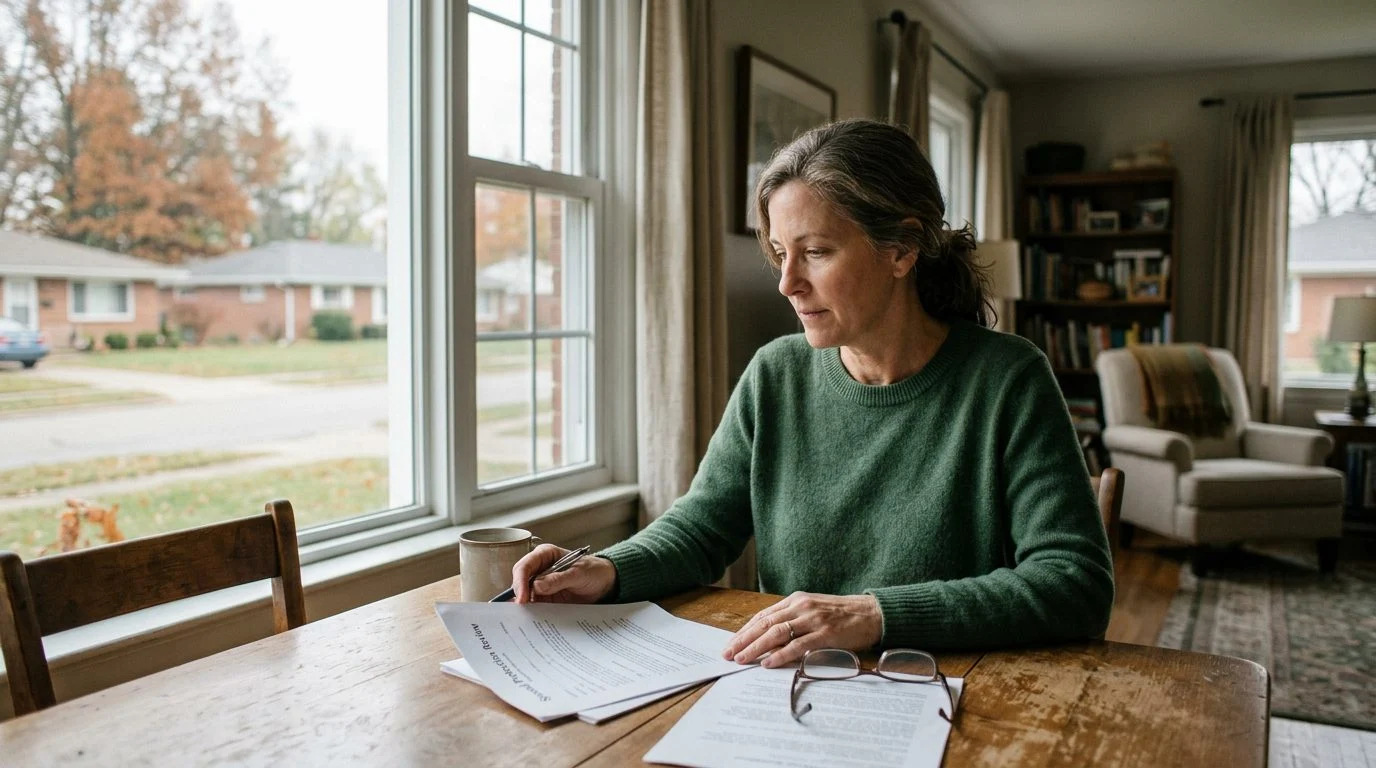
Medicaid Spousal Protection Review in Ohio
If your spouse has just moved into a nursing home, you may be asking how much you can keep: your savings, your income and your home. A spousal protection review is a careful look at exactly that, for the spouse who stays home while the other needs Medicaid help paying for care.
Feeling overwhelmed is a normal reaction to a change nobody planned for. You do not have to learn every rule on your own. Keeping track of those rules is our job, and we walk you through them one step at a time.
For example, imagine Ruth, a retired school cook in Newark, whose husband Dale moved into a nursing home after a long decline. Ruth stayed in the house they had kept for decades, and at night she wondered whether their savings would run out. Her daughter found a law firm that does this work, and the first conversation gave Ruth a clear list of what a review would look at. Her options came into view before any paperwork was filed. Every family’s facts are different, so Ruth’s outcome would depend on her own savings, income and home.
What a spousal protection review is and who it is for
A spousal protection review checks what the spouse at home can keep when the other spouse needs nursing home care. It looks at savings, income, the house and the timing of the Medicaid application, all before anything is filed. Ohio Medicaid can help pay for nursing home care, and staying home longer is often possible too.
Most often, the reader of this page is the spouse at home. You may face the same questions, especially if your spouse is still deciding or the application is already pending. You do not need to know the rules before the first conversation. Bring recent account statements, the house deed if you have it, and a list of your biggest worries.
What the review looks at: savings, income and the home
The review starts with the savings the spouse at home can keep, and Ohio’s rules set that share by formula. The at-home spouse’s protected share of the couple’s savings is the greatest of several amounts, including one half of the couple’s combined countable resources or the federal maximum, whichever is less, and the federal minimum (Ohio Adm.Code 5160:1-6-04).
The federal government publishes these spousal figures every year. Income gets the same careful sorting. Each income stream is traced to whose name it is paid in.
The house is often the biggest question. The value of your home is one of the first things we look at with you, because it can shape which planning choices make sense for your family. The home equity limit does not apply to a person who needs nursing home care when his or her spouse is lawfully living in the home (Ohio Adm.Code 5160:1-6-02.1). Planning can often help the at-home spouse stay in the home, financially secure and living the way they want. Whether that works depends on your family’s facts, and we check those facts with you before anything is decided.
Medicaid timing: the look-back and planning ahead
Timing matters in Medicaid planning, so it helps to look at the look-back before moving any assets. Ohio’s look-back period is sixty months (five years) before the individual’s baseline date, and a transfer of assets for less than fair market value on or after that look-back date is presumed to be improper (Ohio Adm.Code 5160:1-6-06). Families often move a bank account into a child’s name, retitle the house, or give money to relatives during a crisis. Each step can look harmless and still cause a problem with the application.
When care is needed now, or a transfer has already happened, the picture is not hopeless. Planning can often protect a significant part of the spend-down amount, which is the savings that would otherwise go to care. Options can remain even after money has been spent, and planning may still help qualify for Medicaid-paid care before all savings are used. Each case depends on the facts, and the order of steps matters.
Be wary of anyone who pushes you to move money quickly.
After your spouse passes: estate recovery and the house
Estate recovery is the state’s process for seeking repayment from the estate of some Medicaid recipients after they die, generally those who were fifty-five or older or permanently institutionalized, for Medicaid services the program correctly paid. Ohio may not seek estate recovery from the estate of a permanently institutionalized person while that person’s spouse is alive (R.C. 5162.21). That protection lasts while the spouse of the permanently institutionalized person is alive, and the law also bars recovery while another person it lists, besides the spouse, is alive. Planning for what comes later looks at how the house and accounts are titled, and which documents are in place today.
Planning can help at this stage. A plan set up and funded correctly, with the right documents and assets titled to match it, can help a family skip probate. Probate is the court process for settling an estate, and it can be expensive, slow and hard on a grieving family. Careful planning can help with that, but no one can promise the same result for every family.
How the review works, step by step
The review moves in four steps, and our team guides you through each one.
- Step one: the first conversation. We learn about your spouse’s care, your savings, your income and your home.
- Step two: the strategy meeting. We review your options and choose a plan, including what the Medicaid application needs and when to file it.
- Step three: plan documents. Every plan we prepare includes a general durable power of attorney for finances, a health care power of attorney, a living will and a HIPAA release. In our plans, the financial power of attorney is a key tool for protecting assets.
- Step four: funding and ongoing guidance. We coordinate your assets so they match the plan, then stay with you as needs and rules change. The timeline depends on your family’s facts.
How Jarvis Law Office helps
Jarvis Law Office works as a trusted guide through this process. We track the rules, explain each choice in plain words and walk you through each step, so you do not carry the rules alone. The firm has offices in Lancaster, Dublin and St. Clairsville, and it serves families in every Ohio county.
Our Care Navigators can also help when your family needs to find its way through the health care system, such as arranging care at home or a move to a facility. They are not lawyers and do not give legal advice; the legal questions go to our attorneys. Our fee is a flat fee, with no recurring insurance-style fees.
Questions families ask about a spousal protection review
Will the spouse at home have to sell the house to pay for nursing home care?
It depends on your family’s facts, but planning can often help the spouse at home keep the house. We look at the home, the savings and the timing together.
Can we start a review after my spouse has already moved into a nursing home?
Yes, your family can still plan from this point. Timing questions are part of the first conversation.
How much can the spouse at home keep?
The at-home spouse’s protected share of the couple’s savings is the greatest of several amounts, including one half of the couple’s combined countable resources or the federal maximum, whichever is less, and the federal minimum. The exact amount depends on your savings, your income and the timing of the application.
Do we need to decide everything before we call?
No. The first conversation is where your questions get sorted out, one at a time.
Does a review ensure Medicaid approval?
No one can know that before the facts are in. A review is planning help based on your family’s facts, and we cannot predict how any application will turn out.
Next step: a free discovery call
The next step is a free discovery call with our team, and it is the easiest way to see your options. If your spouse has just moved into a nursing home, you are carrying a lot right now. You do not have to sort out the savings, the house and the paperwork by yourself. The free discovery call is confidential and carries no obligation to continue. Bring your questions, and we will start with the ones that worry you most.
Related practice areas
- Long-Term Care and Memory Care Planning in Ohio
- Dementia Caregiver Planning Consultation
- Memory Care Admission Contract Review in Ohio
- Dementia Care Planning for Ohio Families: Home or Facility