
Medicaid and long-term care planning | Serving families in every Ohio county
A nursing home bill should not be your spouse's burden to carry alone
Here is how to think through the question of what can reach your home and savings, and how a family can get clear answers before the next bill arrives.
By Timothy Jarvis · Published November 16, 2026
Can the nursing home come after you for your spouse’s bill?
If a facility has handed you a stack of papers, or a statement has arrived, you may feel worried and rushed. You don’t have to work this out alone. Sorting through the rules is the firm’s job, and our team guides families through it one step at a time.
This page answers the question you came with: can a nursing home collect from a spouse in Ohio? It explains which papers to read, the protections for the spouse who stays at home, the planning that may be possible, and what to do next. If you’re reading this late at night with a bill in hand, you’re in the right place for a calm first look.

A short example: the spouse at home and the admission papers
For example, imagine a couple, Ruth and Dale, in a small town in southeast Ohio. A slow decline at home left Dale unable to manage his medications and the stairs, so Ruth signed a pile of admission forms in one afternoon. Later she worried she had taken on his whole bill, and she lay awake wondering whether their savings and the house were at risk. Ruth brought the papers to a lawyer, who read the exact wording with her and explained what each part meant for her. Together they looked at what she could keep for herself and how the house was titled. Every family’s papers and facts are different, and results vary from one family to the next.
What to look for in nursing home admission papers
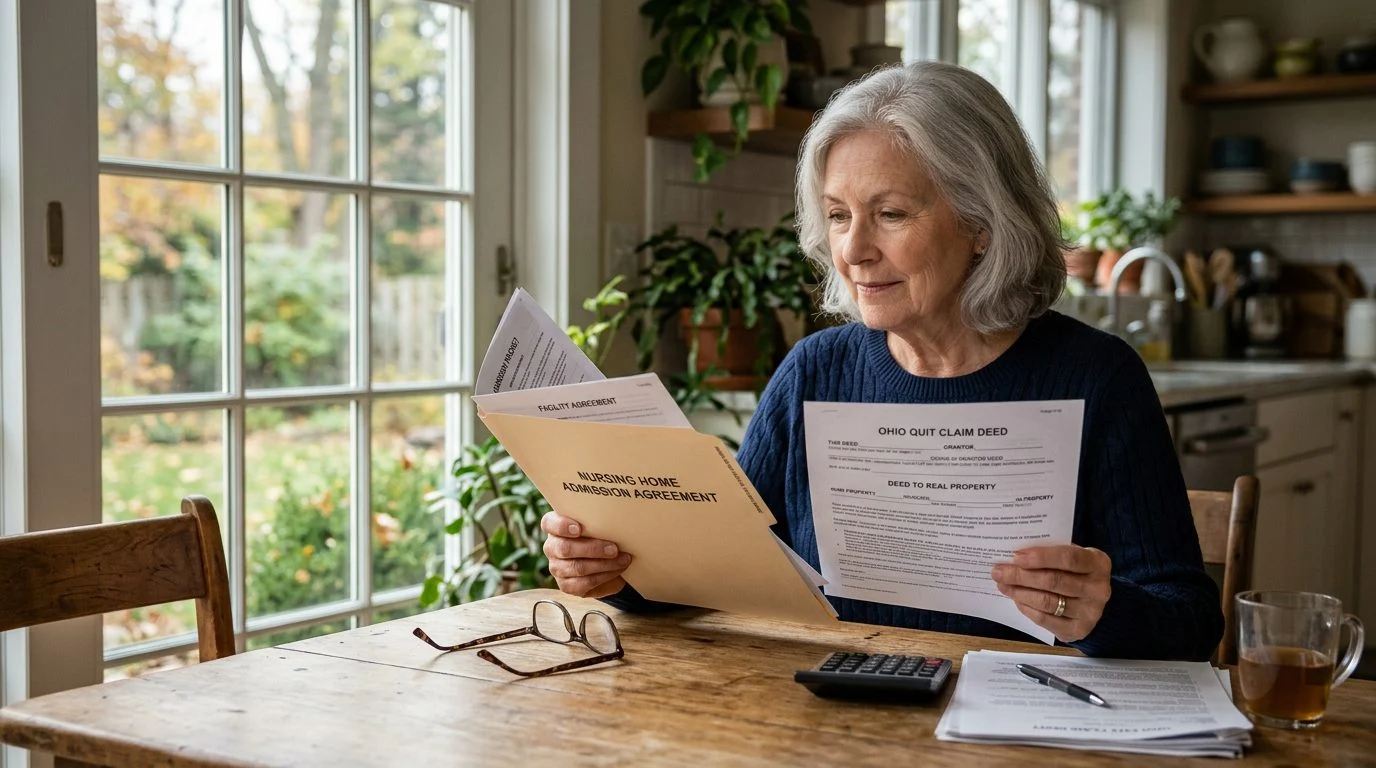
The wording on admission papers is where the question of your own responsibility usually starts. Read everything before you sign, and don’t feel pushed to sign on the spot. Ask the facility for a complete copy of every form you’re asked to sign, and keep it with your own notes. A copy also helps later, if a question comes up about a charge or a date.
Pay close attention to any line that names you, the spouse, as the person responsible for payment. When you meet with the facility, we can help you prepare questions about its charges and how it makes discharge decisions. The National Consumer Voice resident rights guide covers these topics in plain language. Bring the papers to your free discovery call, so we can review them with you line by line.
How the at-home spouse is protected
Ohio’s Medicaid rules include protections for the spouse who stays home, often called the community spouse, while the spouse in care is called the institutionalized spouse.
In any month your spouse is eligible for long-term care in a medical institution, a home and community-based services waiver, or PACE, none of your income may be treated as available to your spouse (Ohio Adm.Code 5160:1-6-04).
After the month your spouse is determined eligible for Medicaid, none of your resources may be treated as available to your spouse, for as long as your spouse stays eligible without a break in coverage (Ohio Adm.Code 5160:1-6-04).
These protections are easy to misread, so it helps to know the basic idea before you look at a bill. The Medicaid.gov’s 2026 figures set the maximum community spouse resource standard at $162,660. That is the highest amount in the standard for the at-home spouse, but your family’s own number depends on how your savings are counted.
For 2026, Ohio’s home equity limit is $752,000, and it rises every January. For a family trying to keep the house, that limit is one of the first numbers we look at together. Whether you can keep the house is a separate question from the bill, and it’s worth looking at early.
When Ohio Medicaid can help pay for your spouse’s care
Ohio Medicaid can help pay for nursing home care, for many (not all) assisted living and memory care settings, and for care at home. Paying for care is often the question behind the admission papers. For many families, staying home longer is possible, and a move to a care setting later stays an option.
Thinking about how care will be paid is a separate step from reading a bill, and it’s worth taking each one in turn. Medicaid applications come with their own forms, and we help families keep track of each one. Renting out the house while a spouse is in care, and keeping or selling the home, are choices we can talk through with you. Each choice has its own timing and its own paperwork, so we take them one at a time.
What planning can look like for your family
Planning can often protect certain assets, and timing makes a big difference. When planning starts well before care is needed, it can often shield certain assets from the spend-down, which is the use of savings toward care costs, and from estate recovery. For a spouse who is a permanently institutionalized individual, Ohio cannot seek Medicaid estate recovery from your spouse’s estate while you, as the spouse, are alive (R.C. 5162.21).
If care is needed now, a significant part of the spend-down can often still be protected, depending on your family’s facts. Options can remain even when planning starts late, and a couple may be able to qualify for Medicaid-paid care well before spending everything. Planning can often keep the at-home spouse in the home, financially secure and with quality of life intact.
In our plans, a strong financial power of attorney is one of the tools we use to protect a family’s assets. To prepare, gather a list of each bank account, retirement account and the house, and note how each one is titled.
Getting help with the care decisions along the way
Care Navigators can help your family find a way through the health care system when that help is needed. They can help with a discharge plan, questions about care options, and the steps after a hospital stay. The firm’s Care Navigators are not lawyers and do not give legal advice; the attorneys answer the legal questions. Care decisions and legal decisions often happen side by side, so it helps to keep them clearly apart.
Keep one folder for everything from the facility, with notes from each call and each date you were given. Ask who handles billing questions, and write that name down. If anyone pressures you for money or personal information, the Ohio Attorney General’s seniors page lists guidance on scams and financial exploitation.
How Jarvis Law Office helps families with spousal bill questions
Jarvis Law Office guides your family step by step, from the first call through ongoing help, so you don’t have to work out the rules by yourself. The first step is a free discovery call, which is confidential and comes with no obligation to continue. We listen to your family’s situation and review the admission papers with you. A strategy meeting follows, where you choose a plan that fits your family’s goals.
Then we prepare the plan documents. Every plan includes a general durable financial power of attorney, a health care power of attorney, a living will and a HIPAA release. Next we coordinate your assets so they match the plan, which takes more than paperwork. We stay with you through ongoing guidance as your needs change. Whatever you decide, we explain each step in plain words, so you know what is happening and why. Our fee is a flat fee, with no recurring insurance-style fees.
Probate can be expensive and slow for a grieving family, and a plan set up and funded correctly can help a family skip it. Timothy Jarvis is the responsible lawyer for this page. Our offices are in Lancaster, Dublin and St. Clairsville, and we serve families in every Ohio county.
Common questions
Is my spouse’s nursing home bill mine to pay?
Not always. What you owe turns on what you signed and on your family’s facts.
Does Ohio protect the spouse who stays home?
After the month your spouse is determined eligible for Medicaid, none of your resources may be treated as available to your spouse, for as long as your spouse stays eligible without a break in coverage.
Can Ohio pursue the home from a spouse’s estate while you are alive?
For a spouse who is a permanently institutionalized individual, Ohio cannot seek Medicaid estate recovery from your spouse’s estate while you, as the spouse, are alive.

Bringing your papers to a free discovery call is a calm first step
If a bill has arrived or a move is coming, you may be carrying more than you can easily hold right now. Admission papers, questions about your own responsibility, and worry for the spouse at home can pile up quickly. You don’t have to face them alone. Gather the papers the facility gave you, a list of your accounts and the questions you wrote down, then book your free discovery call with our team. Bringing the papers is a good start, even if you aren’t sure what they mean yet. We will review them with you at a pace that works for your family.
How planning can help the spouse who stays home
Protecting the home you share
Planning can often help the spouse at home keep the house, stay financially secure and keep a good quality of life, depending on your family's facts.
Timing makes a difference
Planning started five or more years before care is needed can often shield more of your assets. Even when care is needed now, a significant part can often still be protected.
Care settings Medicaid can help pay for
Ohio Medicaid can help pay for nursing home care, many assisted living and memory care settings, and care at home. Staying home longer is often possible, and a move later remains an option.
Care Navigators on your side
Our Care Navigators can help your family find a way through a complicated health care system when you need that help. They do not give legal advice; our attorneys do that.
Plans that work when they are needed
We set up the right documents and coordinate your assets to match the plan. Careful planning is also what can help your family avoid probate later.
Do not wait for the bill to define your options
Questions about a spouse's care costs are easier to answer before a crisis forces the decision. Bring your papers to a conversation with us, and we will walk through them with you step by step.
What to bring to your free discovery call
Facility paperwork
Whatever the facility gave you when your spouse was admitted, so we can read it with you.
Bills and notices
Recent statements and any letters from the facility or from Medicaid.
A list of what you own
Bank accounts, retirement accounts, the home, vehicles, and anything held in your name or jointly.
Your family's goals
What you most want to protect, and who depends on you now and in the years ahead.