
What Is the Spousal Allowance for Medicaid in Ohio?
By Timothy Jarvis · Published November 15, 2026
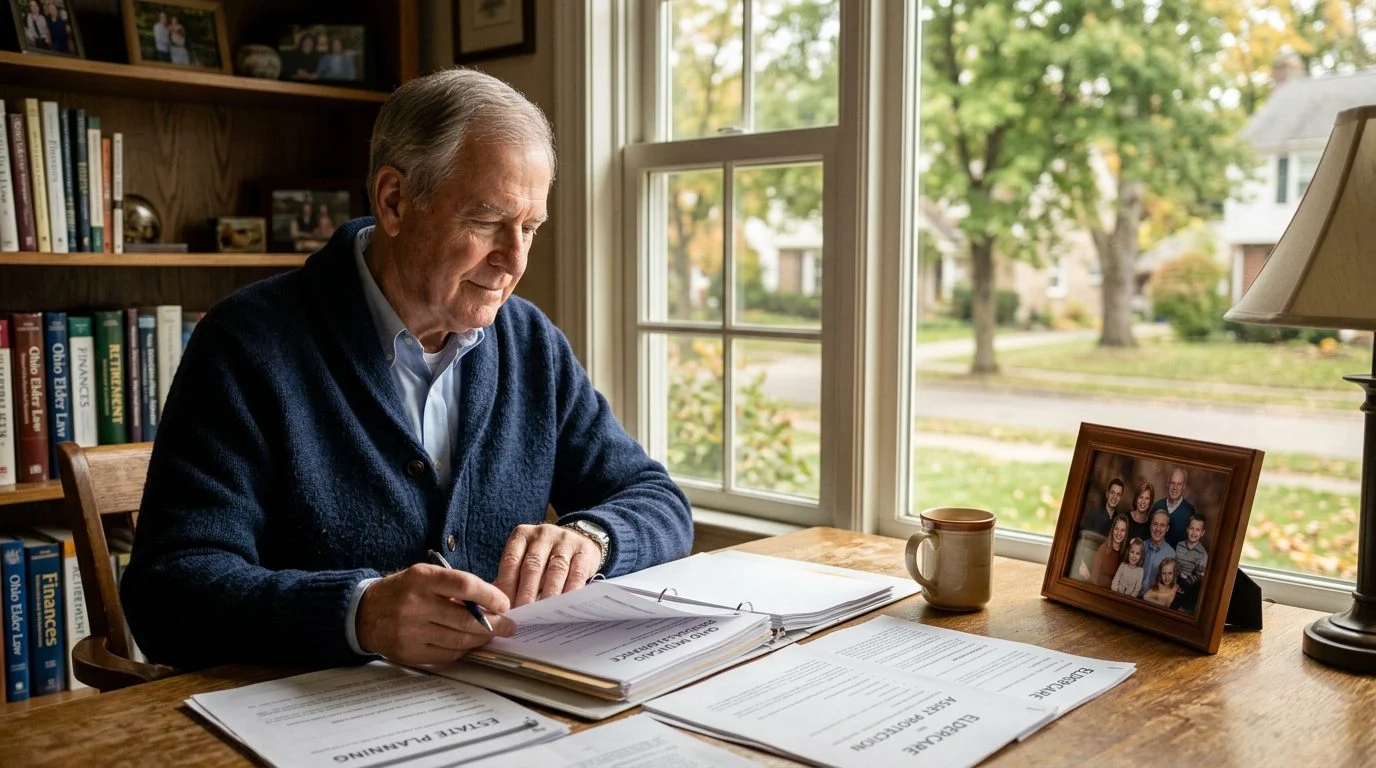
If your spouse has just moved into a nursing home, you’re probably asking one question first: what can you keep? The spousal allowance for Medicaid in Ohio is the set of protections that lets the spouse at home keep some savings, a monthly income and, often, the house. Here is how it works, in plain words.
Your spouse is in a nursing home now, and you want to know what you get to keep
You are not the only one asking this question. Maybe you’re watching the bills arrive and wondering how long the savings will last. Maybe you fear having to sell the house you call home. Those fears make sense. The good news is that Ohio’s Medicaid rules include protections for the spouse who stays home. Staying on top of those rules is our job, not yours. Our team guides families step by step, from the first conversation through the day a plan is in place. You don’t have to figure all of this out yourself. Your spouse’s care matters, and so does your own need for a safe, steady home. Families in your position often want the same few things: good care for their spouse, a home they can keep, and enough income to live on. Planning can’t promise any particular result, but it can show you the options.

For example, imagine a couple who faced the same question
For example, imagine a couple, Dale and Ruth, who live in a small town in Ohio. Dale moved into a nursing home after years of slow decline at home, and Ruth could no longer manage his care alone. Ruth stayed in their house with a modest savings account and a monthly pension check. She feared the bills would drain everything and leave her with nothing to live on. At a planning meeting, the family looked at their savings, their income and their home one piece at a time. Ruth didn’t have to master the rules herself to make a decision. She came away knowing which protections might apply and which questions still needed answers. This is an illustrative example, not a real client or a result the firm obtained. Every family’s facts are different, so results vary.
The two sides of the spousal allowance: savings and monthly income
The spousal allowance has two sides: the savings the spouse at home may keep, and the monthly income that stays with that spouse. The savings protection is called the community spouse resource allowance. For 2026, the maximum community spouse resource standard is $162,660. What applies to your couple depends on the countable assets you have and how they’re counted, so that number is a starting point, not a promise.
For a nursing-home spouse who is subject to a resource limit, eligibility cannot be approved until the couple’s combined countable resources are equal to or less than the community spouse resource allowance plus two thousand dollars (Ohio Adm.Code 5160:1-6-04).
Getting that list of assets right early helps keep the application on track. The income side works differently. For each month the nursing-home spouse qualifies for care in a medical institution, an HCBS waiver or PACE, the at-home spouse’s income does not count as available to the nursing-home spouse (Ohio Adm.Code 5160:1-6-04). That’s why your monthly income picture matters just as much as the savings. The CSRA may be increased to generate additional income for the at-home spouse when a state hearing finds that all of the nursing-home spouse’s available income has already gone to the at-home spouse and that this is still not enough to meet the at-home spouse’s minimum monthly needs allowance. We check the current figures with you rather than relying on older pages.
Keeping the home: the home equity limit in Ohio
For the spouse at home, the house is usually the first worry. The rules treat the home in a way that often helps the spouse who stays in it. The home equity limit does not apply to an individual when the individual’s spouse is lawfully residing in the individual’s home (Ohio Adm.Code 5160:1-6-02.1).
Ohio also uses a home equity limit. For 2026, Ohio’s home equity limit is $752,000, and it rises every January. We walk through how that limit fits your home, your deed and your family’s plan, because the details decide what applies. If you’re worried about the house, that worry is common and worth raising early. Protecting your own home is part of a plan that cares for both of you, not a selfish goal.
What planning can look like for the spouse at home
Planning can often help the spouse at home stay in the home, financially secure, with quality of life intact. Every family’s situation is different, so these are possibilities, not promises. Planning done five or more years before care is needed can often shield assets from the spend-down and from the estate recovery lien, and more time gives more room to work. In those cases, planning can often shield some assets from the spend-down and from estate recovery. When care is needed now, a significant part of the spend-down may often still be protected. Gifts or transfers made in the years before you apply for your spouse can affect when Medicaid starts paying, so timing matters. How far back Medicaid looks, and which transfers do not count against you, are details we will go over with you for your own situation. In our plans, the financial power of attorney is a key asset-protection tool, and every plan includes one. When a plan is set up and funded correctly, with the right documents and assets matched to it, a family can avoid probate later, a process that can be expensive and drawn out for a grieving family.
Can Ohio take the house after your spouse dies?
While you are alive, Ohio cannot seek estate recovery for your spouse’s nursing home care, either from your spouse’s estate or from the sale of a home that carries a Medicaid lien. If your spouse received Medicaid-paid long-term care, Ohio Medicaid cannot seek repayment from your spouse’s estate, or from the sale of a home carrying its lien, while you are still living; it can turn to that estate only later, and other exceptions and waivers may also apply, which we will walk through with you. We will walk through how this could apply to your home and family (Ohio’s estate recovery law). Whether the home is at risk depends on your family’s facts, so raise the question early.
Does your income count toward your spouse’s care?
During any month the nursing-home spouse is eligible for long-term care services in a medical institution, HCBS waiver, or PACE, no income of the at-home spouse is considered available to the nursing-home spouse. We review your own income with you so you know where you stand.
Avoiding the Medicaid mistakes that cause delays or penalties
Because a Medicaid application involves timing and paperwork, we handle it carefully from the start. Once the plan is set, we prepare and file the Medicaid application on your family’s behalf, so the details aren’t left to a family in a hard moment. Ohio Medicaid can help pay for nursing home care. It can also help pay for many, though not all, assisted living and memory care settings, and for care at home. Ohio Medicaid can help pay for nursing home care, care at home, and many, though not all, assisted living and memory care settings. Many families prefer staying home longer, and that’s often possible. A move to a care setting later remains an option.
How Jarvis Law Office helps you through this
Our job is to take the rules off your plate so you can focus on your spouse. We begin with a first conversation about your spouse’s situation, your household and what matters most to you. From there we meet to choose a plan, prepare the plan documents, and coordinate your assets so they match the plan, which takes more than paperwork. We stay with you afterward, giving ongoing guidance as your needs change. When care decisions come up, our Care Navigators can help you find your way through the health care system. Care Navigators are not lawyers and do not give legal advice; the legal work stays with our attorneys. Timothy Jarvis is the responsible lawyer for this page. Our offices are in Lancaster, Dublin and St. Clairsville, and we serve families across Ohio.
Take the next step with a free discovery call
If your spouse has just entered a nursing home, questions about savings and the house can’t wait long. You don’t have to work through them alone. Start with a free discovery call with our team, a calm place to begin. The first discovery call is free, confidential, and with no obligation to continue. Bring your questions about the savings, the income and the house. We’ll help you see your options step by step.