
Medicaid Planning | Serving families in every Ohio county
Protecting the Home and Land Your Family Worked For
Here is how families think through what a parent leaves behind, and how planning can help you decide what to do next.
Planning from Ohio's offices
3
Offices in Lancaster, Dublin and St. Clairsville
Ohio
Families served in every Ohio county
By Timothy Jarvis · Published November 22, 2026
If one of you may need nursing home care, you may be asking whether Medicaid could reach your home and family land.
Your home and any family land may be part of that estate, so it helps to look at them now. You do not have to figure all of this out yourself. You do not have to work through these rules on your own.
What Medicaid estate recovery could mean for your home and family land
Many families assume the house will pass to their children untouched. That assumption is worth checking early.
Ohio’s Medicaid program can seek repayment from the estate of a person who received Medicaid care. This applies whether that person was 55 or older or was someone expected to stay in a nursing home for good. We will walk through which of those protections could apply to your family (Ohio’s Medicaid estate recovery law).
For many families, the home and land are most of what they own, so this question carries real weight.
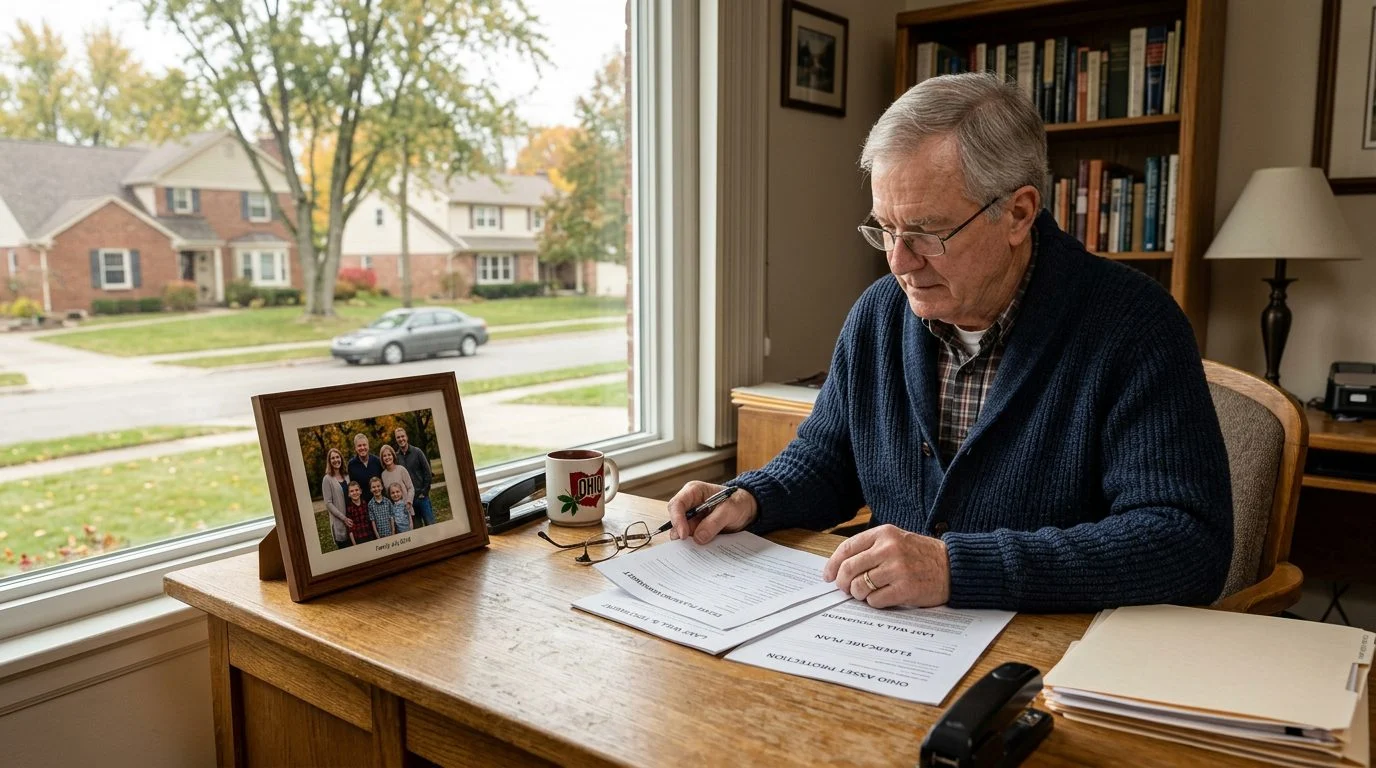
For example, imagine a couple, Walt and Linda, who live in a small town in southeastern Ohio. They have owned their home for 40 years, and a parcel of family land sits behind it. When Walt’s slow decline at home ends in a nursing home, Linda fears losing the house and land to care costs. Their two children already disagree about who should get the land. A planning meeting shows them options they had not considered, and they leave with a plan to review before anything is signed. Every family’s facts are different, and results vary with each family’s own situation.
Many families worry less about the bill itself and more about the property ending up with the state instead of their children.
If you're worried that Medicaid could reach the home and land you want to leave your children, our team invites you to a free discovery call to talk through your options. Talk it through with Jarvis Law Office — the first discovery call is free, confidential, and carries no obligation.

Your fears, answered plainly
Each of your main worries has a practical answer, and planning early gives you the most room to act.
Losing the home and land to nursing home costs. Planning that starts well before care is needed can often shield assets from the spend-down (the money used toward care before Medicaid helps) and from the estate recovery lien, which is a claim against property. Every family’s outcome is different, but many find they have more options than they expected.
Not qualifying because of the land. Whether a separate parcel counts is a question we answer after reviewing your deed and where the land sits, and we take it step by step.
Your children disagreeing over the land. Unclear documents and property held in different names are a common source of family disagreement. A written plan with the right documents in place gives your children a clear answer about what you wanted. Families sometimes ask about a hardship waiver for an heir, and timing matters.
The Ohio Department of Medicaid may, at the sole discretion of its director or designee, waive estate recovery when recovery would work an undue hardship on survivors, and an heir who would suffer that hardship may request a waiver within thirty calendar days after notice of the claim is mailed by the Ohio attorney general (AGO) (Ohio Adm.Code 5160:1-2-07).
A costly mistake protecting the property. Moving a deed or giving property away in a hurry can create problems that are hard to undo.
For an institutionalized individual, giving away assets for less than fair market value within the sixty-month look-back period before the baseline date is presumed improper and results in a restricted Medicaid coverage period, unless a listed exception applies or the presumption is rebutted by a satisfactory showing to the agency (Ohio Adm.Code 5160:1-6-06).
Review each step with us before you sign anything.
How Ohio Medicaid can help pay for care, and where your home fits
Ohio Medicaid can help pay for nursing homes, many assisted living and memory care settings, and care at home. Not every assisted living or memory care setting qualifies, so each one needs a closer look.
Many families want to stay home longer, and that is often possible. A move to a care setting later stays an option, so the choice need not be made all at once.
Our Care Navigators can help you find your way through a complicated health care system when care decisions come up. They help with care decisions and do not give legal advice.
Ohio also sets a home equity limit, which is one reason the house gets its own review:
For 2026, Ohio’s home equity limit is $752,000, and it rises every January.
What planning can look like for a couple like you
Planning that starts well before care is needed gives a couple the most room to protect what they have built. When that early start is possible, planning can often shield assets from the spend-down and from the estate recovery lien. If care is needed now, a significant part of the spend-down amount can often still be protected, and options remain well before everything is spent.
For example, imagine a couple, Jim and Carol, in a farm town in central Ohio. Jim needs nursing home care, and Carol wants to stay in the house they have lived in for decades. Their planning begins with a review of what the couple owns. That review helps Carol see which assets can stay with her and which need a different plan. Results vary with each family’s facts, and this story is only an illustration.
Planning can often keep the spouse at home in the home, financially secure, with quality of life intact.
Passing the home and land to your children without probate or disputes
A plan set up and funded correctly is how families can often skip probate later. Probate is the court process for settling a person’s estate. For a grieving family, it can be expensive, drawn out and stressful. Ohio Legal Help explains how a home can pass to a beneficiary through a transfer on death designation.
Avoiding probate and avoiding estate recovery are different questions, though.
A person’s estate for Medicaid estate recovery includes property in which the person had any legal title or interest when they died, to the extent of that interest, including property passed to a survivor through joint tenancy, survivorship, life estate, or living trust (R.C. 5162.21).
That is why we review both at once. The home and land need to stay out of probate, and the plan also has to answer the estate recovery question.
In our plans we include a general durable power of attorney for finances, a health care power of attorney, a living will and a HIPAA release. The financial power of attorney is also one of the tools our planning uses to protect a family’s assets.
You want the home and land to reach your children, and you want them to understand the plan. Clear documents and properly titled assets help make that happen.
How we work with you, step by step
Our work follows six steps, from the first conversation through ongoing guidance. First, we learn your situation and what matters most to you. Next, a strategy meeting helps us choose a plan together. We then set up the plan documents. Assets are funded and coordinated to match the plan, which takes more than paperwork. Where care is needed, we handle the Medicaid application. After that, we keep giving guidance as your needs change.
Our offices are in Lancaster, Dublin and St. Clairsville, and we serve families in every Ohio county.
Our fee is a flat fee, with no recurring insurance-style fees. Your first step is a free discovery call, which is confidential and carries no obligation to continue.
You do not have to carry every detail yourself. We take that load so you can focus on your family.
Not sure what your next step is?
Talk it through with Jarvis Law Office — the first discovery call is free, confidential, and carries no obligation.

Common questions, and a next step
Here are short answers to the questions families ask most about Medicaid estate recovery planning in Ohio.
Does Medicaid go after estates or homes?
Ohio’s Medicaid program shall seek recovery from the estate of a person age 55 or older who is not permanently institutionalized, for Medicaid services correctly paid for that person, but no adjustment or recovery may be made from that estate while the person’s spouse is alive.
Does Ohio Medicaid automatically renew?
Eligibility is reviewed over time, and we help families keep track of what is required.
Is it too late if care is already needed?
Options often remain, though what is possible turns on your family’s facts.
If you are carrying this worry about your home and land, a free discovery call is a calm place to begin. We listen first, look at what you own, and talk through your options at your pace. Book your free discovery call with our team.
How Jarvis Law Office helps families plan
Planning before the question comes up
We look at the home, savings and other assets a parent may leave behind, and work out how they can be titled and coordinated with the rest of the plan.
The right documents in place
Our plans include a general durable financial power of attorney, a health care power of attorney, a living will and a HIPAA release, so your parent's wishes are written down and ready to use.
Care Navigators at your side
When the health care system feels fragmented, our Care Navigators can help your family find their way through it on your behalf.
Plain words and a flat fee
We explain each option in everyday language and work with a flat fee, with no recurring insurance-style charges.
Questions are easier to answer before a crisis
Many families come to us when a parent is still at home and the future feels uncertain. Looking at the home and savings early gives your family more choices.
Your next steps, one at a time
Tell us your situation
Start with a conversation about your parent, your family and what worries you most. You do not need to have the answers yet.
Review the options together
We walk through what planning can look like for your family, including how a home and other assets may be treated.
Put the plan in place
We prepare the documents and help coordinate your parent's assets so the plan works the way it was designed.
Stay with us as needs change
Families' situations shift over time. We keep guiding you as your parent's needs and the rules change.