
Long-term care planning | Ohio families
Your Spouse Goes to a Nursing Home. Do You Keep the House?
Many Ohio couples face this choice in the same week the hospital discharge papers arrive. You do not have to sort it out alone, and a calm first conversation can show you what is possible for your family.
By Timothy Jarvis · Published November 20, 2026
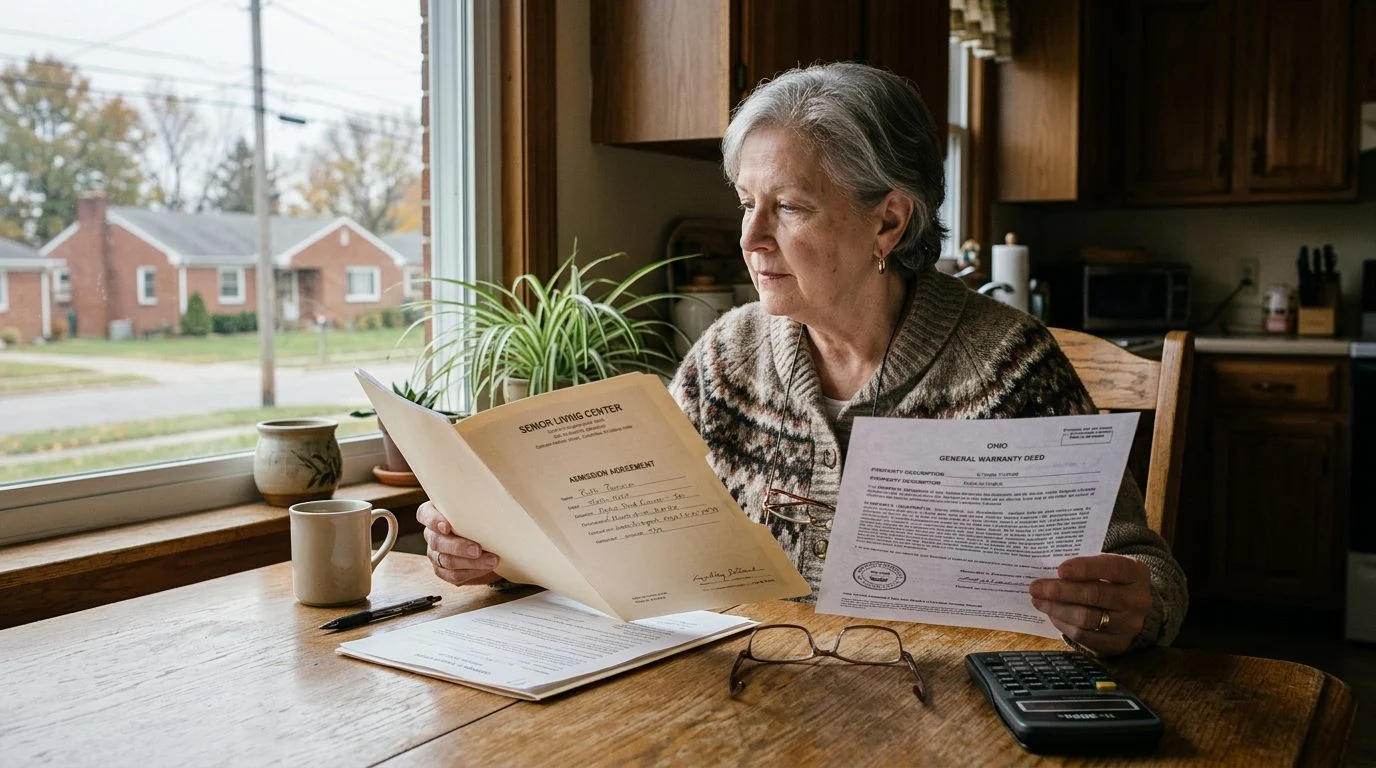
Your spouse has moved from the hospital to a nursing home, and now you are at home with the bills, the house and the savings. If your spouse has just moved into a nursing home, the monthly bills can make it hard to see what comes next.
Every family’s facts are different, so we start by looking at yours with you. Ohio’s rules include protections for the spouse who remains at home, and we explain how they apply to your situation. We will walk through how this applies to your family, step by step, so you know what to expect.
Your spouse has moved from the hospital to a nursing home: what you face at home
This move often brings the first real look at what nursing home care costs. You do not have to work out the rules by yourself.
For example, imagine Frank and Lois, a couple in a small town in Hocking County. Frank spent a week in the hospital with pneumonia, and his doctors said he could not go home yet. He moved to a nursing home for skilled care, and the billing office sent Lois a monthly figure she could not picture covering. Lois stayed in the house they had lived in for thirty years, afraid the savings would run out and she would have to sell. A planning conversation helped them see what Medicaid could cover, what Lois might be able to keep, and which steps to take first. Every family’s facts are different, so another couple’s path will look different.
Medicare and Medicaid do different jobs. Medicare skilled nursing facility care covers short-term skilled care after a qualifying hospital stay. Long-term nursing home care is where Medicaid usually comes in, according to KFF on nursing facilities and Medicaid.
If your spouse is moving through a complicated health care system, our Care Navigators can help your family find their way, on your behalf, when you need that help. Care Navigators are not lawyers and do not give legal advice. Our attorneys handle the legal planning.
Your spouse's move from the hospital to a nursing home brings hard decisions, and you do not have to face them alone, so we invite you to a free discovery call. Talk it through with Jarvis Law Office — the first discovery call is free, confidential, and carries no obligation.

What Ohio Medicaid can help pay for, and where
Ohio Medicaid can help pay for nursing home care, for many assisted living and memory care settings, and for care at home. Each setting is different, so the details matter for your spouse’s own facility. The Ohio Medicaid facility care page explains how a nursing facility resident’s costs are worked out, including allowances for a community spouse.
Many families prefer to stay home longer, and for many that is possible. A move to a care setting later remains an option if your family needs it.
Your first practical steps are simple to name, even if they are hard to do. Know the monthly bill. List which savings, income and property are in each name. Decide when to start planning. Those three answers shape nearly everything else on this page.
What you may be able to keep: income, savings and the house
The spouse at home is treated differently from the spouse in the nursing home. Planning can often keep you financially secure and in your home.
In any month your spouse is eligible for long-term care services in a medical institution, none of your income is treated as available to pay for your spouse’s care (Ohio’s rules on the income of the spouse at home).
Your spouse’s care and your own income are separate questions, and that separation is part of what protects you. Your savings work differently. The amount you may keep is called the community spouse resource allowance, and Ohio’s formula works it out.
The savings you may keep as the spouse at home, the community spouse resource allowance, is figured under specific rules that we walk through with you (Ohio’s Medicaid resource rules).
The 2026 maximum community spouse resource standard is $162,660, one of the figures that feeds into that formula. The 2026 Medicaid standards from CMS lists the current figures.
The home is the other big question. For 2026, Ohio’s home equity limit is $752,000, and it rises every January.
When you, the spouse at home, are lawfully living in the home, the home equity limit does not apply to your spouse who needs long-term care (Ohio’s home equity rules).
If your spouse leaves the home for a nursing home with no plan to return, the home remains an excluded resource, not counted as an asset, for as long as you keep living in it while your spouse receives long-term care services (Ohio’s rules on the home as a resource).
We walk through each figure with you in the conversation, so you see your own numbers rather than general averages.
Why timing matters: how Medicaid looks back
Timing matters because Medicaid reviews money and property moved in the years before an application.
Planning started early, often five or more years before care is needed, can often shield assets from the spend-down and from estate recovery. The spend-down is the savings that go toward care before Medicaid starts helping. If care is needed now, or a past transfer is already a problem, a significant part of the spend-down amount can often still be protected.
It is not too late to act. Options often remain, and you can often qualify for Medicaid-paid care well before the savings are gone. Please do not move money or property to family in a hurry. A quick transfer can cause a delay, so we review the plan before anything moves.
Estate recovery: what could happen to the house after your spouse dies
Many spouses carry this worry quietly: that the house they still live in could be claimed after their spouse dies.
Planning can often shield assets from the estate recovery lien when the plan is built around your family’s facts and timing.
Probate is the court process for settling a person’s estate. For a grieving family, it can be costly, slow and stressful. A plan set up and funded correctly, with the right documents and assets titled and coordinated to match, can help your family skip probate later. Getting that planning right is the firm’s part of the work, so you are not left to sort it out after a loss. Careful planning can also help more of what you have built reach your children and grandchildren.
What planning looks like, and how the application goes through
A complete and consistent application helps prevent delays, and the work starts well before anything is filed.
In our plans we include a general durable financial power of attorney, a health care power of attorney, a living will and a HIPAA release. A strong financial power of attorney is a key asset-protection tool in our planning, which is why it is part of every plan we prepare.
A Medicaid application usually means gathering statements, listing income and assets, and explaining any past transfers. The goal is a file that is complete and matches itself from page to page. Medicaid applications ask for detailed records, so we walk through the paperwork with you step by step. We review those details before anything is filed.
The exceptions and fine points are something we will walk through with you in the conversation.
Not sure what your next step is?
Talk it through with Jarvis Law Office — the first discovery call is free, confidential, and carries no obligation.
Questions spouses at home ask about a nursing home stay
Will I lose the house if my spouse is in a nursing home?
If your spouse leaves the home for a nursing home with no plan to return, the home remains an excluded resource, not counted as an asset, for as long as you keep living in it while your spouse receives long-term care services. Whether your home is protected in your own case turns on how the deed is titled and on your family’s facts, which we review with you.
Can I keep my income while my spouse is in a nursing home?
Many spouses at home keep their own income, and we show you how Ohio’s rules apply to your family.
What if we already moved money to our children?
Past transfers are reviewed as part of a Medicaid application, so bring them to the first conversation. Early review leaves more options open.
Do I have to figure this out alone?
No. Our attorneys and team guide you step by step, and keeping up with the rules is our job, not yours.
How much does planning cost?
The firm charges a flat fee, with no recurring insurance-style fees. The free discovery call is confidential and comes with no obligation to continue.

How Jarvis Law Office helps you, and the next step
We help you move from worry to a plan, one step at a time. A first conversation lets us understand your family’s situation, and a strategy meeting is where you and our team choose a plan that fits. We prepare the plan documents and coordinate the assets so they match the plan, which takes more than paperwork. Where Medicaid is part of the plan, we handle the application. As your needs change, we keep guiding you. For the health care side of the move, our Care Navigators can help as well.
We serve families in every Ohio county from our offices in Lancaster, Dublin and St. Clairsville.
You are still researching, and that is a reasonable place to be. If your spouse has moved from the hospital to a nursing home, you deserve a clear picture of your home and income before you decide anything. We invite you to a free discovery call. It is free, confidential, and has no obligation to continue.
What families tell us they need most
Care for their loved one
Most families want their spouse or parent to get good care without losing the home they worked for.
A plan for the household
We look at the whole household, including the spouse who stays home, so one person's care bill does not decide everything.
Support for the whole family
Adult children often carry the paperwork and the phone calls. We work with the family so the load is shared and clearer.
Plain words, step by step
We explain each choice in everyday language and move at a pace the family can follow.
Before anything changes hands
Signing over the house or changing its title in a hurry can close options that are still open. Talk with us before you sign anything.
Bring these questions to your free discovery call
Whose name is on the deed?
How the home is titled shapes what can be done with it, so bring a copy of the deed if you have one.
Is your loved one likely to return home?
Whether a move to a facility is expected to be temporary or long-term changes the planning picture.
What income and savings does the household have?
List the bank accounts, retirement income and monthly bills so we can see the full picture.
Who is making decisions right now?
Tell us whether a power of attorney or health care decision-maker is already in place. Care Navigators can also help you find your way through the health care system.