
Medicaid Planning · Ohio Families
Your Parent Is Already in a Nursing Home. Let's Plan the Next Steps Together.
You do not have to sort out the bills, the paperwork and the choices alone. Our team guides your family one step at a time.
By Timothy Jarvis · Published November 23, 2026
If your parent is already in a nursing home, the bills, the paperwork and the phone calls may have landed on you before anyone made a plan. Yes, a parent in a nursing home can still have options. Medicaid planning can still help protect what the family can protect and help carry out your parent’s wishes.
What Medicaid Planning Can Still Do for a Parent in a Nursing Home
Medicaid planning can still do a great deal, because Medicaid looks at what your parent owns and how it has been handled, not only at what happens next. According to the Administration for Community Living, almost 70% of people turning 65 are likely to need some long-term care. Many adult children reach this point with no power of attorney, no written wishes and no clear idea how care is paid for.
You likely want what most families want for a parent: their wishes honored, the home and savings protected, good care, fewer costly mistakes, and a plan the whole family understands. You do not have to figure out these rules alone. Keeping up with them is our job, and our team guides your family step by step.
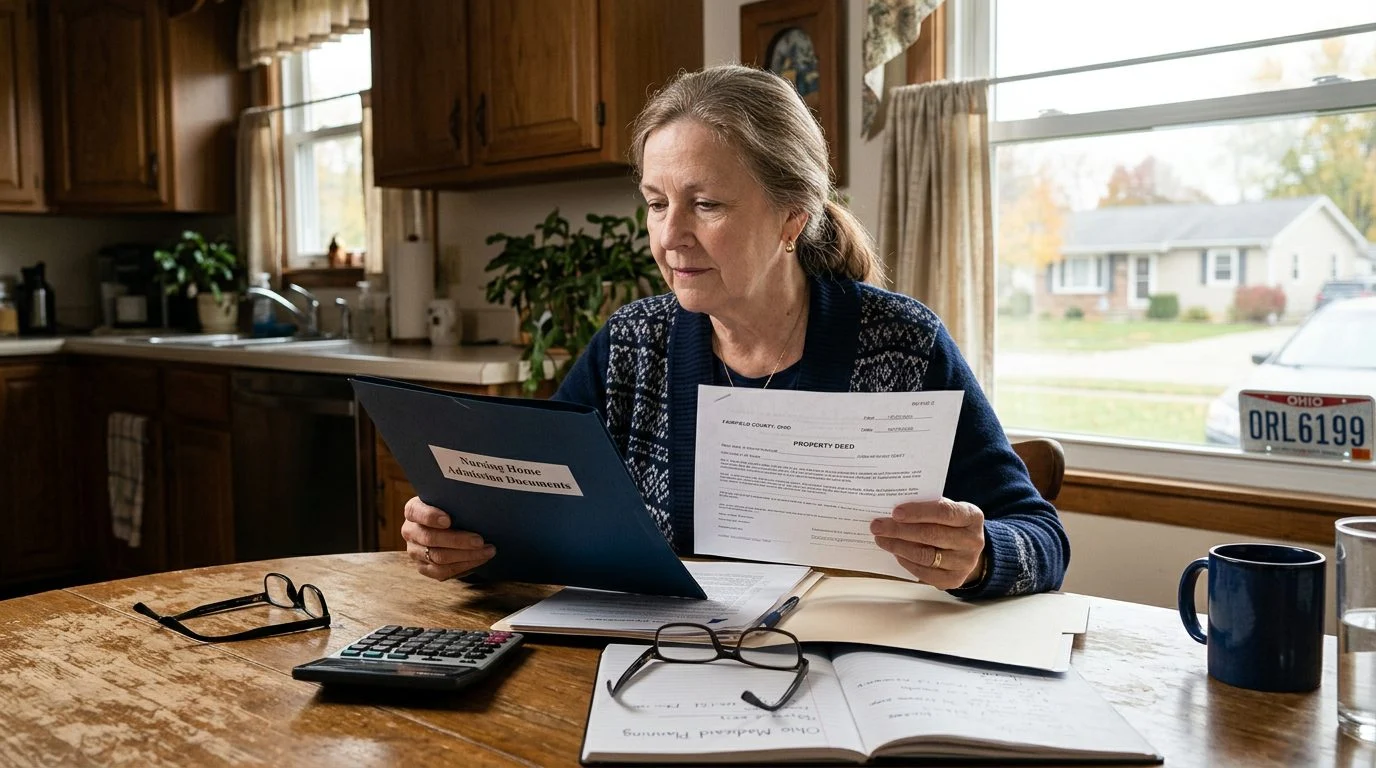
For example, imagine a daughter named Carla in Mansfield. Her father, Walt, moved into a nursing home after a slow decline at home, and she has been paying his bills from her kitchen table. She feared the house he had worked for would be sold to pay for his care, and her brother, who lives out of state, disagreed about what came next. A planning conversation helped Carla see her options and gave her father’s wishes a written home. Every family’s facts are different, so results will vary with each family’s own circumstances.

How Ohio Medicaid Can Help Pay for Your Parent’s Care
Ohio Medicaid can help pay for nursing home care, which is the setting your parent is already in. The state’s nursing facility payment rules count your parent’s income and personal needs allowance when working out what your parent pays toward care. Ohio Medicaid can also help pay for many, though not all, assisted living and memory care settings, and for care at home.
Staying home longer is possible for some families, and a move later can remain an option. That means your family does not have to decide everything at once.
Here is what planning looks like for a parent already in care. We review your parent’s income, savings and paperwork, so you know what Medicaid will ask for before anyone fills out a form. Our Care Navigators can also help you find your way through a complicated health care system when care decisions get hard. They help with care, not legal advice.
What Happens to Your Parent’s Bank Accounts and Savings
Every family’s savings and other assets are different, and we look at them with you before any decisions are made. Medicaid also looks back at what has already been moved, so your family needs a clear picture before anyone applies.
The look-back date is sixty months (five years) before the baseline date, which for a person already eligible for medical assistance when first institutionalized is the first date of institutionalization (Ohio Adm.Code 5160:1-6-06).
Transfers deserve special care. If an institutionalized person or spouse disposes of assets for less than fair market value on or after the look-back date, that transfer is presumed improper and results in a restricted Medicaid coverage period (RMCP) (Ohio Adm.Code 5160:1-6-06). A transfer can sometimes be explained, but that takes written proof.
The presumption of an improper transfer can be rebutted: the person, the spouse, or someone acting for them may show the agency that the asset was transferred for fair market value or other valuable consideration, or exclusively for a purpose other than to qualify for medical assistance, and must provide a written explanation with supporting documentation (Ohio Adm.Code 5160:1-6-06).
Planning done well before care can often shield some assets from the spend-down, because transfers made more than sixty months (five years) before the individual’s baseline date fall outside the look-back date. Options can remain well before everything is spent, though what fits your family depends on its own facts. Joint bank accounts raise their own questions, so bring every statement to your discovery call.
The Family Home, Estate Recovery and Ohio’s Home Equity Limit
The family home is often one of the most important assets to plan around. For 2026, Ohio’s home equity limit is $752,000, and it rises every January. That limit is one of the first things we review with a family, because it shapes what happens to the house.
The Ohio attorney general will seek recovery from the estate of a permanently institutionalized individual of any age for all Medicaid benefits correctly paid, but only after the death of the individual’s surviving spouse, if any, and only when the individual has no surviving child who is under age twenty-one or is blind or permanently and totally disabled (Ohio Adm.Code 5160:1-2-07).
What this means for the house varies with who lives there and how the home is titled. If a surviving spouse still lives in your parent’s home, Ohio’s estate recovery rules have specific protections for that home, and how they apply to your family is something we will walk through with you.
Probate can be expensive, drawn-out and stressful for a grieving family, and careful planning can often help a family avoid it. Avoiding probate does not by itself protect a home or savings from Ohio’s estate recovery, because that process can also reach assets that pass outside probate, such as jointly owned property and assets held in a living trust.
The Documents to Put in Place Now
Without the right documents, you may not be able to act for your parent in an emergency. That is why a financial power of attorney matters now. In our plans, a strong financial power of attorney is one of the key tools we use to protect a family’s assets. Our plans include:
- a general durable power of attorney for finances
- a health care power of attorney
- a living will
- a HIPAA release
In our plans, the health care power of attorney and the living will are the documents that say how your parent wants medical decisions made. The financial power of attorney and the HIPAA release are also part of our plans, each doing a different job.
Siblings often disagree when a parent’s wishes are unclear. A written plan gives brothers and sisters the same starting point. A family talk with your parent, before anything is signed, can ease those arguments. Our team works with your parent’s wishes in mind and walks your family through each document before a crisis arrives.
How Jarvis Law Office Helps, Step by Step
Jarvis Law Office concentrates its practice in elder law, Medicaid planning and estate planning. We serve families throughout Ohio from offices in Lancaster, Dublin and St. Clairsville. Our first step is a free discovery call, which is confidential and carries no obligation to continue.
After we understand your parent’s situation, our team and your family meet to choose a plan that fits your parent’s wishes and your family’s finances. We then set up the plan documents for your parent. Next, we fund and coordinate the assets to match the plan, which takes more than paperwork. Where care is paid through Medicaid, we prepare the Medicaid application step by step. Our guidance continues as your parent’s needs and the rules change.
We work on a flat fee, with no recurring insurance-style fees. When the plan is set up and funded correctly, your family is in a better position to avoid probate later.

Common Questions About Medicaid Planning for a Parent in a Nursing Home
Is it too late if my parent is already in a nursing home?
No. Options can often remain, and a parent may still qualify for Medicaid-paid care well before spending everything.
What happens to my parent’s bank account in a nursing home?
Medicaid reviews your parent’s assets. Planning looks at what can be protected and what must be spent.
Can I move money to my children now?
If an institutionalized person or spouse disposes of assets for less than fair market value on or after the look-back date, that transfer is presumed improper and results in a restricted Medicaid coverage period (RMCP). Talk with us before any transfer is made.
Can I act for my parent without a power of attorney?
Planning works best when the right documents are in place. That is why a financial power of attorney matters now.
Do I have to pay the nursing home bill myself?
Your parent’s own income and assets come first in the plan. We walk you through what the facility may ask of you.
If you want to see what planning could look like for your family, book a free discovery call with Jarvis Law Office.
How Jarvis Law Office Helps Your Family
We Start by Listening
Every family's situation is different. We begin with your parent's care, your home and your savings, so the plan fits your real life.
We Put the Plan in Writing
Once you choose a direction, we prepare the documents your family needs and explain each one in plain words.
We Keep Track of the Details
Staying on top of the rules and the deadlines is our job. We follow each step so you can focus on your parent.
Care Navigators Are Available
When your family needs help with the health care system, our Care Navigators can guide you through it on your parent's behalf. They do not give legal advice.
Pause Before You Move Money
Before you move money, retitle property or sign new papers for your parent, talk with us first. Some moves can change what planning options remain, and we can walk through them with you.
Where Your Family Can Begin
Gather What You Have
Collect your parent's bills, account statements, insurance papers and any existing estate documents. A rough pile is fine.
Tell Us About the Care
Share the facility, the monthly costs and your parent's wishes for the future. Each detail helps us see the options.
Meet for a Free Discovery Call
The first discovery call is free, confidential and carries no obligation to continue. It is a chance to ask questions and see if we are a good fit.
Plan Step by Step
Together we choose a plan, set up the documents and coordinate your parent's accounts, with ongoing guidance as needs change.