
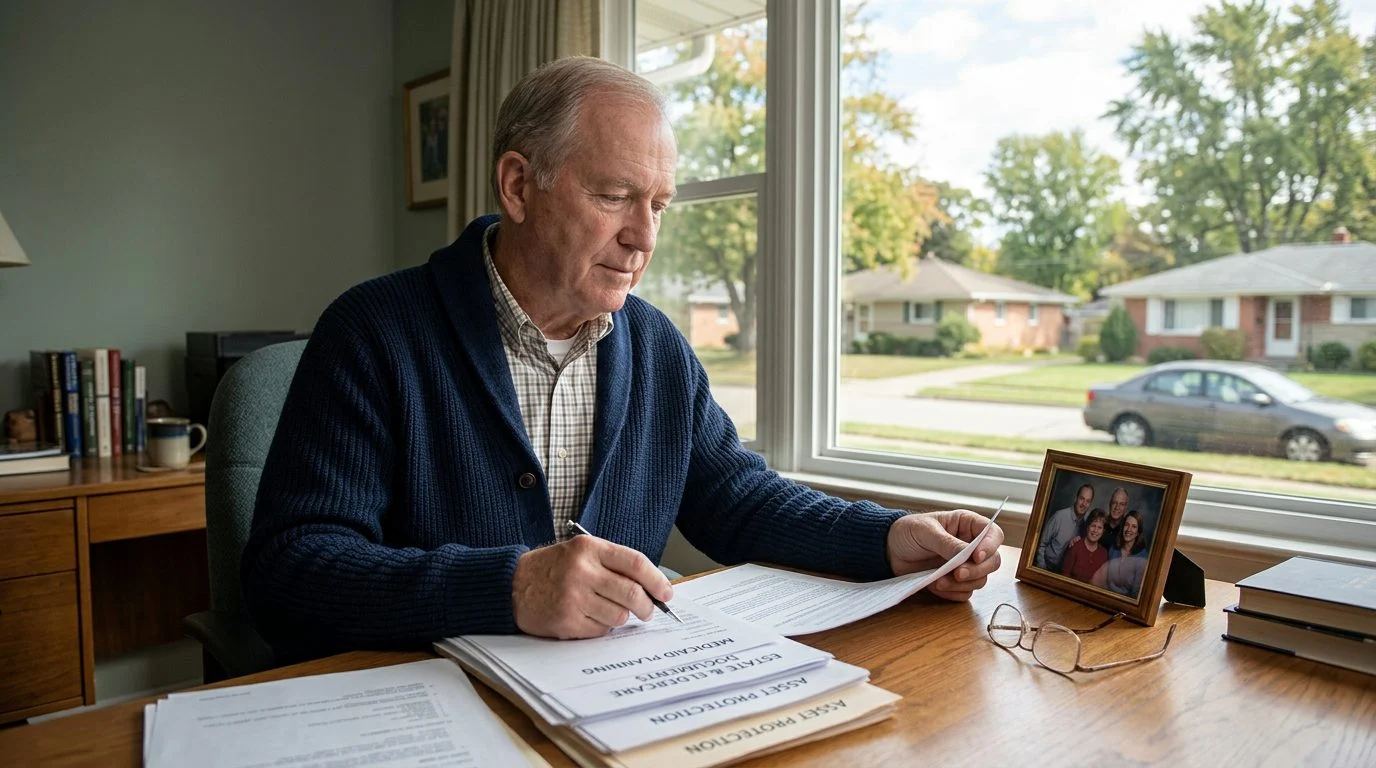
Ohio Medicaid planning for married couples
Keep Your Home When One Spouse Needs Care
A calm, step-by-step plan for the spouse who stays home, guided by the Jarvis Law Office team from the first conversation onward.
Where we are
3
Ohio offices: Lancaster, Dublin and St. Clairsville
Every county
We serve families across Ohio
By Timothy Jarvis · Published November 22, 2026
Ohio Medicaid: How Couples Keep the House When One Needs Care
If your spouse may need nursing home care, you may be asking whether you can keep the house and savings you have worked for. In many Ohio marriages, the spouse who stays home can often keep the home and part of the savings when planning is in place. Here is how a couple keeps the house on Medicaid in Ohio, explained step by step.
If your spouse may need care soon, you don't have to sort out the house and savings alone, so our team invites you to a free discovery call. Talk it through with Jarvis Law Office — the first discovery call is free, confidential, and carries no obligation.

What happens to your house when only one of you needs care
Often the house can stay with the spouse who lives at home, when the couple plans before care starts. The worry is understandable. If you own your home and have saved what you could, you may be hoping to leave something to your children. Then one of you needs round-the-clock care, and the bills start to feel like they could swallow everything. The Administration for Community Living reports that almost 70 percent of people turning 65 are likely to need some long-term care, so planning ahead can make sense whatever your health is today.
For example, imagine a couple, Ray and Linda Hostetler, in Newark, both in good health, who simply want a plan in place before either of them ever needs care. Ray and Linda want to stay in their paid-off house and leave their savings to their children, and they want to understand their options while both of them are still well. When they sit down with an attorney, they begin to see choices they did not know they had. Every family’s facts are different, so the Hostetlers’ path says little about yours.
What the spouse at home can keep in Ohio
Knowing how your savings are counted comes first, and that starts with the share that stays with the spouse at home. The spouse who stays at home may keep a certain amount of the couple’s combined countable resources, called the community spouse resource allowance (Ohio Adm.Code 5160:1-6-04). Planners often call this protected share the community spouse resource allowance.
The home gets its own set of rules. The home equity limit does not apply when the individual’s spouse is lawfully living in the home (Ohio Adm.Code 5160:1-6-02.1). For 2026, Ohio’s home equity limit is $752,000, and it rises every January. Because that figure changes each year, we check the current number for every plan we prepare.
For 2026, the federal maximum community spouse resource standard is $162,660, according to the CMS informational bulletin. Your own protected amount depends on your combined savings and income, so we work it out with you rather than guess. With planning, the spouse at home can often stay in the home, financially secure, with quality of life intact.
The five-year look-back and why timing matters
What you do with the house and savings, and when you do it, matters a great deal. Transfers of assets for less than fair market value made on or after the look-back date, which is sixty months (five years) before the baseline date, are presumed improper (Ohio Adm.Code 5160:1-6-06).
Medicaid can look at the reason behind a transfer, and financial records help explain it. That is why gifts of the house or savings to children are a decision to review with us first, before anything is signed or moved.
Planning done early, before care is needed, often gives a family more choices, and we can talk through what that might mean for your situation. Options usually remain well before everything is spent.
Some couples also look at partnership long-term care insurance.
Estate recovery and what happens to the house later
Ohio may seek estate recovery only after the death of the individual’s surviving spouse, if there is one (Ohio Adm.Code 5160:1-2-07).
This is why the second death is often when families first face estate recovery, and when the house may pass to the children. Planning looks ahead to that moment. How the house is titled and what your documents say can often shape how the home passes to your children, and we review both with you.
Probate is the court process for settling a person’s estate. It is often expensive, slow and stressful for a grieving family. A plan set up and funded correctly, with the right documents and assets titled to match, can help a family skip probate.
Where Ohio Medicaid can help pay for care
Ohio Medicaid can help pay for nursing home care, many (but not all) assisted living and memory care settings, and care at home. Which setting fits depends on your spouse’s needs and on what your family wants.
The Ohio PASSPORT waiver offers home- and community-based services, including adult day care and respite. It starts with a screening. Staying home longer is often possible, and most families prefer it. A move to a care setting later stays an option, so you do not have to decide everything at once.
Our Care Navigators can also help your family find a way through a fragmented health care system when you need that help. They are not lawyers and do not give legal advice. The legal planning stays with our attorneys.
Not sure what your next step is?
Talk it through with Jarvis Law Office — the first discovery call is free, confidential, and carries no obligation.
What a plan includes: documents and how the assets are set up
Every plan we prepare includes the same core documents, and the home and accounts must be set up to match them.
- A general durable power of attorney for finances
- A health care power of attorney
- A living will
- A HIPAA release
In our plans, a strong financial power of attorney is a key tool for protecting a couple’s assets. It matters most if one spouse can no longer manage money. The health care power of attorney and the living will cover medical choices, while the HIPAA release lets the people you name see your health information.
Documents alone are not enough. The house, bank accounts and other assets need to be titled and coordinated with the plan, and that step is what makes the planning work. It is detailed work, and it is one of the steps we handle for you.
Questions couples ask before they decide
Couples usually start with the house, and the answers depend on how the home and savings are set up.
Will the state take our home?
Planning can often keep the home in your hands while your spouse lives in it. Estate recovery is the main risk to plan for later.
Do we have to spend all our savings first?
Not always. The spouse who stays at home may keep a certain amount of the couple’s combined countable resources, called the community spouse resource allowance. Your protected amount is worked out with us, not guessed at.
Can we just give the house to the children?
Transfers get a close look. Transfers of assets for less than fair market value made on or after the look-back date, which is sixty months (five years) before the baseline date, are presumed improper. So this is a decision to make with us first, not alone.
Is it too late if one of us already needs care?
Often not. Options usually remain, and a significant part of the savings can often still be protected.
How the process works and how Jarvis Law Office helps
Our work moves through six steps, from the first call to ongoing help, and you do not have to work out the rules alone. The first step is a free discovery call, which is confidential and comes with no obligation to continue. We listen to your family’s situation, then meet to choose a plan that fits your goals. Next, we prepare the documents and coordinate the house and accounts to match. If care is needed, we handle the Medicaid application, and we stay with you as needs change.
We act as a trusted guide through each step. Our fee is a flat fee, with no recurring insurance-style fees. Jarvis Law Office concentrates its practice in elder law, Medicaid planning and estate planning. We have offices in Lancaster, Dublin and St. Clairsville, and we serve families in every Ohio county.

A next step for your household
You can start with one conversation about your own house and savings. You may be reading this because you are thinking ahead about long-term care and what it could mean for the home and savings you hope to pass on. A decision about the house can wait until you have a clear picture, and you don’t have to build that picture alone.
Take the first step by booking a free discovery call. Bring your questions about the house, the savings and your spouse’s care, and we will talk through your options with you. You want what you have built to be protected and to reach your children, and that is a good place to begin.
What couples often work through with us
Keeping the home
Many couples worry the house will be sold to pay for a nursing home. We look at how the home can stay in your family's hands.
The spouse at home
The spouse who stays home carries the bills, the daily worries and the caregiving. We look at what planning can do to keep that spouse secure.
Planning before the crisis
Questions are easier to answer before a hospital stay or a move to a care setting sets the timeline. A conversation now lets us look at your choices together.
Step by step, with us
You do not have to sort out the rules alone. Our team guides you through each decision, and our Care Navigators can help with the health care system when you need that help.
Why families choose to plan with us
Your home and savings in view
We review what you own, how it is titled and what would happen to it, so the plan fits your household.
Your spouse's quality of life
Planning can address how the at-home spouse stays financially steady and able to live well in familiar surroundings.
The right documents in place
Our plans include a general durable financial power of attorney, a health care power of attorney, a living will and a HIPAA release, all set up with you.
A flat fee, explained up front
You will know the fee before you commit, with no recurring insurance-style charges.
Don't wait for a crisis to ask
Medicaid rules are detailed, and the choices that matter most are often made before care begins. Talking with us early gives you more room to decide what you want.