
Elder law and planning in Ohio
Start the Nursing Home Cost Conversation Before It Becomes Urgent
An early, calm talk gives your parents room to choose how they want to be cared for, and gives your family time to plan together.
By Timothy Jarvis · Published November 20, 2026
If your parent is getting older, you may already wonder what care would cost and who would pay for it. The right time to talk to your parent about nursing home costs in Ohio is before a hospital stay or a new diagnosis forces the decision.
Start with your parent’s wishes, in a calm setting, and save the money questions for a later talk. You don’t have to work out the rules alone. Our team at Jarvis Law Office guides families step by step.
Why talking before a crisis changes the conversation
Talking early gives your parent a real voice in choices that otherwise get made in a hurry.
When a parent ends up in the emergency room, decisions come fast, and the people in the room may not know what your parent wants. A calm talk ahead of time lets your parent say where they want to live, what help they would welcome, and how they want money handled.
Families planning ahead usually want the same things: a parent’s wishes honored, the home and savings protected, good care when it is needed, fewer costly mistakes, and less weight on one son or daughter. Those goals give your conversation a shared direction.
Staying on top of Ohio’s care and benefit rules is part of the work a planning firm does. That job belongs to us, so you can spend your energy on your parent.
If your parent is slipping at home or a care bill has just arrived, you do not have to face it alone, and a free discovery call is a calm place to start. Talk it through with Jarvis Law Office — the first discovery call is free, confidential, and carries no obligation.

For example, imagine a daughter and her father in a small Ohio town
A calm early talk can turn a frightening bill into a shared plan.
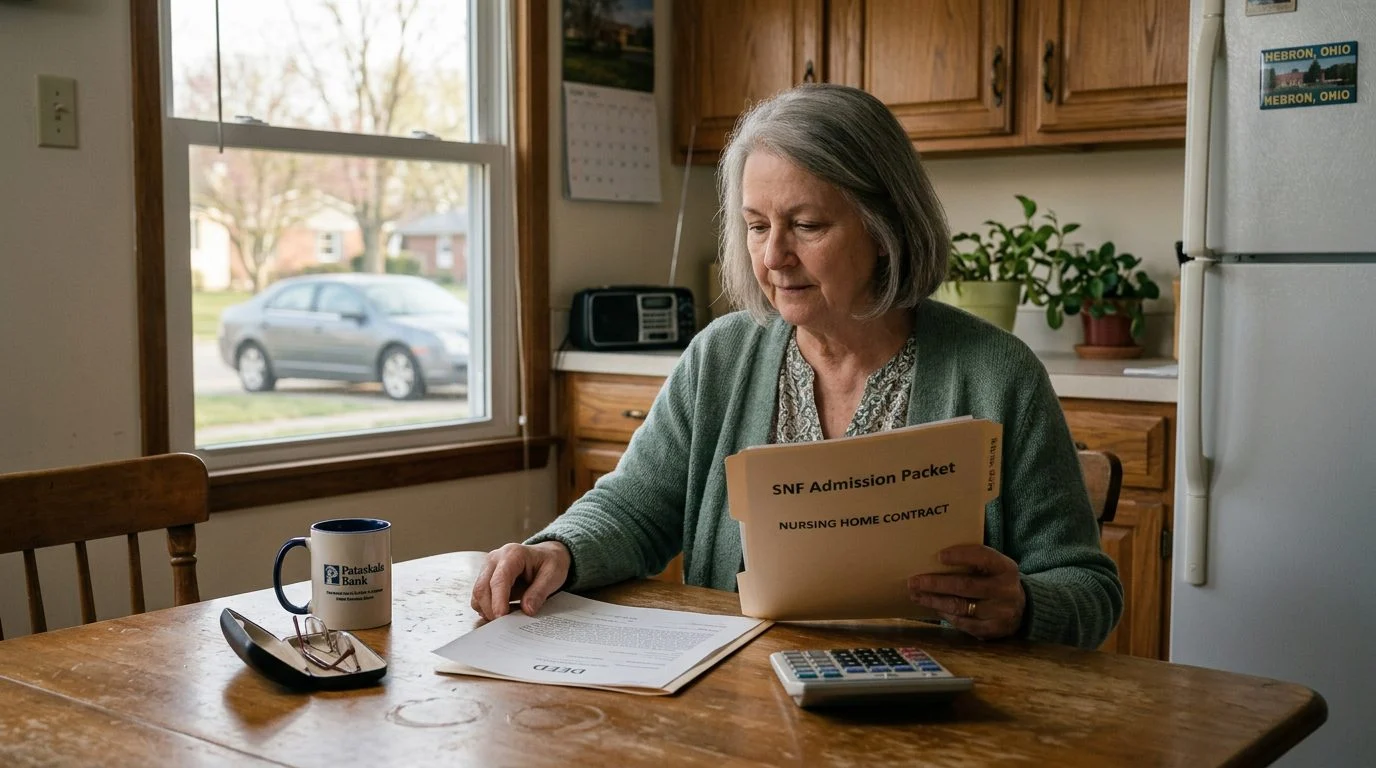
For example, imagine Karen, who lives about an hour from her widowed father, Walt, in a small town in Perry County. She noticed unpaid bills piling up on his kitchen table and a stove burner left on twice. Karen feared a nursing home bill could drain the family’s savings, and she dreaded that raising money would make Walt shut down. Her brother lived out of state and had strong views about the house. Instead of waiting for a call from the hospital, Karen asked Walt what he wanted, wrote down his answers, and set a second talk for the next month. Every family’s facts are different, and results vary with each family’s own situation.
The lesson is the order of things. The talk came first, and the decisions followed.
Who pays for nursing home care, and where Ohio Medicaid can help
Families usually pay for nursing home care from income and savings first, and Ohio Medicaid can help pay for care later.
You can read the details on Medicare skilled nursing facility coverage.
Ohio Medicaid can help pay for nursing home care, and for many (not all) assisted living and memory care settings and for care at home. Program details are explained in Ohio Medicaid support for community living.
Staying home longer is possible, and most families prefer it. A move to a facility later remains an option, so you don’t have to decide everything at once.
If the health care system feels like a maze, our Care Navigators can guide your family through it, step by step, whenever you need that help. Our Care Navigators can also help your family find a way through the health care system when you need that help. They are not lawyers and do not give legal advice.
How to start the conversation with your parent
Start with your parent’s wishes, in a calm place away from a hospital bed or a stack of bills.
Open with questions instead of prices. Ask where your parent wants to live as they age, what help they would welcome, what they have already set aside, and who they trust to help. Then listen more than you talk.
Listen for fear and pride. A parent who says “I’m fine” may be afraid of losing independence. A parent who waves off money talk may feel embarrassed. Name what you heard, and let them correct you.
Expect some resistance, because it is normal. If the talk stalls, a neutral third person can help. One of our Care Navigators can take on the care side of the conversation.
Write down the answers and agree on when you will talk again. You don’t need to settle everything in one sitting.
If you notice money moving in ways your parent cannot explain, the Ohio Attorney General’s seniors resources explain how to report concerns.
The documents to ask about, and why a strong financial power of attorney matters
Ask whether your parent already has a financial power of attorney, a health care power of attorney, a living will and a HIPAA release.
Every plan our firm prepares includes these four documents, so they are the right place to start. In our plans, we include a health care power of attorney, one of the documents we prepare with every family. A living will records their wishes about end-of-life care.
In our plans, a strong financial power of attorney is a key tool for protecting assets. It lets a trusted person manage money if your parent can no longer do it alone, and it is one of the tools our planning uses to protect the family’s savings.
Keep it practical. Ask where the papers are kept, whether the people named still fit, and whether anyone has seen them recently. Old choices can go stale after a move, a death or a falling out.
What planning can look like for your parent and a spouse at home
Planning started early can often protect more of a family’s home and savings, though the right path depends on your parent’s facts.
Medicaid looks back at certain transfers made before care begins, and that look-back is why timing matters.
A sale or gift made for less than full value by that person or their spouse in the five years before the baseline date can lead to a restricted Medicaid coverage period (Ohio Adm.Code 5160:1-6-06). There are some exceptions, such as a transfer your parent can show was made exclusively for a reason other than qualifying for Medicaid, and we walk through those details with you.
For many families, the real question is how much time is left to plan well.
Options often remain well before everything is spent.
For a married parent, planning can often keep the spouse at home financially secure and the quality of life intact. Transfers between spouses are treated differently from other gifts.
Transfers of assets between the institutionalized person and their spouse, or to another person for the sole benefit of that spouse, are not considered improper (Ohio Adm.Code 5160:1-6-06).
Transferring the home to an adult child is one of several exceptions the rule recognizes. One route applies when the child provided care that let the parent live at home instead of in a facility, lived in the home for at least two years immediately before and continuously since the parent became institutionalized, and submitted a notarized ODM 10271 Affidavit of Child Caregiver and the ODM 10272 Physician Certification or an equivalent written statement from the attending physician (Ohio Adm.Code 5160:1-6-06).
Which path fits your parent depends on the facts, and we review those facts with you.
Not sure what your next step is?
Talk it through with Jarvis Law Office — the first discovery call is free, confidential, and carries no obligation.
Keeping probate out of your family’s future
Probate is the court process for settling a person’s estate after death, and it can be expensive, slow and stressful for a grieving family.
Careful planning can help a family skip probate later. The goal is a plan set up and funded correctly, with the right documents and assets titled to match it.
In our planning, paperwork is only part of the job. We coordinate how the home and accounts are titled so they line up with the plan, which can help keep your family out of probate.

How Jarvis Law Office helps, and the next step
We help your family one step at a time, starting with a conversation about your parent’s situation.
First, we learn your parent’s circumstances and what matters most to them. Next, we meet to choose a plan together. Then we set up the documents, coordinate the assets so they match the plan, and stay with you as needs change.
Our practice focuses on elder law, Medicaid planning and estate planning. We serve families in every Ohio county from our offices in Lancaster, Dublin and St. Clairsville.
Our plans carry a flat fee, with no recurring insurance-style charges. Our free discovery call is confidential and carries no obligation to continue.
If your parent is slipping at home or a care bill has just arrived, you do not have to face it alone. Book your free discovery call and we will start with your parent’s situation.
Frequently asked questions
How far back does Medicaid look at transfers?
Giving away assets for less than fair market value by the person or their spouse within the sixty months (five years) before the baseline date is presumed improper and results in a restricted Medicaid coverage period (RMCP). Timing is why an early talk matters.
Does Ohio Medicaid pay for assisted living?
Ohio Medicaid can help pay for many assisted living and memory care settings, though not all of them. The specific setting matters, so ask about it early.
When should my family start planning?
Start before a hospital stay or diagnosis forces the decision, and revisit the plan as needs change.
What a planning conversation can cover
Your parent's wishes
Where they want to live, what kind of care they would welcome, and what matters most to them if their health changes.
The home and the savings
How the house, bank accounts and other assets are titled today, and what a family may want to protect if care is needed later.
The documents already in place
Whether a financial power of attorney, a health care power of attorney, a living will and a HIPAA release are ready, and who would act if your parent could not.
The whole family's roles
Who will help with decisions, who can manage the day-to-day, and how siblings can share the work without carrying it alone.
You do not have to figure this out alone
Costs, care settings and paperwork can feel overwhelming, especially in the middle of a health change. Our team walks families through each step, and our Care Navigators can help your family find their way through the health care system when that support is needed.
Ways to open the conversation gently
Choose a calm moment
Pick a time away from a hospital visit or a bill that just arrived, when your parent can talk without pressure.
Ask questions before offering answers
Ask what care would look like for them, what they fear most, and what they hope for, then listen before you suggest a plan.
Gather what is already on paper
Bring together the deeds, account statements and any existing documents so the next conversation starts from facts.
Bring in guidance early
A conversation with our team can turn family worries into clear options, so decisions are made with time and information instead of in a crisis.
Take the first step together. Our first step is a free discovery call, which is confidential and carries no obligation to continue.
Related practice areas
- Medicaid Planning in Ohio
- Medicaid Planning in Fairfield County
- Ohio Medicaid Planning When the Spouse at Home Is Also Sick