
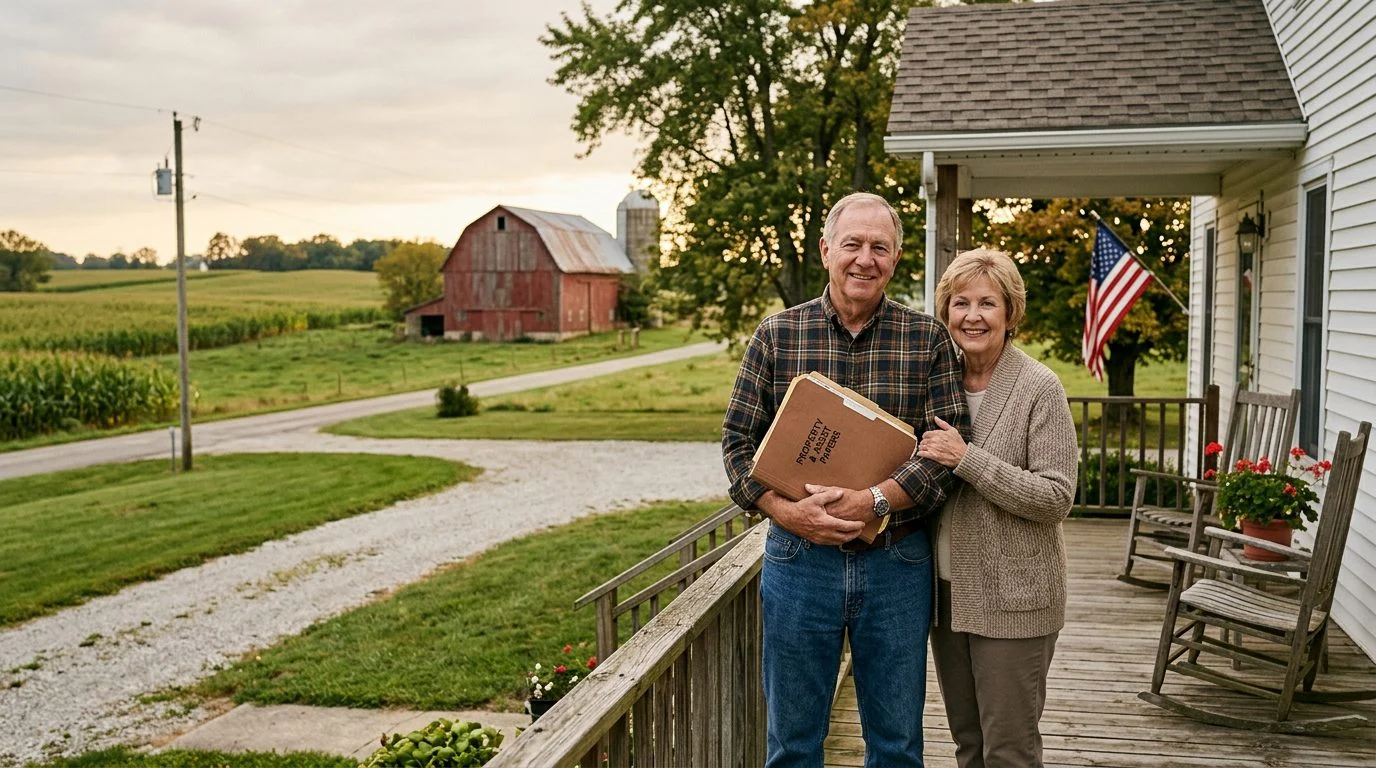
Farm asset protection in Ohio
Keep the Family Farm in the Family: A Clear Review of Your Land and Assets
Land often carries a lifetime of work, and it can be hard to decide what to do with it. We help Ohio farm families sort out their options one step at a time.
By Timothy Jarvis · Published November 25, 2026
If your home and a parcel of family land are most of what you own, you may wonder whether a nursing home bill could take both. A farm property asset protection review in Ohio is a careful look at how your home, land and savings would be treated if one of you needed long-term care, while you still have choices. Careful planning can often protect a meaningful part of what you have built, and you don’t have to work out these rules alone.
What a farm property asset protection review is, and who it’s for
A farm property asset protection review is a plain, step-by-step look at what you own and what would happen if one spouse needed long-term care. It covers the house, each parcel of land, your savings and the documents you already have. It’s meant for married couples in or near retirement and for parents who want their land kept in the family.
For example, imagine Walt and Joan Riddle, who farm about sixty acres outside Logan in Hocking County. When Walt’s memory began to slip, Joan could no longer manage his care at home. She feared the nursing home bills would reach the farmhouse and the land his grandfather worked. A review helped them see their options before any decision was forced on them. Every family’s facts are different, so the Riddles are only an illustration.
Jarvis Law Office focuses on elder law, Medicaid planning and estate planning. We serve families in every Ohio county from our offices in Lancaster, Dublin and St. Clairsville.
If you're worried that nursing home costs could reach the home and land you want to leave your children, we invite you to book a free discovery call with our team. Talk it through with Jarvis Law Office — the first discovery call is free, confidential, and carries no obligation.
Why the land can be at risk when one spouse needs nursing home care
The main risk is that nursing home bills draw down your savings and then reach your property.
Once the institutionalized spouse is determined eligible for medical assistance, no resources of the community spouse are considered available to the institutionalized spouse, for as long as eligibility continues without a break in coverage (Ohio Adm.Code 5160:1-6-04).
For 2026, the federal maximum community spouse resource standard is $162,660, according to CMS guidance on 2026 Medicaid standards.
Ohio Medicaid can help pay for nursing home care, many (though not all) assisted living and memory care settings, and care at home. Staying home longer is possible, and most families prefer it. A move later stays an option.
Timing matters. Ohio presumes that a transfer of assets for less than fair market value made on or after the look-back date is an improper transfer, and the look-back date is sixty months (five years) before the individual’s baseline date (Ohio Adm.Code 5160:1-6-06). A transfer made close to care can change the picture, so we review every transfer before anything is signed.
Ownership matters after a death, too. Ohio’s Attorney General seeks recovery from the estate of a permanently institutionalized individual of any age for Medicaid benefits correctly paid, but only after the death of the individual’s surviving spouse, if any, and only when the individual has no surviving child who is under age twenty-one or is blind or permanently and totally disabled (Ohio Adm.Code 5160:1-2-07). How the land is titled shapes who could be exposed, which is why titling is part of the review.
When a home is part of the picture, the home equity limit matters. For 2026, Ohio’s home equity limit is $752,000, and it rises every January.
Estate planning may shield some assets from estate recovery, and an undue hardship waiver is decided case by case, based on the family’s actual circumstances. After a person’s death, the Ohio Attorney General may mail notice of an estate recovery claim. An heir or potential heir who would suffer undue hardship, or a person with an interest in the estate’s assets, or their representative, can then ask for an undue hardship waiver, but only within thirty calendar days of that notice. Whether a request is granted depends on the facts of each one. A spouse at home can often stay in the home, financially secure and with quality of life intact. What fits your family depends on your facts.
What the review examines in your home, your land and your savings
The review looks at how each asset is owned, what it’s worth to your plan, and which documents are missing.
- Titles. Whether the house and each parcel are held in one name, both names or another way changes what happens next.
- The land. Whether it’s one parcel or several, and how the acreage and buildings bear on its value and use.
- Savings and beneficiary forms. Bank and retirement accounts with named beneficiaries can pass outside a will, so they belong in the picture.
- Probate exposure. Whether the land would pass under a will into probate, and what your children would have to handle.
- Documents. Whether you have a will, and the documents in every plan we prepare: a general durable power of attorney for finances, a health care power of attorney, a living will and a HIPAA release.
Keeping the land in the family and out of probate
Careful planning can help your family skip probate, a court process that can be expensive, slow and stressful for relatives who are grieving. A plan set up and funded correctly, with the right documents and assets titled to match, is what makes that possible. Getting that right is our part, and it takes more than paperwork. The deed, the beneficiary forms and the plan have to line up.
In our plans, a strong financial power of attorney is a key tool for protecting a family’s assets. In our plans, we include a general durable power of attorney for finances, and we will walk you through choosing the person you would want in that role.
Helping your children avoid disputes over the land
A written plan that says who decides what is the surest way to keep land out of a family argument. Many disputes start because no one knows what a parent wanted. Writing your wishes down now lets your children act on them without guessing, and it lightens their load.
When care decisions come up, our Care Navigators can help your family find its way through the health care system on your behalf. They are not lawyers and do not give legal advice, so the legal side stays with our attorneys. You choose when your children join these conversations, and you can bring them in when you’re ready.
How the review works, step by step
The review starts with a free discovery call and moves, in stages, toward a plan you choose.
The free discovery call is confidential, with no obligation to continue. It gives us a chance to hear your situation and what you want for your home and land.
Next comes a fuller conversation about the house, the parcels, your savings and your family. At a strategy meeting, we review what’s exposed and talk through the options, and you choose the plan that fits.
We then prepare the plan documents for you to sign. Your assets are titled and coordinated to match the plan, which is more than paperwork. Timing varies from family to family, and we’ll tell you what to expect as we go.
Last, we stay with you. Ongoing guidance continues as your health and needs change, so the plan keeps pace with your life.
Not sure what your next step is?
Talk it through with Jarvis Law Office — the first discovery call is free, confidential, and carries no obligation.
Common questions and mistakes to avoid
Most questions about farm property come down to timing and how things are titled. Here are questions families often raise.
Will we have to sell the farm to qualify for Medicaid?
Not necessarily. Planning can often protect a meaningful part of the land, and the review shows which tools may fit your family.
Can we give the land to the children now?
Not without a close look first. Ohio presumes that a transfer of assets for less than fair market value made on or after the look-back date is an improper transfer, and the look-back date is sixty months (five years) before the individual’s baseline date.
Can the state come after the land when we die?
Ohio’s Attorney General seeks recovery from the estate of a permanently institutionalized individual of any age for Medicaid benefits correctly paid, but only after the death of the individual’s surviving spouse, if any, and only when the individual has no surviving child who is under age twenty-one or is blind or permanently and totally disabled. Every family’s situation is different, so we walk through how this applies to yours on the call.
What if we wait until one of us needs care?
Options can remain even after care begins, but an early review gives you more choices.
A costly mistake to avoid
Moving a title or signing a transfer before anyone has reviewed how it affects Medicaid and your children is a costly mistake. Ohio’s Attorney General publishes guidance on scams and financial exploitation of seniors, so take your time with anyone who offers a quick fix. See the Ohio Attorney General’s seniors resources.

Start with a free discovery call about your home and land
If you’re worried that nursing home costs could reach the home and land you want to leave your children, you don’t have to sort it out alone. The rules around Medicaid, titles and probate are complicated, and staying on top of them is our job, not yours. We guide families step by step, from the first conversation through the plan and the years after. To take the first step, book a free discovery call and talk through your home, your land and what you want for your children.
Why families bring their farm to us
Protecting what you built
Generations of work went into the land, the buildings and the equipment. We look at how a plan can help keep that work in your family.
Keeping the family together
Farm decisions can strain relationships. We help you think through options openly so everyone understands the plan.
Care for your future
Planning ahead can give you more say in your own care and in how your farm is handled if your health changes.
Clear options, no guesswork
We explain each tool in plain words and show how it might fit your land, your savings and your goals.
Think before you transfer
Giving land or equipment to children or others can seem like a simple fix, but the timing and the way it is done can matter a great deal. Please speak with us before you sign anything or change a deed.
What a farm review looks at
Who will work the land next
We talk through your plans for the farm, whether a child, relative or outside buyer, and what each choice would mean.
The home and buildings
We look at how the house, barns and outbuildings are titled and what would happen to them under your current arrangements.
Savings, equipment and income
Equipment, livestock, crop income and bank accounts all count in a plan. We review how they fit together.
Care costs down the road
If long-term care ever becomes needed, we explain how a plan can help protect the farm while your family gets good care.