
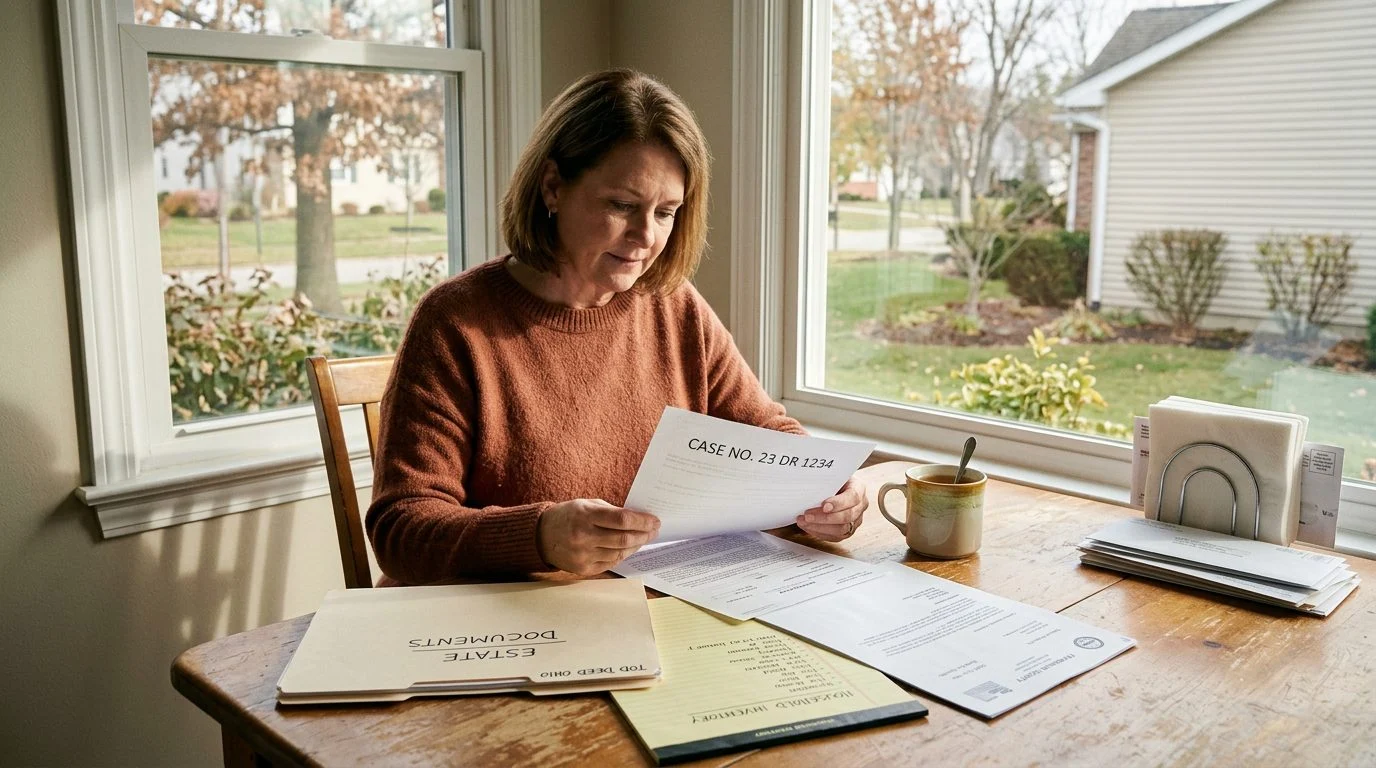
Transfer on Death Deed Ohio: Help Keep Your Home Out of Probate
By Timothy Jarvis · Published November 19, 2026
Transfer on Death Deed Ohio: Home to Children, No Probate
Most people who ask about a transfer on death deed in Ohio already own a home and have some savings. They want those assets to reach their children without a court process. A transfer on death designation affidavit can name who receives your home when you die, and a payable on death account can name who receives your savings. When both are set up correctly and match the rest of your plan, they can help your family avoid probate.
You may have assumed estate planning is for wealthier families. For a paid-off home and modest savings, a few well-placed steps often matter most.

Why a modest estate still benefits from planning
Planning helps a modest estate because probate is a court process that any family can face. Probate is the court-supervised way an estate is settled. It can be slow and costly, and it arrives when a family is grieving.
You likely want your children and grandchild to receive what you built, not wait on paperwork. Planning is how that goal gets served.
For example, imagine a couple, Ray and Lorraine Hale, who own a paid-off home in a small Perry County town. When Ray died without a plan, their two children waited many months for the court to finish the estate, and they paid bills from the savings their parents had hoped to leave them. Lorraine had feared exactly that. With the right designations and documents in place beforehand, the children might have skipped that court step. Every family’s facts are different, so this is only one way it can go.
What a transfer on death deed is
In Ohio, what many people call a transfer on death deed is a transfer on death designation affidavit. It is a notarized document that names who receives your home when you die. You may hear either name, but the document you sign is the affidavit.
A transfer on death affidavit for your home only works if it is recorded with the county recorder before the owner dies (R.C. 5302.22).
Naming a transfer on death beneficiary does not change who owns the home now, and a person designated as a transfer on death beneficiary has no interest in the home until the owner dies (R.C. 5302.23).
You still own the home while you are alive. Many families weigh whether to keep the home, live in it, or sell it, and we talk through those choices with you before anything changes. Ohio Legal Help explains how this tool applies to a home. The designation covers only the real estate, so bank accounts and vehicles need their own steps. A backup name also matters, in case the person you name does not survive you. We walk through the finer details with you on the discovery call.
What a payable on death account is and how it works with the home
A payable on death account names a person to receive your savings when you die. It does not change how you own the money today.
A payable on death account can name a person to receive its money when the owner dies, and that person’s interest does not vest until then (R.C. 2131.10).
Pairing that account with a transfer on death designation for your home can let the house and savings pass to your children together. Each tool covers only its own asset, so the two must work as a team.
Beneficiary names are where many plans go wrong. A name from years ago can send savings to someone you no longer intend to name. Make a simple list of every account and the name on each one, and check it each year. Ask each bank or brokerage how it handles changes, since each institution has its own forms.
Designations help keep assets out of probate only when the whole picture is coordinated. A correct designation on one account cannot fix a gap somewhere else.
How a plan keeps the home and savings out of probate
A plan keeps your home and savings out of probate when the right documents exist and each asset is set up to match them. Four pieces usually carry that work: the home designation, the account designations, a will to catch anything left out, and a durable power of attorney for finances. We include a power of attorney in our plans so that a person you trust can help manage your affairs if you ever need that help.
In every plan we prepare, we include a general durable power of attorney for finances, a health care power of attorney, a living will and a HIPAA release. We treat the financial power of attorney as a key tool for protecting your assets, because it lets a trusted person manage your money if you cannot.
A revocable living trust is a different tool, and it can hold property for a grandchild over time. Whether a trust fits your family depends on your facts, so we compare the options with you rather than choosing for you.
These are possibilities, not promises. The outcome follows from how each plan is built and kept current.
What to expect: the steps from first call to finished plan
Planning with the firm follows six steps, from a first conversation to ongoing guidance as your needs change. The first conversation covers your home, your savings and what you want for your children and grandchild. At a strategy meeting, you and our team choose a plan together. Then we prepare the documents and set up the home designation and account designations to match. These final steps are more than paperwork, because the plan works only when every piece is in place. Ongoing guidance keeps the plan current as your family changes.
The firm charges a flat fee, with no recurring insurance-style fees.
If your children later need help finding their way through the health care system, our Care Navigators can help them. Care Navigators are not lawyers and do not give legal advice.
Common questions and objections, answered
Most families ask whether they can handle this alone, and a form by itself does not finish a plan.
Can we fill out a form ourselves?
You could, but the signing, notary, recording and beneficiary steps have to line up. One mismatch can send the home back toward probate.
Do we have to record the affidavit before one of us dies?
A transfer on death affidavit for your home only works if it is recorded with the county recorder before the owner dies.
Can our children take the house while we are alive?
Naming a transfer on death beneficiary does not change who owns the home now, and the named person has no interest in the home until the owner dies.
We can explain how this applies to your home on the discovery call.
Can we change our minds later?
The owner can revoke or change a named transfer on death beneficiary at any time without that person’s consent, by recording a new affidavit before the owner dies (R.C. 5302.23).
We can walk through how changes are made for your family.
Does adding a child to the deed now solve the problem?
Before any change to the deed, we review with you how it affects ownership, taxes and the rest of your plan. It deserves a careful review first.
How Jarvis Law Office helps couples like you
Jarvis Law Office takes the deeds, designations and beneficiary details off your hands, so you do not have to work them out alone. Staying on top of the rules for your family is the firm’s job. We review your home, your accounts and your goals together, so your children and grandchild are considered in one plan rather than in separate forms.
Jarvis Law Office serves families in every Ohio county from its offices in Lancaster, Dublin and St. Clairsville. Wherever you live in Ohio, the first step is a conversation about what matters to you.

Take the next step toward a plan that spares your children probate
If you want your home and savings to reach your children and grandchild without probate, the next step is a conversation. You may still be deciding whether a modest estate needs a plan at all, and that is a sensible place to be. A free discovery call lets you talk through your home, your accounts and your grandchild’s share with our team. The free discovery call is confidential and carries no obligation to continue. We cannot predict how any particular plan will turn out, but we can show you what planning could look like for your family.