
Medicaid and long-term care planning | Ohio families
Talking With Your Spouse About Nursing Home Costs, Together and Before It Is Urgent
A calm, step-by-step way for couples to share what they fear, what they want and what they can plan for, with a guide beside them.
By Timothy Jarvis · Published November 24, 2026
Many families don’t talk about nursing home costs until a health change forces the question. This guide explains how to talk to spouse about nursing home costs while there is still time to think clearly.
Start with what each person wants, not with paperwork. Then gather income, savings, the home and documents together, and learn how Ohio Medicaid treats a couple when one spouse needs care. You don’t have to work all of this out alone. Keeping up with Medicaid’s rules and yearly figures is part of what Jarvis Law Office does for families every day, step by step.
Why Talk About Nursing Home Costs Before a Crisis?
A calm talk now lets a couple choose together instead of deciding under pressure. A stroke or a fall can change a household in one afternoon. Decisions made in a hospital hallway are hard to make well.
Medicare coverage of nursing home stays is limited, as Medicare.gov explains. So many families need to plan for costs Medicare does not cover.
Starting early gives you both room to ask questions, compare options and bring in help. Nobody has to know every answer on the first night. This page is a practical guide to starting that talk and what it should cover.
If you're planning for a parent or spouse whose health has changed, you don't have to sort out the rules alone. Jarvis Law Office offers a free first discovery call to talk it through. Talk it through with Jarvis Law Office — the first discovery call is free, confidential, and carries no obligation.

Start the Conversation With Your Wishes, Not the Paperwork
Begin by asking what each of you wants if one of you needs help every day. Money matters, but wishes come first. Sit down when neither of you is in a hurry, and take turns asking and listening.
Good questions include:
- If one of you needed daily help, would you want to stay in the home?
- Would you be open to moving to a family member’s home, assisted living, memory care or a nursing home?
- Who would provide the care, and how would each of you feel about that?
- What matters most each day: faith, family, pets, routines or the neighborhood?
Note where you agree and where you differ. Naming differences early gives you time to work through them. Writing down shared wishes helps later, even before any legal step is taken.
Gather the Numbers Together: Income, Savings, the Home and Documents
Make one shared list of income, accounts, property and documents before you meet with anyone about planning. Include every income source, such as pensions and retirement payments. List bank, retirement and investment accounts, the home, vehicles and other property.
Write down whose name each item is in. The name matters. Under Ohio’s community spouse rule, income paid solely in one spouse’s name is considered available only to that spouse, unless the income is from a trust or other instrument establishing ownership otherwise. Income paid in both names, and not also to another person, is considered one-half available to each, unless an instrument shows otherwise. When income is paid in both names and to another person, it is considered available to each spouse in proportion to their interest; when the portion of interest is not specified, then one-half of the joint interest shall be considered available to each spouse.
Then locate your wills, trusts, powers of attorney, health care documents and beneficiary designations. Keep copies where the family can find them. Knowing the numbers is the starting point for any planning talk. You can bring this inventory to a discovery call, and the firm can review it with your family.
How Ohio Medicaid Treats a Couple When One Spouse Needs Care
Ohio Medicaid looks at a couple’s resources differently when one spouse enters a nursing home and the other stays in the community. The spouse in the facility is the institutionalized spouse. The spouse who is not in a medical institution, is not eligible for an HCBS waiver, and is not receiving PACE services is the community spouse, as Ohio’s community spouse rule defines the terms.
That rule totals the couple’s countable resources on the institutionalized spouse’s snapshot date. Either spouse may ask for a state hearing if they believe the amount of resources set aside for the community spouse is not enough to live on.
For 2026, the maximum community spouse resource standard is $162,660, per the CMS guidance on 2026 figures. These are the current year’s figures, and they change from year to year.
The home matters too. For 2026, Ohio’s home equity limit is $752,000, and it rises every January. The limit does not apply when the individual’s spouse is lawfully residing in the home, under Ohio’s home equity rule. The home can also be an excluded resource regardless of value when it is the principal place of residence and the deed is in the name of the individual, the individual’s spouse, or the eligible child’s parent, or the home is deeded to a revocable trust, under Ohio’s home treatment rule.
Keeping up with these rules is part of what the firm does for families every day. You don’t have to track every change on your own.
What the Talk Can Lead To: A Family Example
Planning ahead can show a couple which options may fit their own facts. Imagine a couple, Ruth and Walt, who sit down together while both are still healthy. They list their income and accounts, and they name the documents they already have.
Later, Walt has a stroke and needs nursing home care. Ruth wants to keep the home they have shared. Because they already talked, Ruth is not making every choice in one week. She can ask how the home’s treatment and the spouse-at-home rules apply to her situation.
With planning, Ruth could review income, accounts and the home with a clearer picture. Planning can often help her keep the home, protect savings the couple has built and maintain her quality of life while Walt’s care is arranged, though every family’s situation is different.
Ruth and Walt are an imagined example. Every family’s situation is different, and the outcome depends on its facts.
Options Families Weigh: Care at Home, Assisted Living, Memory Care and Nursing Homes
Most couples compare care at home, assisted living, memory care and nursing home care before choosing one. Care at home keeps a loved one in familiar surroundings. It relies on help from family or paid caregivers.
Assisted living and memory care offer a setting with daily support. Memory care is designed for people living with dementia. A nursing home provides round-the-clock care, and Medicare covers only limited stays.
Residents of nursing homes have rights.
Care decisions also affect money. Talk about both together, because a move to a facility changes income, housing costs and what the community spouse needs. The firm’s Care Navigators can help families find their way through the complicated health care system on your behalf, if and when the time comes. Care Navigators are not lawyers and do not give legal advice.
Not sure what your next step is?
Talk it through with Jarvis Law Office — the first discovery call is free, confidential, and carries no obligation.
Review the Documents You Should Have Before a Crisis
Many couples put a power of attorney and an updated will or trust in place while both are healthy. A power of attorney names someone you trust to handle money or decisions if you cannot. Without one, your family may have fewer options when a health crisis hits.
A will says who receives property at death. A living trust holds property you own and names who receives it. Both should match the wishes you discussed first. Ohio’s estate recovery rules can reach assets held in a living trust, so this document belongs in the planning conversation, as R.C. 5162.21 explains.
Keep health care documents where your family can find them. Reviewing documents is a conversation, not a commitment to any particular plan. You can ask questions and decide later.
Why Timing Matters: The Look-Back and Planning Ahead
Timing matters because Medicaid looks back at gifts and other transfers your spouse made during the years before help is requested, and the date that look-back is counted from depends on the kind of care and on when you apply, which is something we will walk through with you. Under Ohio’s transfer rule, when an institutionalized individual (or his or her spouse) disposes of assets for less than fair market value on or after the look-back date, the transfer is presumed improper. That presumption can lead to a restricted Medicaid coverage period.
The rule lists exceptions. One covers a home transferred to a child who provided care that let the parent live at home and who lived in the home for at least two years before, and continuously since, the parent became institutionalized. That child should be ready to document the care, because the agency may ask for verification of the relationship.
Estate recovery is a second timing issue. How estate recovery applies depends on each family’s facts, and we will walk through how it applies to your situation. The estate can include assets held in joint tenancy or a living trust, under R.C. 5162.21.
Planning early, before care is needed, gives a family more room to choose how to protect their assets. When care is needed now or the full look-back will not pass, families can often still protect a significant part of what the rules say must be spent down, sometimes far more. It is often not too late to look at the options. Planning can help a family qualify for Medicaid-assisted care long before a full spend-down.

Take the Next Step Together
The first step is a calm talk about five things: wishes, numbers, documents, Medicaid rules and timing. Wishes come first, then the numbers and papers.
Can we talk about nursing home costs before one of us needs care?
Yes. Starting while both of you are healthy gives you time to think, ask questions and decide together.
Does the spouse at home lose the house?
Ohio’s home equity limit does not apply when a spouse lawfully lives in the home. The home can also be excluded when it is the principal place of residence.
Does Medicare pay for a long nursing home stay?
Medicare coverage of nursing home stays is limited. Many families plan for the costs it does not cover.
It serves families in Fairfield, Franklin, Licking, Pickaway, Perry and Hocking counties. If your spouse’s health has changed or may change, bring your inventory and questions to our free discovery call, which is confidential and carries no obligation to continue. It is confidential and carries no obligation to continue. Contact the firm to get started.
You do not have to work this out by yourselves
A guide for both of you
We walk you and your spouse through the decisions together, so neither of you has to carry the weight of the planning alone.
Planning that protects what you built
We look at how your home and savings could be protected, and we explain each option in plain words so you can decide what fits your family.
Care Navigators when care is needed
If your family needs help finding its way through the health care system, our Care Navigators can guide you through it on your behalf.
Staying on top of the rules
Ohio's rules change over time. Keeping track of them for you is our job, so you can focus on each other and on the choices in front of you.
Start the conversation before a decision is forced on you
When a nursing home admission arrives suddenly, there is little time to think. Talking now, while you are both able to weigh your choices, gives you room to ask questions and decide what you want.
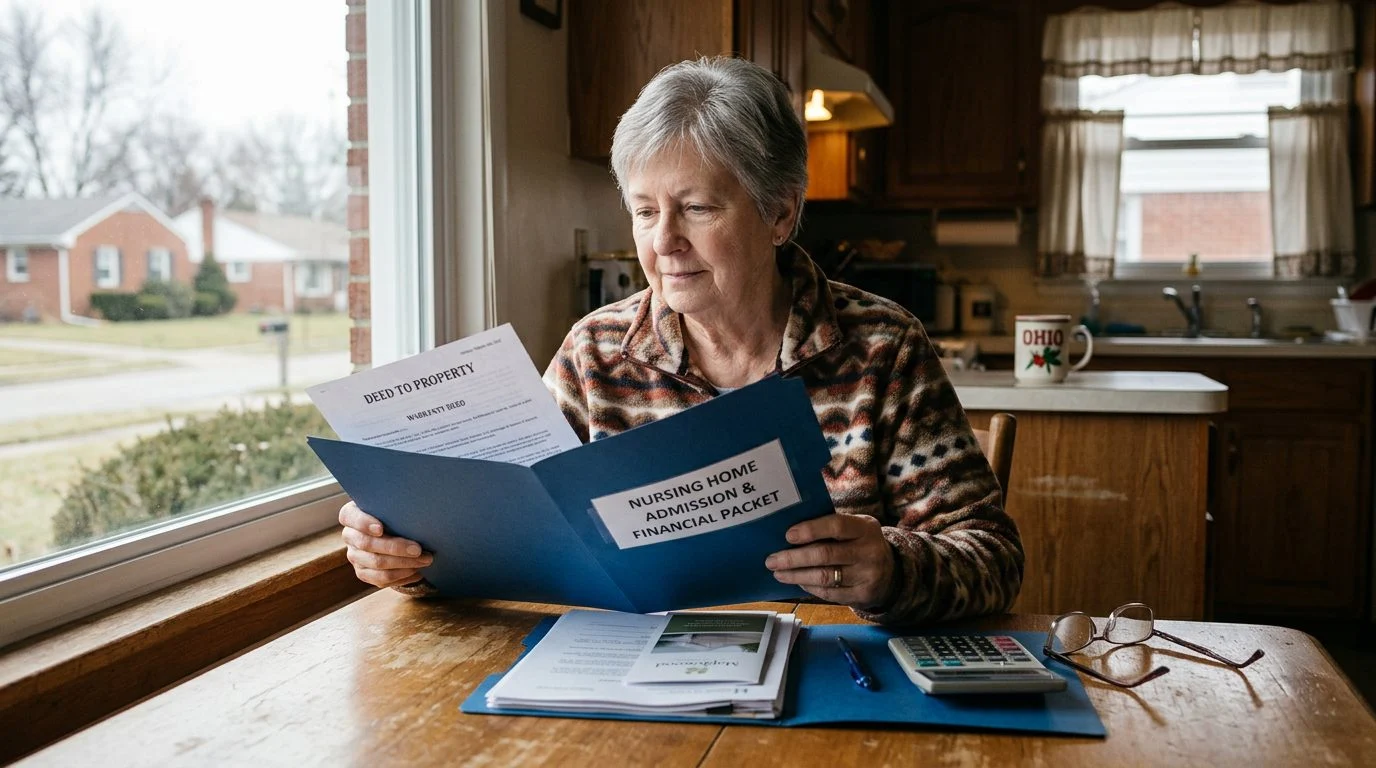
Questions to bring to the kitchen table
What does each of you want?
Take turns describing the care you hope for, the place you want to live and what matters most to you as a couple.
What do your home and savings mean to you?
Talk about what you have built, what you want to keep and what you want to leave for your children or grandchildren.
Who do you trust to help?
Decide together who will speak for you if you cannot, and make sure your plan names the people you choose.
What would make the next step easier?
Write down the questions that worry you most, so your first conversation with us can start with what matters to your family.