
Ohio Home Equity Limit and Memory Care for a Paid-Off Home
You worked hard for your paid-off house, and you want your children to inherit it. The worry that memory care bills could take the home and your savings is a heavy one to carry.
A paid-off house is not automatically safe under Medicaid’s rules. Ohio’s home equity limit is one rule that can decide whether your home counts, and planning can help you see your options.
Our home is paid off. Does Ohio’s home equity limit mean it is safe?
Not automatically. Equity is the part of a home you own, meaning its value minus any debt against it. With no mortgage, the whole value of a paid-off home counts as equity. Here is the 2026 figure:
For 2026, Ohio’s home equity limit is $752,000, and it rises every January.
Many couples worry about the home first and the savings second. The home is often the largest thing a family owns, so knowing where it stands is a sensible first step. Whether your home counts depends on the facts of your family’s situation.
What Ohio’s home equity limit is, in plain words
The limit is a real threshold, not a suggestion: if the equity in a home is above it, the person who owns that home may not qualify for Medicaid-paid long-term care. Many couples hear “home equity limit” and assume the house is already lost. That fear is understandable, but the rule is more than one number.
The figure moves over time, so check the number for the current year before you make decisions.
The home equity limit does not apply when the individual’s spouse is lawfully residing in the individual’s home (Ohio Adm.Code 5160:1-6-02.1).
That exception can matter a great deal for couples. If one spouse moves into memory care while the other stays home, the home may be treated differently. The other exceptions are something we walk through with you on the free discovery call.
For example, imagine a couple with a paid-off $300,000 home
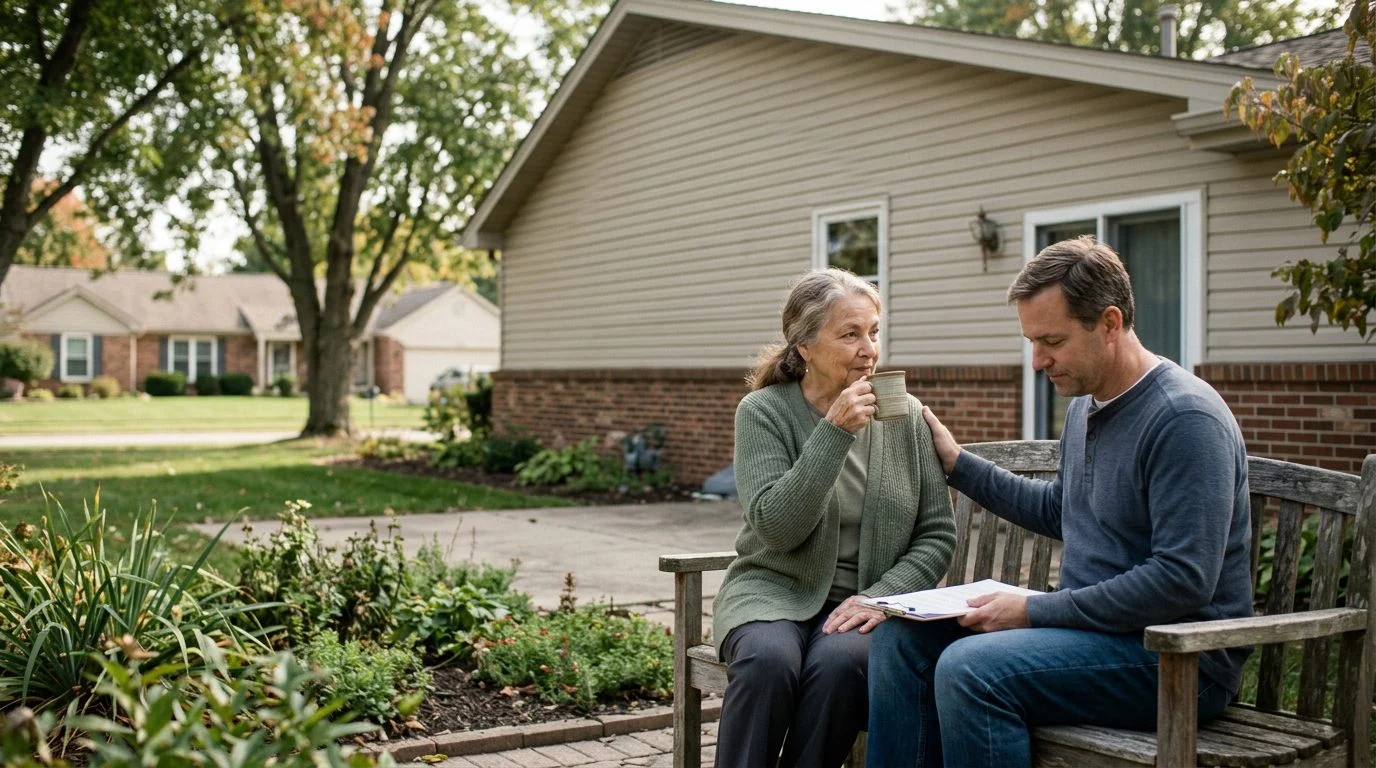
For example, imagine a couple, Ruth and Walt, in their early seventies, living in a small town in Hocking County. Their house is paid off and worth about $300,000, and their savings are modest. One afternoon, while they were talking over coffee, Walt mentioned that he and his wife were both healthy and had never really written down what they wanted if their health changed someday, so they decided to start planning while they had time to think it through. Ruth lies awake, afraid they will have to sell their home to pay for his care. A conversation with a planning team helps them see their choices, including what their situation looks like with Ruth staying in the house and what their grown children might inherit. They leave with a plan to decide on, rather than a rush to sell.
Every family’s situation is different, and Ruth and Walt’s story is only an illustration.
Why a home under the limit still needs a plan
Being under the limit helps, but it does not settle the whole question. Medicaid also looks at savings and at money or property moved in the years before care.
A transfer of assets for less than fair market value made on or after the look-back date by an institutionalized individual or the individual’s spouse is presumed improper and results in a restricted Medicaid coverage period, and the look-back date is sixty months (five years) before the individual’s baseline date (Ohio Adm.Code 5160:1-6-06).
That look-back is why timing matters. A quick move, such as signing the house over to the children to get under a number, can create problems instead of solving them.
Savings are the other piece. Many families spend savings on care before Medicaid helps, and that stretch is called the spend-down. Planning can often change how much of that spend-down is protected, so it is worth looking at early. A plan made before a crisis gives you more room to choose than one made in the middle of one.
How Ohio Medicaid can help pay for memory care
Ohio Medicaid can help pay for nursing homes, many assisted living and memory care settings, and care at home. Not every setting is covered the same way, so we check the specific place with you before you decide.
Many people will need some long-term care. The Administration for Community Living reports that almost 70% of people turning 65 are likely to need some.
Medicare works differently. It covers short-term skilled nursing care after a qualifying hospital stay, as described on Medicare’s skilled nursing page. Medicaid is the program that pays for long-term nursing facility care, as KFF’s nursing facility facts explain.
Staying home longer is possible for many families, and most families prefer it. A move to a care setting later stays an option.
For a spouse who stays home, the 2026 federal maximum community spouse resource standard is $162,660. That standard is one of the figures that shapes what a spouse at home can keep. Planning can often help keep the at-home spouse in the home, financially secure, with quality of life intact.
What estate recovery means for what you leave your children
Estate recovery is the state’s claim after a death, but it may be sought only after the death of the individual’s surviving spouse, if any; it is where many families’ inheritance plans get tested. Here is how the rule works:
After a person dies, the Ohio attorney general will seek recovery from the estate for Medicaid benefits correctly paid in two situations: when the person was permanently institutionalized at any age, or when the person was 55 or older and not permanently institutionalized, for benefits paid after reaching age 55 (Ohio Adm.Code 5160:1-2-07). Recovery may be sought only after the death of any surviving spouse, and only when there is no surviving child who is under age twenty-one or is blind or permanently and totally disabled.
Planning started later may still protect part of what your family built, and options often remain well before everything is spent.
A plan set up and funded correctly can also help your family avoid probate. Probate is the court process that settles an estate after a death, and it can be expensive, slow and stressful for grieving children. Right documents and titles that match the plan are how we work toward that.
How Jarvis Law Office helps you take the next step
You do not have to work out Medicaid, your home and your children’s inheritance on your own. Staying on top of these rules is our job, and we guide you step by step.
Our team begins with a conversation about your family’s situation. In a strategy meeting, we help you choose a plan that fits what you want for your home, your savings and your children.
Our plans include a general durable power of attorney for finances, a health care power of attorney, a living will and a HIPAA release. We treat the financial power of attorney as a key asset-protection tool in our planning, because it names someone you trust to handle money if you cannot. After the documents are signed, we help title your assets to match the plan. That step is more than paperwork.
Our Care Navigators can also help you find your way through the health care system when you need that help. They are not lawyers and do not give legal advice. Our practice concentrates in elder law, Medicaid planning and estate planning, and we work on a flat fee with no recurring insurance-style fees.
Take the next step with a free discovery call
If memory care costs are weighing on you, your next step can be a simple one. Book a free discovery call with Jarvis Law Office. It is confidential and carries no obligation to continue.
Common questions
Can the state take our house after we die?
After a permanently institutionalized person dies, the Ohio attorney general will seek recovery from that person’s estate for Medicaid benefits correctly paid, but only after the death of any surviving spouse and only when there is no surviving child who is under age twenty-one or is blind or permanently and totally disabled.
Does the home equity limit apply if my spouse still lives at home?
The home equity limit does not apply when the individual’s spouse is lawfully residing in the individual’s home.