
Medicaid and long-term care planning in Ohio
Thinking about selling the house for nursing home care? You don't have to sort it out alone.
Families across Ohio ask us this question in hard months. Here is how we can help you weigh your options, one step at a time.
Serving Ohio families from three offices
3
Offices in Lancaster, Dublin and St. Clairsville
All Ohio
We serve families in every Ohio county
By Timothy Jarvis · Published November 14, 2026
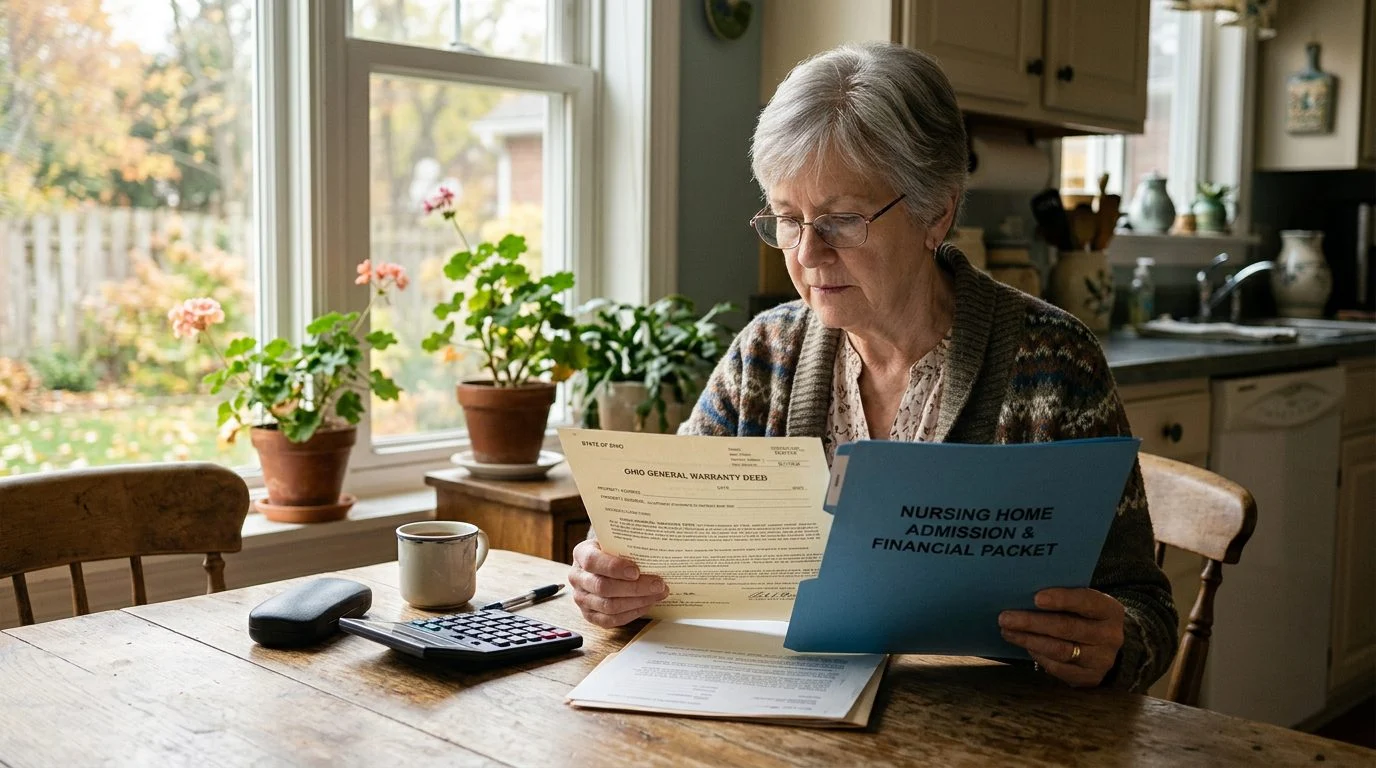
If your spouse has just moved into a nursing home, the bills can make your house feel like the next thing at risk. When a spouse moves into a nursing home, the family home is often the first thing that worries the one who stays behind. Selling a home can affect Medicaid planning, and we can walk you through what that could mean for your family’s situation.
A sale made without a plan can leave the spouse at home with too little to live on. Almost 70% of people turning 65 will need some long-term care, according to the Administration for Community Living. You do not have to work out these rules alone.
Can you sell the house to pay for your spouse’s nursing home in Ohio?
Timing matters most here. A sale made before a plan is in place can change what your household has to work with.
Medicaid looks at what a couple owns, and money from a sale that sits in savings generally counts toward eligibility for the spouse in care. That surprises many families, who expect the house to be the only issue. Medicaid does not count every asset the same way, though, and the spouse at home has protections that a rushed sale can undo. The spouse at home can be left with cash and no clear plan for the house, the income or the timing. Before any sale or transfer, it helps to know which assets count, which are protected and what care will cost over time. We can help you sort that out before you sign anything.
If you are deciding whether the house can be kept while your spouse is in care, schedule a free discovery call with our team before any sale. Talk it through with Jarvis Law Office — the first discovery call is free, confidential, and carries no obligation.

What one family’s situation can look like
Seeing the choices play out in an example makes them easier to weigh.
For example, imagine a couple, Ray and Lois, who have lived in a farmhouse outside Sandusky, Ohio, for thirty-one years. Ray moved into a nursing home after a slow decline left him unable to manage the stairs. Lois stayed at home, afraid the bills would drain their savings and force her to sell the house she had loved for decades. Before anything was signed, Ray and Lois met with our team, who walked them through their savings, their house and the timing. They came away seeing that a sale was only one of several choices, and that planning might help Lois stay in her home. Results vary with each family’s own facts, so treat this as an illustration, not a forecast.
For Lois, the question was never only about money. It was about staying in her own home, keeping her own income and making choices with her children rather than for them. Your goals may look similar: your spouse’s care covered, your home protected, enough to live on, and your spouse’s wishes honored. Planning starts by naming those goals and then testing each option against them.
Why a sale without a plan can cost the spouse at home
A sale without a plan can leave the spouse at home short of cash for daily life, and many spouses name that fear first.
A community spouse may keep a certain part of the couple’s combined countable resources, called the community spouse resource allowance (CSRA) (Ohio Adm.Code 5160:1-6-04).
For 2026, the federal maximum community spouse resource standard is $162,660, according to federal CMS guidance.
After the community spouse resource allowance is subtracted from the couple’s combined countable resources, the spouse in the nursing home is resource eligible only when the remainder is less than or equal to two thousand dollars (Ohio Adm.Code 5160:1-6-04).
Think of that protected share as the spouse at home’s cushion for daily life. Money for groceries, utilities, insurance, property taxes and repairs keeps a household running, and a large sale can use it up quickly. Planning may help keep the spouse at home in the house, financially secure and with quality of life intact, as a possibility, not an assurance. The aim is not to fight with Medicaid. It is to make sure the person who stays home can keep living well.
Ohio’s home equity limit, explained simply
A house is treated differently from other assets for Medicaid, but only up to a limit.
If the spouse in the nursing home leaves the home with no intent of returning, the home remains an excluded resource for as long as the other spouse keeps living in the home while the spouse receives long-term care services (Ohio Adm.Code 5160:1-3-05.13).
For 2026, Ohio’s home equity limit is $752,000, and it rises every January.
Think of that figure as a starting point for planning, not a verdict on your house. We walk through those details with the family, one step at a time. Keep in mind that the home rules sit alongside the spouse-at-home protections described above, so the two are planned together.
What planning can look like for the spouse at home
Planning can often protect more than families expect, though every outcome is different and depends on the facts.
When planning starts well before care is needed, it can often shield some assets from the spend-down and from later estate recovery. The spend-down is the period when savings go toward care.
Giving the house or savings to children quickly is not the fix.
Transfers of assets for less than fair market value that the institutionalized person, or his or her spouse, makes on or after the look-back date are presumed improper and can lead to a restricted Medicaid coverage period. The look-back date is sixty months (five years) before the individual’s baseline date (Ohio’s Medicaid transfer rules).
When care is needed now, a significant part of the spend-down can often still be protected. Options often remain well before the savings run out.
In our plans, we include a strong financial power of attorney. It is one of the tools we use to protect the family’s assets and keep decisions in the family’s own hands. Every plan we prepare includes a general durable power of attorney for finances, a health care power of attorney, a living will and a HIPAA release.
What happens to the house after your spouse dies
After your spouse dies, the house can still be at risk in some situations, so planning ahead matters.
In some situations, Ohio’s Medicaid program can seek repayment from a person’s estate after care has been paid for, and a house is often a large part of that estate. The rules on these transfers depend on each family’s facts, and we walk through how they apply to yours on the free discovery call.
Planning well before care is needed gives a family more options, and we can explain what that could mean for your situation. Probate, the court process for settling an estate, is often expensive, drawn-out and stressful for a grieving family. A plan set up and funded correctly, with the right documents and assets titled to match, can help your family avoid probate later. Getting that planning right is our part, so your family can skip probate later.
Not sure what your next step is?
Talk it through with Jarvis Law Office — the first discovery call is free, confidential, and carries no obligation.
How Ohio Medicaid can help pay for your spouse’s care
Ohio Medicaid can help pay for nursing home care, and it can help with some other care settings and with care at home.
Which assisted living and memory care settings Medicaid can help pay for varies, so the setting your family is considering matters, and we can walk you through the options. Long-term care costs can be significant, which is why many families ask us about planning ahead, and we can explain how those costs may affect your family. Medicare’s nursing home payment guide explains the difference.
Staying at home longer is possible, and many families prefer it. A later move to a care setting remains an option.
Our Care Navigators can also help your family find their way through the health care system on your behalf when that help is needed. They are not lawyers and do not give legal advice. They help with the care side while we handle the legal planning.
The Medicaid application is a step we can prepare with you, with complete records and careful timing. Each application turns on its own facts.
How Jarvis Law Office helps you decide
We help you decide by making your choices clear before anything is signed.
We start by understanding your spouse’s care needs, your savings, your house and your income. Then we meet to choose a plan that fits your household. Next, we set up the plan documents and coordinate your assets so they match the plan, which takes more than paperwork. We stay with you as needs change.
Our fee is a flat fee, with no recurring insurance-style charges. Our team reviews the household’s savings, income and home together, so the plan fits the household.
You do not have to do this alone. Staying on top of the rules is our job, and the first step is a conversation.

Take the next step with a free discovery call
If your spouse is in a nursing home now or will be soon, the time to look at your options is before any sale or transfer.
Our free discovery call is confidential and carries no obligation to continue. Our offices are in Lancaster, Dublin and St. Clairsville, and we serve families in every Ohio county.
Can I keep the house if my spouse is in a nursing home?
If the spouse in the nursing home leaves the home with no intent of returning, the home remains an excluded resource for as long as the other spouse keeps living in the home while the spouse receives long-term care services.
What is the community spouse resource allowance?
A community spouse may keep a certain part of the couple’s combined countable resources, called the community spouse resource allowance (CSRA).
Should I sell the house before applying for Medicaid?
Timing shapes what is possible, which is why planning comes before a sale.
If you are deciding whether the house can be kept while your spouse is in care, schedule a free discovery call with our team before any sale. We will walk through your options in plain words.
How we help families decide
A calm first conversation
Your free discovery call is confidential and carries no obligation to continue. We listen to your family's situation and explain the options in plain words.
A plan built around your home
We look at what matters most to your family, including the home, the savings and who will be living there, before any decision is made.
Documents and paperwork handled
Our plans include the documents your family will need if decisions have to be made for a loved one, so the people you trust are ready to act.
Guidance as needs change
Care needs shift over time. We stay with you through each change and bring in our Care Navigators, who help families find their way through the health care system when that help is needed.
Before you list or transfer the house
Decisions about the family home are hard to undo. Please talk with us before you sign a sale, transfer or deed so we can review your family's full picture first.
Questions we hear most often
Can my spouse stay in the home?
Many spouses who remain at home want to know this first. We will walk through what planning can look like for your household.
What if we need Medicaid for care?
Ohio Medicaid can help pay for care in many settings, including nursing homes and some home and assisted living care. We explain how each option fits your family.
How do we protect what we have built?
Careful planning can help protect savings and the home, and it can help your family avoid probate later. Every plan depends on each family's own facts.
You don't have to figure this out by yourself. Let's talk about your family's next step.
Related practice areas
- Long-Term Care and Memory Care Planning in Ohio
- Medicaid Interview for a Nursing Home Resident in Ohio
- Medicaid Personal Needs Allowance in an Ohio Nursing Home