
Medicaid and long-term care planning for Ohio families
Your Spouse in a Nursing Home: What Happens to Your Home?
Ohio families can plan for the house and the care at the same time, with a team that explains each step in plain words.
Planning from Ohio offices, for families across the state
3
Offices in Lancaster, Dublin and St. Clairsville
Free
First discovery call, confidential and without obligation
Every county
We serve families throughout Ohio
By Timothy Jarvis · Published November 16, 2026
If your spouse has just moved into a nursing home, you may be asking what happens to you and your home. When a spouse goes to the nursing home, the spouse at home is not automatically left with nothing. Several early steps shape what comes next.
Medicaid has rules that treat the spouse at home differently from the spouse in care. Those rules have details that matter, and this page explains the main points in plain words.
What happens to you when your spouse moves into a nursing home
Your home and your daily life at home can often be protected, but the details decide how.
Fear of the bills makes complete sense. Nursing home bills are high, and the decisions can feel rushed. You are not the only person facing this change, and you are not expected to know every rule. You do not have to figure all of this out yourself. Staying on top of the rules is our job, and we guide families step by step.
For example, imagine Ruth and Dale Kessler, a couple in Newark. Dale’s Parkinson’s had reached the point where Ruth could no longer manage his care at home, so he moved into a nursing home. Ruth was afraid the savings would run out and she would have to sell the house they had lived in for decades. She wanted to understand where she stood before making any decisions. Ruth and Dale made their own list of each account and piece of property, marking which ones seemed to matter for their plan and which did not, and the options in front of Ruth began to make more sense. Every family’s facts are different, and results depend on those facts.
If your spouse has just moved into a nursing home, you do not have to sort out the savings and the house alone. We would be glad to talk it through with you. Talk it through with Jarvis Law Office — the first discovery call is free, confidential, and carries no obligation.

Your home and savings: what Ohio’s spousal protections can do
Medicaid counts your home and your savings in a way that protects the spouse at home, within set limits.
When a spouse leaves the home with no intent of returning, the home remains an excluded resource for as long as the other spouse keeps living in the home while the first spouse receives long-term care services (Ohio Adm.Code 5160:1-3-05.13).
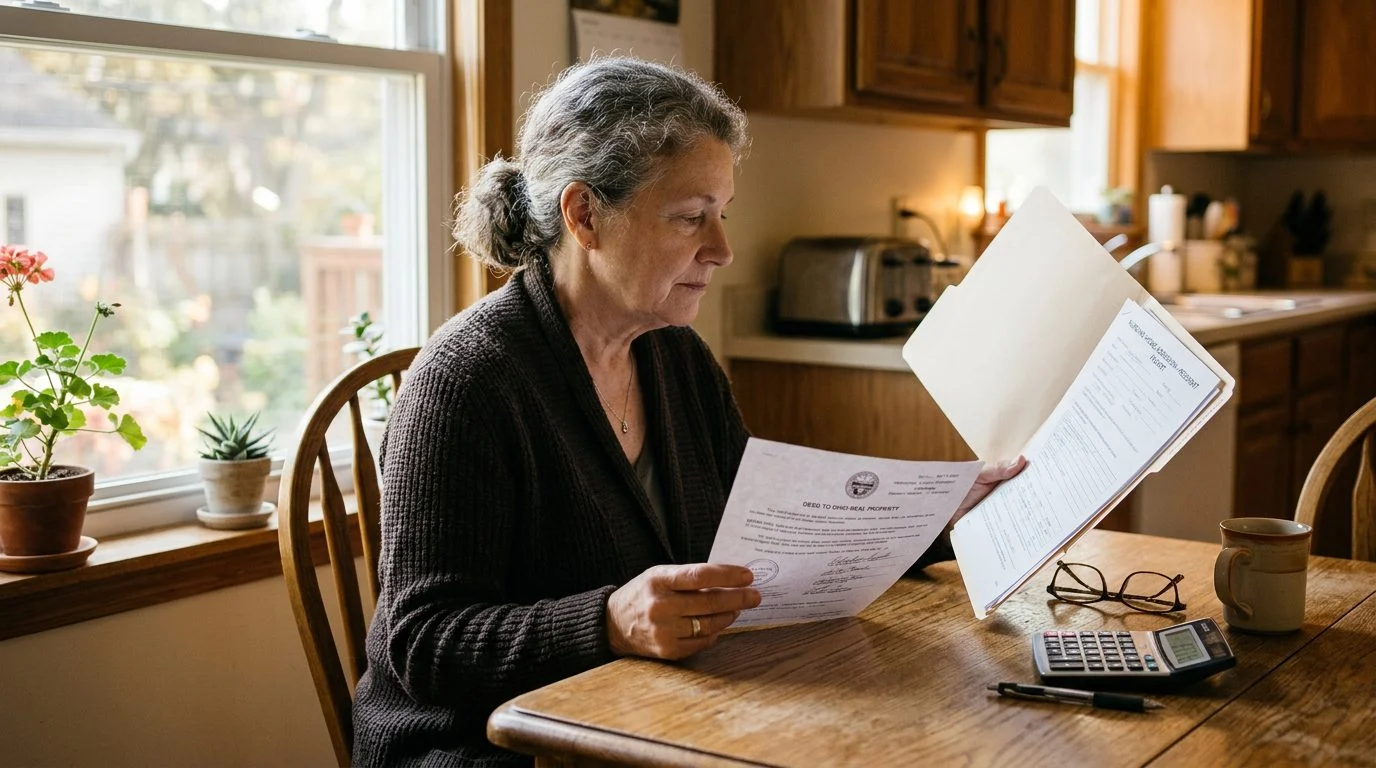
Keeping the deed and any trust papers close at hand helps us see exactly how your home is titled.
Savings are counted differently, too. The community spouse resource allowance is the greatest of several amounts, and one of those amounts is one half of the couple’s combined countable resources or the CMS community spouse maximum resource standard, whichever is less (Ohio Adm.Code 5160:1-6-04). For 2026, the federal community spouse maximum resource standard is $162,660, and Ohio uses figures like this in its calculation. The CMS 2026 Medicaid spousal standards list the figures.
Ohio also has a home equity limit. For 2026, Ohio’s home equity limit is $752,000, and it rises every January. The home equity limit does not apply to a person in a nursing home when that person’s spouse is lawfully living in the person’s home (Ohio Adm.Code 5160:1-6-02.1).
Income matters too, and we look at it with you. Planning can often help the spouse at home stay in the home, financially secure, with quality of life intact. What that looks like depends on your family’s own figures.
How Ohio Medicaid can help pay for your spouse’s nursing home care
Ohio Medicaid can help pay for nursing home care. It can also help pay for many, though not all, assisted living and memory care settings, and for care at home.
Many families want to stay home longer, and that can be possible. A move to a care setting later remains an option. Asking early which settings are covered for your family helps you plan.
Coverage starts with a Medicaid application, and its details depend on your family’s facts and records. Careful paperwork makes that step go more smoothly.
Nursing home resident rights explains these protections.
Our Care Navigators can also help your family find a way through the health care system on your spouse’s behalf, when that help is needed. They are not lawyers and do not give legal advice. Legal planning stays with our attorneys.
The look-back period and the spend-down, explained simply
The look-back is the period Medicaid reviews for money and property that were moved, and planning done early leaves more room to work.
Transfers of assets for less than fair market value made on or after the look-back date, which is sixty months (five years) before the baseline date, are presumed improper and result in a restricted coverage period, although transfers between the spouses are not considered improper (Ohio Adm.Code 5160:1-6-06).
Before Medicaid helps pay, many families spend down savings on care.
It is not too late for many families. Options often remain, and a family can often qualify for Medicaid-paid care well before spending everything. A spouse moving to care is not, by itself, a reason to panic.
Estate recovery and protecting what is left for your family
Estate recovery is the state’s process for seeking repayment from some property after a Medicaid recipient dies, and families often worry about the home.
Planning looks at each piece of property, including how it is titled, to see where the home and savings stand. Planning can look like the right documents, with assets titled and coordinated to match the plan. That can open the door to protecting what you want to leave to children or grandchildren. Your spouse’s wishes matter here too, and a plan can record them.
Probate is the court process for settling a person’s estate, and it can be slow and costly for a grieving family. A plan set up and funded correctly can help a family skip probate later. The result depends on the plan’s details and on the assets involved.
In our plans, a strong financial power of attorney is one of the tools we use to protect assets. It lets a trusted person manage money if you cannot, and we include it in every plan we prepare.
Common mistakes that delay or complicate the application
The most common problems are incomplete paperwork, assets moved without a plan, and confusion about which accounts and property count.
Moving money or deeds in a hurry, often on a friend’s or salesperson’s advice, can cause problems that are hard to undo. The Ohio Attorney General’s senior guidance covers scams aimed at seniors and families.
Gather the statements, deeds, and records you already have. That means bank and retirement statements, the deed to your home, and your spouse’s admission papers. Keep a simple list of every account, property and policy in one place. Bring them to the first conversation so we can be specific.
The details have exceptions, and we walk through them with you in your own situation.
Not sure what your next step is?
Talk it through with Jarvis Law Office — the first discovery call is free, confidential, and carries no obligation.

How Jarvis Law Office helps families in this situation
We guide you step by step, starting with a conversation about your spouse’s care, your home and your savings.
From there, we help map out a plan, set up the documents, and coordinate your accounts and property so they match it. Where Medicaid applies, we handle the application step, and we stay on hand as your needs change. We serve families across Ohio from our offices in Lancaster, Dublin and St. Clairsville.
Our fee is a flat fee, with no recurring insurance-style fees. Your first step is a free discovery call. It is confidential and carries no obligation to continue.
Common questions
Can Ohio’s rules protect the home when a spouse is in a nursing home?
When a spouse leaves the home with no intent of returning, the home remains an excluded resource for as long as the other spouse keeps living in the home while the first spouse receives long-term care services.
Does the look-back still matter after my spouse moves in?
Transfers of assets for less than fair market value made on or after the look-back date, which is sixty months (five years) before the baseline date, are presumed improper and result in a restricted coverage period, although transfers between the spouses are not considered improper.
Which memory care settings Medicaid can help with depends on the setting itself and on your family’s situation, and we can walk through those options with you.
If your spouse has just moved into a nursing home and you are worried about the bills and the house, you do not have to work this out alone. Schedule a discovery call and talk through your spouse’s care and what you want to keep.
A guide for the at-home spouse
You do not have to work out the rules alone. We walk you through what happens to the house, the savings and your income, one step at a time.
Documents that match the plan
Every plan we prepare includes a durable power of attorney for finances, a health care power of attorney, a living will and a HIPAA release, so the people you trust can act for you.
Care decisions with support
When care choices need more than legal answers, our Care Navigators can help your family find their way through a complicated health care system.
Planning that keeps the home out of probate
Careful planning, with the right documents and the house titled to match, can help your family avoid a costly and drawn-out probate later.
Talk with us before you change the deed
Moving the house, adding a name to the title or signing a transfer can affect Medicaid planning. Please speak with us first so we can look at your options before anything is changed.
Questions to bring to your discovery call
Whose name is on the house?
Knowing how the home is titled, and by whom, is often the first thing we review together.
Who lives there now?
Whether your spouse plans to return home, and whether you are still living there, can shape the choices ahead.
What do your documents say?
Bring your existing power of attorney, will and trust, if you have them, so we can see what needs updating.
What are your goals?
Tell us what matters most, whether that is staying in your home, protecting your savings or leaving something for your children.