
Medicaid and long-term care planning in Ohio
Your Spouse Needs Care. You Do Not Have to Sort Out the Rules Alone.
Plain answers for the spouse who stays at home, and a clear first step toward protecting the home you share.
By Timothy Jarvis · Published November 16, 2026
If your spouse has just moved into a nursing home, you may be lying awake wondering whether the savings will run out and whether you will have to sell the house. Ohio Medicaid can help pay for nursing home care for people who meet its income and asset rules, but whether your spouse qualifies depends on the facts of your family’s situation.
You do not have to work out those rules on your own. Staying on top of them is our job, and our team guides families step by step through each decision.
Yes, Ohio Medicaid can help pay for nursing home care when the person who needs it qualifies
Medicare.gov explains how people pay for nursing home care and notes that Medicaid may help, subject to income, resource and other requirements. Medicare can cover a short stay in a skilled nursing facility after a qualifying hospital stay, but that coverage is limited in time (Medicare skilled nursing facility coverage).
This page covers three things: how Medicaid looks at income and savings, how the spouse at home and the house are treated, and why the application needs careful handling. We explain each one in plain words, so you know what to expect.
If your spouse has just moved into a nursing home, you do not have to sort out Medicaid, the savings and the house alone; talk with us. Talk it through with Jarvis Law Office — the first discovery call is free, confidential, and carries no obligation.

For example, imagine a couple who faced the same question
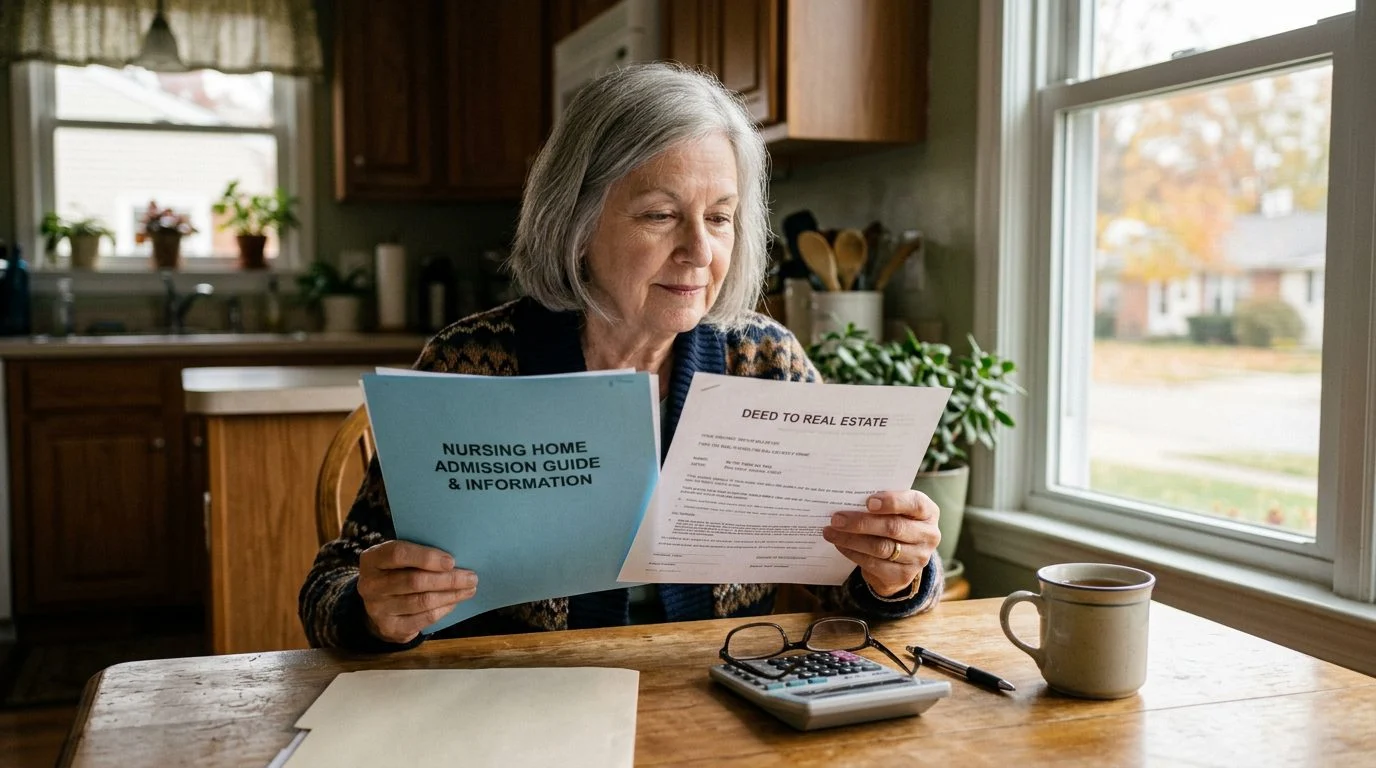
Imagine a couple, Frank and Lena. Frank’s memory had slipped slowly for two years, until it was no longer safe for him to be home alone, and he moved into a nursing home outside Newark. Lena stayed in their house and sat up at the kitchen table doing sums, afraid the savings would be gone within a year and she would have nothing to live on. They sat down with a lawyer who went through what they owned, what Lena’s income was, and when each decision had to be made. Once the rules were laid out against their own papers, the fear turned into a list of questions they could answer one at a time.
Frank and Lena’s answers came from their own records and dates. Every family’s facts are different, so the answers for your family will come from your own records.
How Medicaid looks at your spouse’s income and savings, and what protects you
Medicaid looks at the income of the person who needs care and at the couple’s combined countable resources, and it lets the spouse who stays home keep a community spouse resource allowance (CSRA). The protection that matters most to you starts here.
The at-home spouse may keep a community spouse resource allowance (CSRA) from the couple’s combined countable resources, and the spouse receiving care is resource eligible only if the remaining countable resources, after subtracting that allowance, are $2,000 or less (Ohio Adm.Code 5160:1-6-04).
Income works the same way for the spouse at home, and that is a point many families miss.
In any month the spouse receiving care is eligible for long-term care services in a medical institution, a home and community-based services waiver, or PACE, none of the at-home spouse’s income is considered available to that spouse (Ohio Adm.Code 5160:1-6-04).
Planning can often keep the spouse at home financially secure and living in the house, with quality of life intact. How much this helps depends on your family’s facts. The dollar standards also change from year to year, because federal guidance on the spousal standards is set for each calendar year, so numbers you read online may be out of date. Our guide to long-term care planning in Ohio covers the wider picture, and our team reviews the exact figures for your family with you directly.
Protecting the house: Ohio’s home equity limit and what happens after death
The house is often the biggest worry, and Ohio’s rules treat it differently while you continue to live there.
A home that was the couple’s principal place of residence and is in the name of either spouse is an excluded resource regardless of its value. If the spouse receiving care leaves with no intent of returning, the home stays excluded as long as the other spouse continues to live there while the spouse receives long-term care services (Ohio Adm.Code 5160:1-3-05.13).
For 2026, Ohio’s home equity limit is $752,000, and it rises every January. The limit is one part of how the home is viewed, and how it fits your home depends on who lives there and how the home is titled.
After a death, the worry shifts to estate recovery, which is the state’s claim against certain estates after a Medicaid recipient dies.
While the spouse is alive, Ohio cannot seek estate recovery from the estate of a permanently institutionalized person (R.C. 5162.21).
Careful planning can often help a home pass to family outside probate. Probate is slow, costly and stressful for a grieving family. A plan set up and funded correctly, with the right documents and assets titled to match, is the reason families can often skip probate later. That is what planning can do for you, not a guarantee of any result.
The spend-down, the look-back and what planning can often protect
The spend-down is the process of using income and savings toward care costs until a person’s assets fall within Medicaid’s limits. Gifts and transfers made before applying can affect eligibility, so timing matters. That is why we look at the calendar before anything is moved, sold or retitled.
Planning that starts several years before care is needed can often shield some assets from the spend-down and from estate recovery. When care is needed now, a significant part of the spend-down amount can often still be protected. Options usually remain well before a couple has spent everything, though the exact timing depends on the facts.
In our plans we include a general durable power of attorney for finances, one of the tools our planning uses to protect a family’s assets. It names a trusted person to handle money matters if you or your spouse cannot.
Why the application needs care: denials, penalties and avoidable delays
A Medicaid application for nursing home care is detailed, and one missing record can slow it down. An account left off the form, or a gift made at the wrong time, can lead to a denial or a penalty.
You can help now by gathering bank and retirement statements, records of any gifts or transfers, and bills from the care facility. Understand the timing before anything is moved, sold or retitled, because one step can change what happens next.
We cannot promise any speed or outcome. The exceptions and details are something we will walk through with your family, because they depend on your facts. Our team handles the planning and, only where it fits your family’s situation, the Medicaid application step.
Not sure what your next step is?
Talk it through with Jarvis Law Office — the first discovery call is free, confidential, and carries no obligation.
Ohio Medicaid care settings and staying at home longer
Ohio Medicaid can help pay for nursing homes, for many but not all assisted living and memory care settings, and for care at home. Staying home longer is possible, and it is what most families prefer when it is safe and workable. A move to a care setting later stays an option.
The need for care is common. The Administration for Community Living estimates that almost 70% of people turning 65 are likely to need some long-term care, at home or in a facility.
Care decisions are rarely simple, and the health care system is fragmented. Our Care Navigators can help your family find their way through it on your spouse’s behalf when that help is needed. They are not lawyers and do not give legal advice. Questions about the money and the house are the part our attorneys handle with you.
How Jarvis Law Office helps you take the next step
Jarvis Law Office concentrates its practice in elder law, Medicaid planning and estate planning. We guide families through these decisions one step at a time, so you do not have to do this alone.
Our first conversation focuses on your spouse’s situation and on what you want for your family: your spouse’s care paid for where Medicaid can help, the house protected, enough income for you to live at home, and no costly mistakes. A strategy meeting then helps you choose a plan together. We set up the plan documents and coordinate your assets to match the plan, which takes more than paperwork. Ongoing guidance continues as your family’s needs change.
Our work is billed as a flat fee, with no recurring insurance-style fees. The free discovery call is free, confidential and carries no obligation to continue, so it is a low-pressure place to start.
Talk with us about your spouse’s situation
If your spouse has just entered a nursing home, you are likely juggling the bills, the house and your own future at the same time. Wanting a clear answer on Medicaid, and a plan to protect the home and your income, is a fair place to start.
You can book a free discovery call with Jarvis Law Office and bring your questions. We cannot promise that Medicaid will pay, that the house will be kept or that the application will go through without delay. What we can offer is a clear, plain picture of your options.
Offices in Lancaster, Dublin and St. Clairsville, Ohio, serving families in every Ohio county.

Frequently Asked Questions
Will Medicaid pay for nursing home care in Ohio?
Yes. Ohio Medicaid can help pay for nursing home care for people who meet its financial and medical eligibility rules, and each family’s situation is different.
Can Medicaid take my home if my spouse goes into a nursing home?
Planning can often help a spouse who stays at home keep the home and remain financially secure, but the rules are detailed and depend on your family’s own finances. We would walk through your situation with you before you make any decisions about the house.
Does Medicaid start paying for nursing home care right away?
Not usually. Medicaid reviews your finances, including financial transfers made before you apply, and you may need to use some assets before you qualify.
Do I have to spend all of our savings before Medicaid pays for nursing home care?
Not necessarily. Planning can often help a person qualify for Medicaid-paid nursing home care well before their savings are used up, though how much is protected depends on your own finances and timing.
Don't make this decision under pressure
A nursing home admission often comes sooner than a family expects. Talking with us before that day gives you more room to choose.
How Jarvis Law Office helps the spouse at home
Protecting the home you share
We look at whether planning can help the spouse who stays home keep the house and stay financially secure, and we explain what that could look like for your family.
The right documents in place
Our plans include a general durable financial power of attorney, a health care power of attorney, a living will and a HIPAA release. The financial power of attorney is one of the main tools we use to protect your assets.
Care Navigators beside you
When the health care system feels fragmented, our Care Navigators can help you find your way through it on your behalf. They guide care decisions; they do not give legal advice.
A flat fee you can plan around
We charge a flat fee for our planning work, with no recurring insurance-style fees, so you know the cost before we begin.
Where a spouse can start
Gather the family picture
Write down the care your spouse needs now, the income you each receive and the assets you hold. We will walk through it with you step by step.
Learn what Ohio Medicaid can help pay for
Ohio Medicaid can help pay for nursing home care for people who qualify, and it can also help with some assisted living, memory care and care at home.
Look at your at-home finances
Planning can often help the spouse who stays home remain secure, and we review the choices with you before any decision is made.
Plan before a crisis forces the timing
The earlier a plan is in place, the more options a couple usually has. We help you set the plan up and keep it current as needs change.