
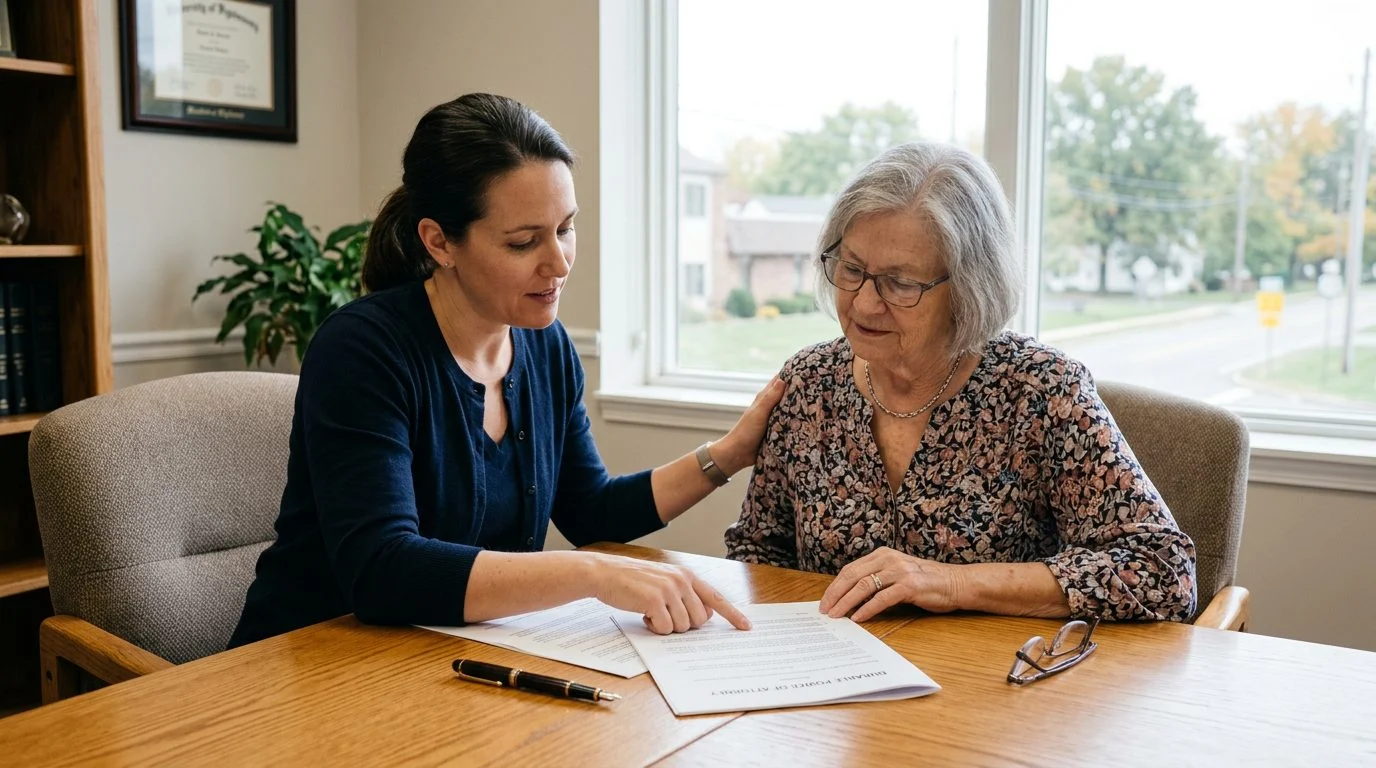
Caregiving and planning for Ohio families
Caring for your mother with dementia? You don't have to plan the next steps alone.
Jarvis Law Office helps Ohio daughters and sons put a clear, calm plan in place, one step at a time.
Serving Ohio families from three offices
3
Offices in Lancaster, Dublin and St. Clairsville
Every Ohio county
We serve families across the state, not only near our offices
By Timothy Jarvis · Published November 23, 2026
You Are Doing a Lot at Once, and You Do Not Have to Figure It All Out Alone
A daughter caring for mother with dementia in Ohio can plan in a clear order: safety, legal papers, Medicaid, then her own time. You do not have to solve all of it at once.
If your mother has Alzheimer’s and still lives at home, you may be wondering where to begin. For many adult children, the parent who needs help is the one they rely on most, and that care sits alongside work and their own family. Now you are also trying to learn how care and money work. That is a lot to carry.
Many families say the next hard day comes without warning, such as a fall, a night of wandering or a hospital stay. Planning now makes that day easier to face.
Jarvis Law Office acts as a trusted guide through this process. The firm keeps up with Medicaid’s rules and yearly figures every day, so you don’t have to track them yourself. The attorneys and team walk your family through each step.
When care decisions arrive, the firm’s Care Navigators can help you find your way through a fragmented health care system. They are not lawyers and do not give legal advice.
If you are caring for your mother at home while work and your own family pull at you, you do not have to work out the legal and money steps alone. Our team can talk them through with you. Talk it through with Jarvis Law Office — the first discovery call is free, confidential, and carries no obligation.

Keeping a Parent Safe at Home: What to Plan for Before a Crisis
The safest plan starts with the risks you already see and a written record of what your parent needs each day. That record helps anyone who steps in for them.
Common dementia risks at home include wandering, falls, medication mix-ups and a stove left on. Each one needs a plan, such as door alarms, a fixed medication schedule and a short list of who to call first.
Keep one folder with your parent’s diagnosis letters, doctor names, medication list, insurance cards and identification. Put emergency contacts on the first page so you can find them fast.
Legal papers belong on this list too. Talking through these documents while your mother can still take part often makes the decisions easier for everyone. Without it, a simple task like paying a bill or signing a form can stall her care.
Care Navigators can help coordinate home supports, appointments and facility visits when the time comes.
Getting Your Mother’s Legal Papers in Place While She Can Still Take Part
The two papers most families need first are a financial power of attorney and a medical power of attorney. It helps to start these conversations with us while your parent can still take part in them.
In every plan we prepare, we include a general durable power of attorney for finances, because it is one of the tools we use to protect a family’s assets. In our plans we include a health care power of attorney along with a financial power of attorney, because the two cover different needs.
Real estate adds a step. Under R.C. 1337.04, a power of attorney used to sign a deed, mortgage or lease must be signed and acknowledged by the principal before the property document is signed.
Bring these details to a first meeting: which papers your parent already has, who they trust to act for them, and where the originals are kept. Missing or unclear papers are often easier to fix early.
Medicaid, a Parent’s Savings and the Look-Back Period
Medicaid long-term care looks at your parent’s assets, may require a spend-down, and reviews transfers made before an application. The look-back is the review period for those transfers.
Under 42 U.S.C. § 1396p, a transfer of assets for less than fair market value on or after the look-back date can make an institutionalized individual ineligible for long-term care Medicaid for a set number of months.
Ohio’s estate recovery rule is different. Ohio Adm.Code 5160:1-2-07 describes how that recovery works.
Planning possibilities depend on the family’s facts. Planning done well before care is needed gives a family more options to consider. When care is needed now, families can often still protect a significant part of what must be spent down, sometimes far more.
For 2026, Ohio’s home equity limit is $752,000, and it rises every January. The Ohio home equity rule explains how the limit works. The home your parent owns and lives in may also be left out of the count for Medicaid, as Ohio’s rule on when a home is not counted explains, and we will walk through with you whether that fits your parent’s situation.
The Guilt of Moving a Parent Out of Their Home
Feeling guilty about a move does not mean you are failing your mother. Many daughters feel this way when memory care or a nursing home comes up.
The decision can rest on your parent’s safety, their care needs and what your family can provide at home. It is not one moment of failure. It is a series of choices made as her needs change.
For example, imagine a daughter whose mother with dementia has started wandering at night. Planning steps might include power of attorney papers, a Medicaid review and a written care plan, so a move, if it comes, is made with choices already in place. Every family’s situation is different, and the outcome depends on its facts.
You can keep a voice in these decisions. Planning can also cover how your parent’s home and savings may be handled if a move happens, so you are not making those calls in a rush.
Protecting Your Job, Your Family and Your Time
Caregiving competes with your job and your teenagers for the same hours. The load needs a plan too.
Ohio has a specific rule for an adult child who has given care at home.
Keep records of the care you give, including hours and daily tasks.
For example, imagine a daughter who did not want to quit her job to care for her father with dementia. Planning might help set up powers of attorney and a shared care plan, so the load spreads across more hands. Every family’s situation is different, and the outcome depends on its facts.
Name a backup agent, write down who does what, and share the paperwork so one person is not the only one who knows where everything is. Care Navigators can help you find services that lighten the daily load.
Not sure what your next step is?
Talk it through with Jarvis Law Office — the first discovery call is free, confidential, and carries no obligation.
What the First Steps With Jarvis Law Office Look Like
The first steps are a conversation, a review of your parent’s papers, a written plan and steady follow-up as their needs change.
- Step 1: First meeting. Share your parent’s situation, diagnosis details and any papers you already have.
- Step 2: Document review. The firm reviews your parent’s powers of attorney, assets, income and home, and lists any gaps.
- Step 3: Written plan. You receive a plan in plain words covering legal papers, Medicaid timing and steps for home and care decisions.
- Step 4: Follow-up. As your parent’s needs change, the firm keeps up with Medicaid’s rules and yearly figures for your family.
The firm serves families in Franklin, Fairfield, Licking, Pickaway, Perry and Hocking counties. It has offices in Lancaster, Dublin and St. Clairsville.
Common Questions From Daughters Planning for a Mother With Dementia
Can I plan if Mom already has dementia?
Planning starts with a review of your parent’s current ability to take part. The first meeting covers that review.
Do I have to quit my job to care for her?
Not always. Planning can help you share the work through documents and a written care plan.
What happens to your mother’s home if she needs long-term care?
Estate recovery is a separate process that may apply after death.
What if we wait?
Look-back and spend-down rules make timing important. It is often not too late to look at the options.
Is the first meeting free?
The firm offers a free discovery call, which is confidential and carries no obligation to continue.

Talk With Jarvis Law Office About Your Parent’s Situation
If your parent is still at home and your plan feels unfinished, you are carrying a lot. Her next change in health could come without warning, and you may be the one who has to act.
When you are ready, book a discovery call with Jarvis Law Office. Start with your parent’s papers, their safety and their money questions, at your own pace. The next step is a conversation, not a commitment.
Where a caregiving daughter can begin
Start with a conversation
Your free discovery call is confidential, and it comes with no obligation to continue. We listen to your mother's situation and yours before we suggest anything.
Put the right documents in place
In our plans, we include a general durable financial power of attorney, a health care power of attorney, a living will and a HIPAA release.
Write down the care plan
A written plan that matches your mother's wishes makes it easier for siblings, doctors and care providers to work from the same page.
Protect what she has built
Careful planning can help keep her home and savings in her family's hands, and it can help the family avoid probate later on.
How Jarvis Law Office helps your family
A guide who stays with you
Our attorneys and team walk your family through each step, from the first call to ongoing help as your mother's needs change.
Plans that match her wishes
We help you protect your mother's wishes, her home and her savings, and we work to keep the family from costly mistakes.
Care Navigators when you need them
Our Care Navigators can help your family find a way through the health care system on your mother's behalf. They do not give legal advice.
A flat fee, not insurance-style fees
We charge a flat fee for the planning work, with no recurring insurance-style fees.
Don't wait for a crisis to ask questions
A conversation while your mother can still take part in her own decisions gives your family more choices. We will walk you through what that means for her.