
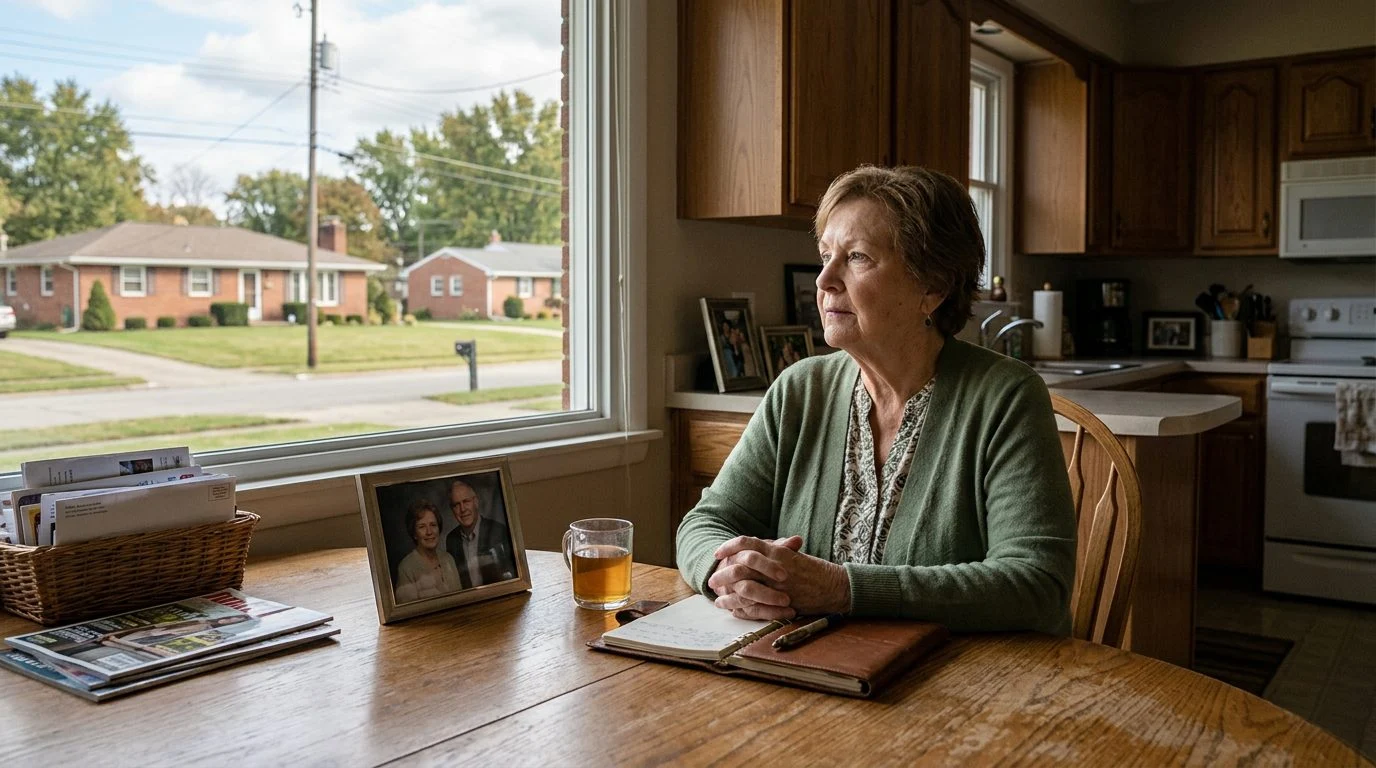
Can You Keep Your Ohio Home if a Spouse Needs Memory Care?
Caring for your spouse at home is exhausting, and a move to memory care can feel like one more decision you have to solve alone. In Ohio, many spouses who stay in the home can keep the house and stay financially secure when their spouse moves to memory care, but timing, savings and Ohio’s rules decide how it works for each family.
You do not have to work through those rules alone. Keeping up with them is the firm’s job, and we guide families step by step.
For example, imagine a couple, Ray and Dolores, who live outside Lancaster in Fairfield County. Dolores’s memory had been slipping for years, and Ray was caring for her at home alone until the nights wore him down. He was afraid that a move to memory care would leave him in an empty house with bills he could not keep up with. A planning conversation helped Ray see his options for the house and the savings, and which steps came first. Ray could then decide how to move forward at a pace he could manage. Every family’s facts are different, so your own path will look different from theirs.
Can you keep your home while your spouse is in memory care in Ohio?
Three worries usually sit behind this question, and each one has a plain answer. The first is that your spouse will be lonely or neglected in a facility. You can stay involved in visits, care decisions and daily routines, and a move can be planned around your spouse’s comfort.
The second worry is your own health. Watching over someone with dementia around the clock wears down the person doing it, and it is fair to plan for your own rest.
The third is the savings. You may fear that years of savings will go to care, with nothing left for your children.
Those worries are reasonable, and planning can address each one. We can show you what the rules mean for your home and your savings, so you are not left guessing.
What memory care means for your spouse and for you
Memory care is housing with supervision and a secure setting designed for people with dementia. It differs from home care, which brings help into your house, and from a standard nursing home, which cares for people with many kinds of medical needs.
Long-term care is more common than many families expect. The Administration for Community Living explains how much care people may need as they get older.
Ohio Medicaid can help pay for nursing homes, care at home, and many, though not all, assisted living and memory care settings. Staying home longer is possible, and most families prefer it when it is safe. A move later stays an option if your spouse’s needs change.
Our Care Navigators can help you find your way through the health care system on your spouse’s behalf when you need that help. They are not lawyers and do not give legal advice; our attorneys handle the legal side.
Why the house and the savings are counted, and what the at-home spouse may keep
Medicaid counts the couple’s savings and property, and the spouse at home is treated differently from the spouse in care. For 2026, the maximum community spouse resource standard is $162,660, as set in CMS guidance on 2026 standards.
After the month the institutionalized spouse is determined eligible for medical assistance, none of the community spouse’s resources are considered available to the institutionalized spouse, for as long as eligibility continues without a break in coverage (Ohio Adm.Code 5160:1-6-04).
For 2026, Ohio’s home equity limit is $752,000, and it rises every January. The same CMS guidance on 2026 figures lists the year’s standards.
The home equity limit does not apply to a person receiving long-term care when that person’s spouse is lawfully living in the home (Ohio Adm.Code 5160:1-6-02.1).
Back to Ray. His savings would be measured against that standard, and the house would be reviewed under the rules above. Planning can aim to keep Ray in the home and financially secure, but what that looks like depends on the couple’s own figures. Results vary with each family’s own facts, so treat Ray’s numbers as an illustration only.
How careful planning can protect your home and your savings
Planning ahead gives a couple the most room, and options can remain even after a move has started.
- Planning done well before care is needed can often help protect some of a family’s assets, depending on each family’s own situation, and we walk through those possibilities with you.
- When care is needed now, a significant part of the spend-down amount can often still be protected.
- Options can remain even when a couple has not planned early. A family may qualify for Medicaid-paid care well before all of its savings are spent.
Planning also looks at when estate recovery can apply.
Ohio’s estate recovery waits until the death of the individual’s surviving spouse, if there is one, and it also depends on other conditions in Ohio Adm.Code 5160:1-2-07.
For the spouse at home, the goal is clear: stay in the home, stay financially secure and keep quality of life intact. Careful planning can often help with all three.
In our plans, a strong financial power of attorney is one of the tools we use to protect assets. Every plan we prepare includes it, along with a health care power of attorney, a living will and a HIPAA release.
What the process looks like, from your first call to ongoing help
You start with a free discovery call, and the work moves forward in clear steps from there.
- Free discovery call: a confidential first talk about your spouse’s care, your home and your savings.
- Strategy meeting: we explain the options, and you choose a plan.
- Plan documents: we prepare the documents the plan needs.
- Assets funded: we title and coordinate your assets so they match the plan. This takes more than paperwork.
- Medicaid application: when the plan calls for Medicaid, we prepare the application.
- Ongoing guidance: we stay with you as your needs change.
How long each step takes depends on your family’s situation and when the move happens, so the first conversation covers timing. We use a flat fee with no recurring insurance-style fees. The free discovery call is confidential and carries no obligation to continue.
Plans set up and funded correctly can help a family avoid probate later, which is expensive, drawn-out and stressful for a grieving family. That is what careful planning can do for a family, though every family’s situation differs.
Common questions from spouses in your position
Here are questions spouses in this situation commonly ask.
Will I have to sell the house to pay for my spouse’s memory care?
That depends on your savings, your timing and the rules that apply to your family. The home equity limit does not apply to a person receiving long-term care when that person’s spouse is lawfully living in the home.
Will the state take our home after my spouse’s care is paid for?
Ohio can seek estate recovery only after the death of the individual’s surviving spouse, if there is one. Planning looks at this early, so the house is part of the plan from the first meeting.
What if we already spent a lot on care at home?
Options can often remain, and a significant part of the spend-down can often still be protected. We review your facts with you before deciding what is possible.
Do I need a will and a trust too?
Not every family needs the same documents. Our plans include the documents your household needs, and the right documents, funded correctly, help a family avoid probate.
How Jarvis Law Office helps you take the next step
You do not have to figure out the rules, deadlines and paperwork by yourself. That is the firm’s job, and we take it on with you.
We start by understanding your situation: your spouse’s care needs, your home and your savings. From there, we help you choose a plan that fits your spouse’s care and your family’s future, prepare the documents, and coordinate the assets so the plan works as intended. The Care Navigators can help with the health care side when you need it, and we stay with you as needs change. The firm serves families in every Ohio county from its offices in Lancaster, Dublin and St. Clairsville.
If your spouse is moving toward memory care and you are not sure what happens to the house, we would welcome a free discovery call to talk through your situation.