
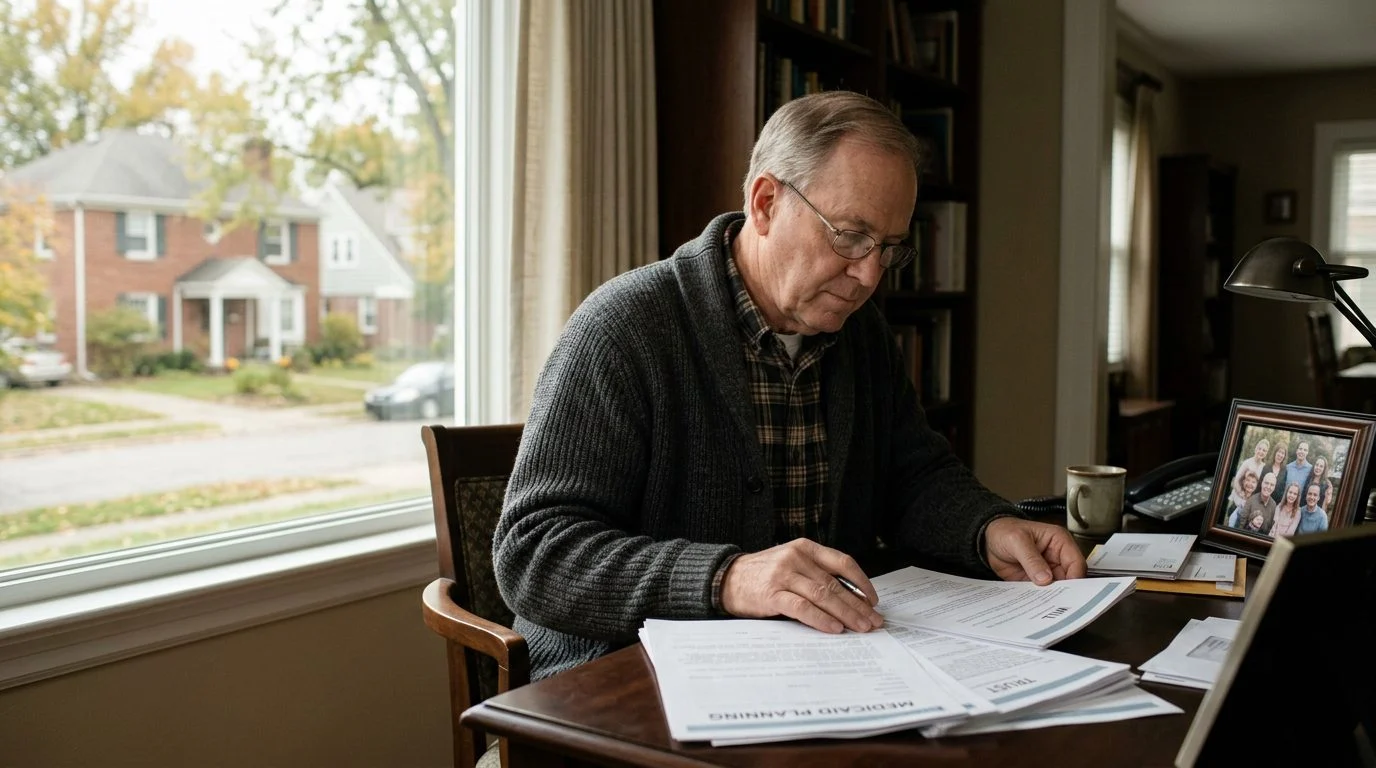
Medicaid planning for Ohio families
How Much Can the Spouse at Home Keep?
A plain-language guide for the husband or wife who stays home while a spouse needs long-term care, from a firm that helps Ohio families take it one step at a time.
Serving Ohio families from three offices
3
Offices: Lancaster, Dublin and St. Clairsville
All Ohio
We serve families in every Ohio county
By Timothy Jarvis · Published November 23, 2026
Your spouse needs nursing home care, and you are left with the bills
If your spouse has moved into a nursing home, you may be watching savings you built together shrink each month. You want to know how much you can keep, and whether you will have to sell the house you live in. Under Ohio Medicaid, the spouse who stays home is treated differently from the spouse in care, and you may be able to keep a protected share of the savings and the home.
Imagine a couple, Frank and Ruth, in a small town in southeastern Ohio. Frank’s health declined at home until he needed round-the-clock care, and Ruth was left facing the bills alone. Their son had read online that the house would be taken, and the family argued about what to do. When they finally sat down with their actual numbers, they saw more options than they expected, and they had time to plan. Every family’s facts are different, so results vary.
You do not have to work out these rules alone. Staying on top of them is our job, and we guide you one step at a time.
If your spouse has moved into a nursing home and the bills worry you, you do not have to work out Medicaid alone. We can talk through your situation on a free discovery call. Talk it through with Jarvis Law Office — the first discovery call is free, confidential, and carries no obligation.
How Ohio Medicaid looks at a married couple
Many families find these rules confusing at first, and we are glad to walk through them with you step by step. Medicaid planning starts from one goal: the spouse who stays home should still have a home and enough to live on.
Many spouses also worry that the nursing home will come after them personally for the bill. Justice in Aging explains how nursing home debt collection works and what to watch for. If you have a bill or admission paperwork in hand, bring it to us, and we will go through it with you.
How much the spouse at home can keep
The spouse at home keeps a protected share of the couple’s savings, called the community spouse resource allowance. The spouse at home’s protected savings amount, called the community spouse resource allowance, is the greatest of: one half of the couple’s combined countable resources or the community spouse maximum resource standard, whichever is less; the community spouse minimum resource standard; an amount set by a state hearing decision; or an amount set under a court order (Ohio Adm.Code 5160:1-6-04).
For 2026, the maximum community spouse resource standard is $162,660, effective January 1, 2026 (Official figure (2026)). The CMS guidance on 2026 figures lists the same amount.
In an illustration, a couple whose savings are large enough that half would exceed that ceiling would see the protected share capped at the ceiling, with the rest counted toward the spouse in care. Frank and Ruth’s numbers are only an example, not a promise about your own savings.
When the nursing home spouse is subject to a resource limit, the couple’s combined countable resources must be no more than the protected amount plus two thousand dollars (Ohio Adm.Code 5160:1-6-04).
Whether your income counts toward household income depends on which budgeting method applies to your family, including whether you and your spouse file jointly or live together, and we work through those rules with you using your family’s numbers.
The home is a separate question. For 2026, Ohio’s home equity limit is $752,000, and it rises every January. When the nursing home spouse leaves the home with no intent of returning, the home stays an excluded resource for as long as the spouse at home continues to live in it while the nursing home spouse receives long-term care services (Ohio Adm.Code 5160:1-3-05.13). The home equity figure is only a starting point, and your own home’s value and situation need a careful review.
Where Ohio Medicaid can help pay for care, and staying home longer
Ohio Medicaid can help pay for nursing home care, many (though not all) assisted living and memory care settings, and care at home. Many families want to keep a loved one at home as long as possible, and that is often possible. Most families prefer it, and a move later remains an option. Ohio Medicaid can help pay for care at home in some situations, and we will explain how that could apply to your family.
Ohio Medicaid’s facility care guidance explains how a resident’s income and allowances affect what care costs. Our team walks through how those pieces fit your family.
When care decisions get hard, our Care Navigators can help you find your way through a complicated health care system on your spouse’s behalf. They are not lawyers and do not give legal advice. They work alongside the legal planning.
The look-back period, the application and what planning can look like
Gifts and transfers made before applying are reviewed, which is why records and timing matter. Missing or unclear paperwork can slow an application or lead to a denial, so we help prepare the file with you.
Planning looks different depending on timing. Planning started well before care is needed can often shield assets from the spend-down, the money a couple uses toward care before Medicaid helps, and from estate recovery. When care is needed now, a significant part of the spend-down amount can often still be protected. Options usually remain well before all of your savings are spent.
Estate recovery, the house after a death, and avoiding probate
Careful planning can often protect the house and savings from that claim, but every family’s facts shape what is possible, and no plan can rule out every lien.
Probate is the court process for settling a person’s estate, and it can be expensive, slow and stressful for a grieving family. A plan set up and funded correctly, with the right documents and assets titled to match, is how many families skip probate later. Helping families avoid probate is part of our work, and it is a reason to plan ahead.
Many spouses also hope something is left for their children or grandchildren, rather than for the nursing home bill. Planning is how that hope is pursued, though nothing about the future is certain.
Not sure what your next step is?
Talk it through with Jarvis Law Office — the first discovery call is free, confidential, and carries no obligation.
How Jarvis Law Office helps you through this
Our team guides you step by step, and the first step is a free discovery call. The call is confidential and carries no obligation to continue.
From there, a first conversation helps us understand your family’s situation. A strategy meeting lets you choose a plan, and we then prepare the documents. Assets are funded and coordinated to match the plan, which takes more than paperwork. When Medicaid is part of the plan, we help prepare the application with you, and we offer ongoing guidance as needs change.
In our plans, the documents include a general durable power of attorney for finances, a health care power of attorney, a living will and a HIPAA release. A strong financial power of attorney is one of the key tools we use to protect a family’s assets. We work on a flat fee, with no recurring insurance-style fees. We serve families across Ohio from our offices in Lancaster, Dublin and St. Clairsville.

Common questions from spouses at home
Here are short answers to the questions spouses at home ask most often.
How much can the spouse at home keep?
For 2026, the maximum community spouse resource standard is $162,660, effective January 1, 2026. We work out your own figure with you, using your family’s numbers.
Can the spouse at home keep the house?
When the nursing home spouse leaves the home with no intent of returning, the home stays an excluded resource for as long as the spouse at home continues to live in it while the nursing home spouse receives long-term care services. Whether that applies to your home is a question we answer with you.
What if assets were moved shortly before applying?
Tell us about any gifts or transfers before anything is filed. We review them together and plan around them, rather than letting them surprise you later.
Is it too late if care has already started?
Often, no. Options usually remain well before the savings are spent, and we look at your numbers to see what is still possible.
Does the firm handle the Medicaid application step?
Yes. When it is part of your plan, we help prepare the application file with you.
What does the free discovery call cover?
It covers your spouse’s care, your savings, your home and the questions you want answered. It is confidential, and it carries no obligation to continue.
You may still be gathering information, and that is a sensible place to be. When you are ready, book a free discovery call with Jarvis Law Office and bring your numbers and your questions.
How we help the spouse at home
Numbers worked out with you
We go through your family's income, savings, home and monthly bills, so the figure we use is your family's own and not a rule of thumb.
A plan for the home and savings
Once we know what you can keep, we look at how your home, accounts and income are titled, and we set up a plan that fits your goals for the years ahead.
Care Navigators when you need them
Our Care Navigators can help you find your way through the health care system on your spouse's behalf, from nursing home choices to care at home.
Documents that work together
Every plan we prepare includes a general durable financial power of attorney, a health care power of attorney, a living will and a HIPAA release. A strong financial power of attorney is one of the tools our planning uses to protect a family's assets.
A conversation before any decision
Your free discovery call is confidential and comes with no obligation to continue. It is the place to ask your questions and decide what to do next, at your own pace.
Talk with us before you move money
Moving accounts, deeds or gifts in a hurry can create problems that are hard to undo. Call us first so we can look at your family's facts before anything changes hands.
What to gather before your call
Account statements
Recent bank, retirement and investment statements for both spouses, if you have them.
Income records
Social Security, pension and other monthly income letters, along with the names of the payers.
Home and deed
The deed to your home and a rough sense of what it is worth and what is owed on it.
Dates and care details
When your spouse entered care or when you expect that move, and where your spouse is living now.