
Medicaid planning for Ohio families
Ohio Medicaid Planning When the Spouse at Home Is Also Sick
Your own health is part of the plan, and you do not have to sort out the rules alone.
3
offices: Lancaster, Dublin and St. Clairsville
Every Ohio county
We serve families across the state
By Timothy Jarvis · Published November 20, 2026
When your spouse needs nursing home care and you are also ill, the home, the savings and your own decisions can all feel at risk at once. Ohio Medicaid planning can often help the spouse at home keep a share of the couple’s resources and income, and protect the home. Here is how that works, in plain words.
You do not have to figure out these rules alone. Keeping up with them is the firm’s job, and we guide families step by step.
When your spouse needs nursing home care and the decisions and bills land on you
Planning can help you protect your home, your savings and your own decisions, and it starts with a clear look at your family’s facts.
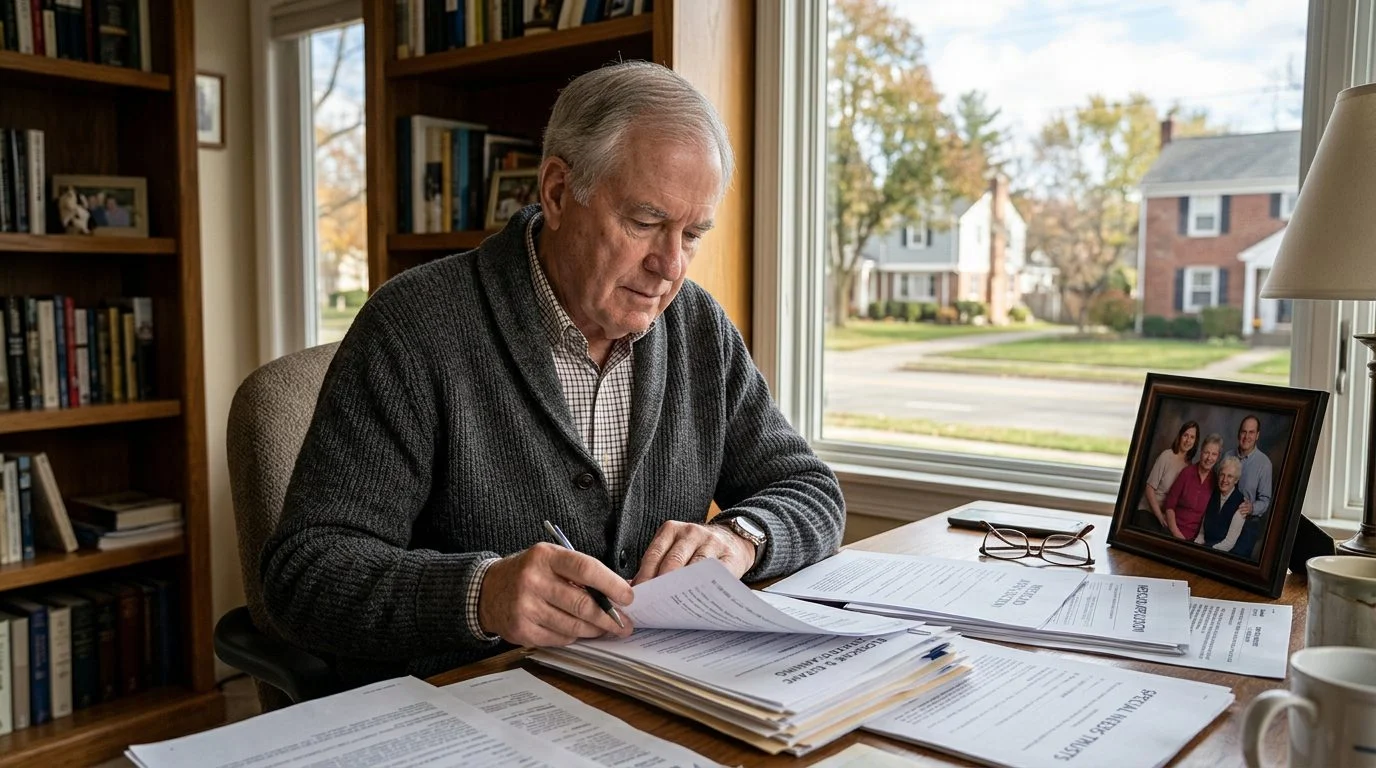
For example, imagine a couple, Ellen and George, in a small town in southeastern Ohio. Ellen has a serious heart condition. George’s memory has declined until he needs nursing home care. Ellen worries the bills will take the house, and she is not sure how she will manage money while her own health fails. Planning helped them see their options, including what the spouse at home can protect. Every family’s facts are different, so what planning can do for yours depends on your own situation.
You want to keep your own health and decisions in your hands. You want to protect what the two of you built. And you may want to stay in your home if that is your wish. Those goals guide how we plan. The Administration for Community Living reports that almost 70% of people turning 65 are likely to need some long-term care.
If your spouse may need nursing home care while you manage your own illness, you do not have to face the home and savings alone; reach out and we will talk through your options with you. Talk it through with Jarvis Law Office — the first discovery call is free, confidential, and carries no obligation.

What Ohio Medicaid can help pay for when your spouse needs care
Ohio Medicaid can help pay for nursing home care, many assisted living and memory care settings, and care at home. Not every facility or setting qualifies, so check the setting before any move. The Ohio Medicaid facility-care guidance explains how income and the community spouse allowance affect nursing facility payment.
Many families want to stay home longer, and most prefer it when it is possible. Staying home longer is possible for many families. If care needs grow, a move later remains an option.
Medicaid looks closely at income and assets. For the spouse at home, the rules about what counts are where planning does most of its work. We walk through those details with you on your discovery call, using your own numbers.
What you can keep: the home, savings and income of the spouse at home
The spouse at home can often keep a share of the couple’s resources, a share of income and the home. The amounts depend on your facts.
The at-home spouse may keep a share of the couple’s combined countable resources, called the community spouse resource allowance, and the couple’s combined countable resources may exceed that amount by no more than two thousand dollars (Ohio Adm.Code 5160:1-6-04).
For 2026, the federal maximum community spouse resource standard is $162,660, which is one of the figures that shapes how much you can keep.
During any month in which the institutionalized spouse is eligible for long-term care services in a medical institution, home and community-based services waiver, or PACE, none of the at-home spouse’s income is considered available to the institutionalized spouse (Ohio Adm.Code 5160:1-6-04).
For 2026, Ohio’s home equity limit is $752,000, and it rises every January. The home equity limit does not apply to a person when that person’s spouse is lawfully living in the home (Ohio Adm.Code 5160:1-6-02.1). That is why the home is often the first thing families ask about.
Planning can often keep the spouse at home in the home, financially secure, with quality of life intact. Your home, your joint accounts and how each is titled all shape what is protected, so we look at them together.
Planning ahead: what asset protection can look like for your family
Planning started early usually gives a family the most room to protect assets. A transfer of assets for less than fair market value made on or after the look-back date is presumed improper, though the presumption can be rebutted with a satisfactory showing to the agency, and the look-back date is sixty months (five years) before the individual’s baseline date (Ohio Adm.Code 5160:1-6-06). That is why timing matters so much.
- Planning ahead, before care is needed, often leaves a family with more choices, and we can walk through those choices with you.
- If care is needed now, or the look-back is a problem, a significant part of the spend-down amount can often still be protected.
- Options often remain even when a family feels late, and many families can qualify for Medicaid-paid care well before spending everything.
We review your facts before suggesting anything, and we tell you plainly what we see.
Protecting your own health and decisions while you are also ill
A strong financial power of attorney lets someone you trust manage money if you cannot. In our plans, it is one of the main tools for protecting the family’s assets.
Every plan we prepare includes a general durable power of attorney for finances, a health care power of attorney, a living will and a HIPAA release. In our plans, the health care power of attorney and the living will are the advance directives. The financial power of attorney and the HIPAA release are not.
Our Care Navigators can help you and your family find your way through the health care system when that help is needed. They are not lawyers and do not give legal advice.
A plan set up and funded correctly can help a family avoid probate later. That careful setup is the part of the work we do ahead of time.
How the planning process works with Jarvis Law Office
Planning with us moves in steps, from your first conversation to ongoing guidance. We start by understanding your situation. A strategy meeting then helps you choose a plan, and we set up the plan documents.
Next we fund and coordinate your assets so they match the plan, which takes more than paperwork. When care is needed, we handle the Medicaid application. Our help continues as your needs change. For a nursing home application, our Medicaid application documents guide lists what families usually gather.
We charge a flat fee, with no recurring insurance-style fees. Your first call is a free discovery call. It is confidential and comes with no obligation to continue.
Not sure what your next step is?
Talk it through with Jarvis Law Office — the first discovery call is free, confidential, and carries no obligation.
Questions families ask when a spouse at home is also ill
Most answers come down to your family’s own situation, and a short call is the fastest way to sort them out.
Will I have to sell the house to pay for my spouse’s nursing home care?
Not always. Planning can often keep the home for the spouse at home, and we review how your home is titled to see what applies.
Does it matter that I am the one who is sick?
Yes. Your own health and decisions are part of the plan, so your power of attorney and health care documents matter as much as the money.
Do we have to spend everything before Medicaid can help?
Not necessarily. The at-home spouse may keep a share of the couple’s combined countable resources, called the community spouse resource allowance, and the couple’s combined countable resources may exceed that amount by no more than two thousand dollars. Planning looks at what the spouse at home can keep.
What if we are already in the middle of a move to a nursing home?
Options often remain. The first step is a conversation, and we can look at timing with you.

Talk with us about your spouse’s care and your own health
If your spouse needs or may soon need nursing home care while you manage a serious illness of your own, you do not have to plan through it alone. Our offices are in Lancaster, Dublin and St. Clairsville, and we serve families across Ohio. Reach out to our team and we will set a time to talk about your home, your income and your own decisions.
How Jarvis Law Office helps
A calm first conversation
We start by hearing your whole situation, including your own health, your spouse's care needs and what the home and savings look like today. Nothing has to be decided in that first talk.
A plan chosen together
We lay out the possibilities for your family in plain words and help you choose the approach that fits your goals, from keeping the home to protecting the savings you have worked for.
The right documents in place
Your financial power of attorney, health care power of attorney, living will and HIPAA release are part of every plan we prepare, so the people you trust can act for you if you cannot.
Medicaid application support
When the time comes, we guide the Medicaid application step by step, so your spouse's care and your own needs are both kept in view.
Care Navigators at your side
Our Care Navigators can help you find your way through the health care system on your behalf when you need that help. They are not lawyers and do not give legal advice, and our attorneys handle the legal planning.
Ongoing guidance as needs change
Health and finances shift over time. We stay with you as the plan needs updating, so the rules do not become one more thing to carry alone.
Talk with us before you move money or sign anything
Signing a deed, moving savings or adding someone's name to an account can change how your plan works. Please speak with us first, even if the step seems small or urgent.
Possibilities we look at with families
Keeping the home
Depending on how the home is titled and your family's facts, planning may be able to help the spouse at home stay in the house rather than sell it to pay for care.
Protecting savings for the spouse at home
Some planning may help keep a portion of the couple's savings available to the spouse who remains at home, so that person is not left without financial security.
Your own health and decisions
When you are ill too, your power of attorney and health care documents matter. We make sure the people you choose can act for you if you need them to.
Care at home or in a facility
Ohio Medicaid can help pay for nursing home care, many assisted living and memory care settings, and care at home. Staying home longer is often possible, and a move later stays an option.