
Medicaid and long-term care planning · Ohio families
Nursing Home Medicaid: Whose Savings, and What About Children From an Earlier Marriage?
A spouse at home, a parent's care, and a family with more than one set of children: you do not have to work through these questions alone.
By Timothy Jarvis · Published November 21, 2026
When your husband needs nursing home care and you have children from an earlier marriage, the question is simple to ask and hard to answer: whose savings count, and what happens to the house? Ohio Medicaid looks at your savings and home together with his, and the spouse at home has protections that planning can build on.
This page explains how that review works, what planning can look like, and what a first step can be.
Whose savings count when your husband is in a nursing home?
Medicaid starts by looking at the couple’s resources together, not only the accounts in his name. Your savings, your home and your income all matter, and so do any gifts or ownership changes made in the years before care.
Your children from an earlier marriage are part of your family’s picture. How your assets are titled, and where they have gone, shapes what planning can do. Each piece is reviewed one at a time, and many details turn on your own facts.
Many spouses at home are surprised by how much the review covers, so it helps to see the whole picture early. You do not have to work all of this out alone. Staying on top of the rules is our job, and we walk through each piece with you, step by step.

For example: a spouse at home, a remarriage and a house
A made-up example can show how these pieces fit together in a real household.
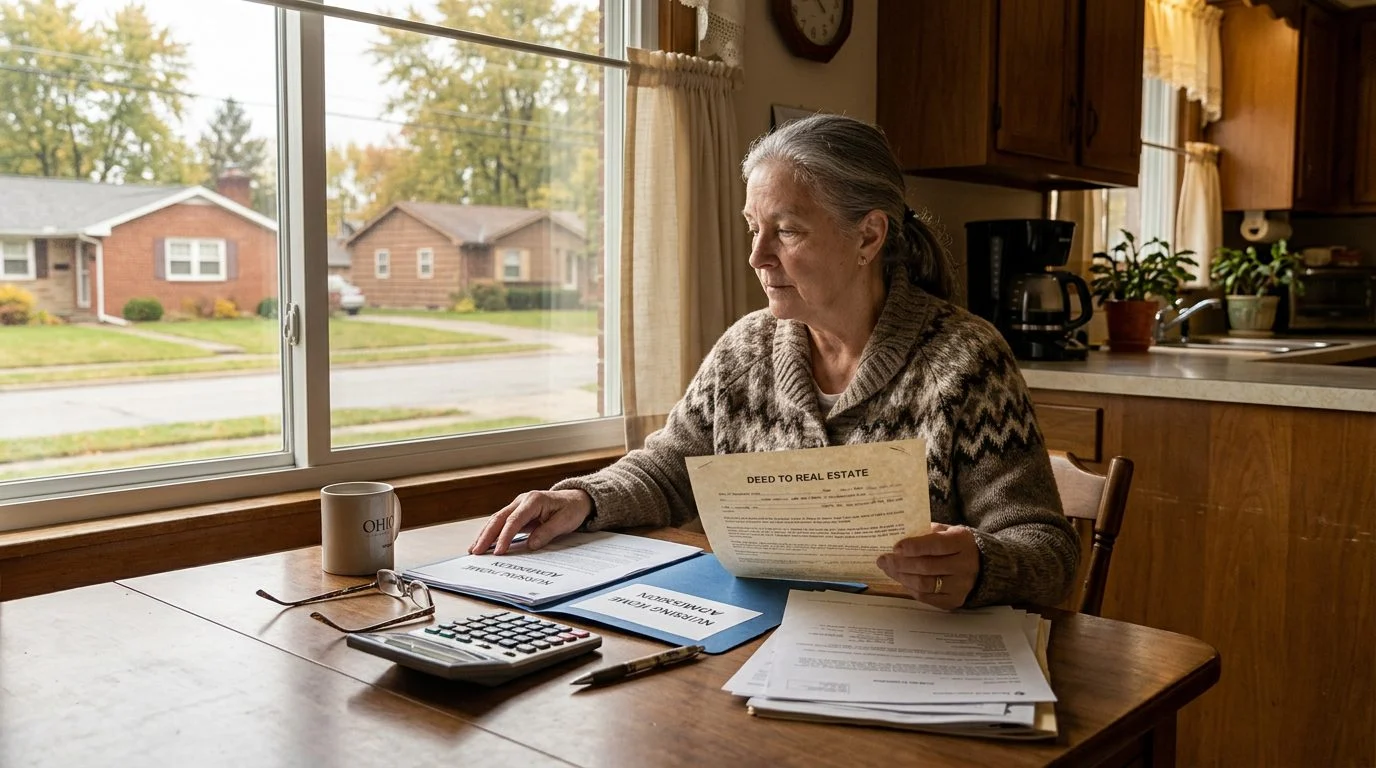
For example, imagine a couple, Ruth and Walt, who live in New Lexington in Perry County. Walt’s memory has been slipping for two years, and this spring he moved into a nursing home. Ruth stayed in the house they bought long ago, and she fears having to sell it to pay the bills. Her two grown children from her first marriage have strong opinions, and each wants to help in a different way. At a first conversation with a lawyer, Ruth learned she had more choices than selling or running out of money. Planning might look like keeping her at home while protecting part of her savings, based on the facts in her family. Every family’s facts are different, so results vary and no two plans look the same.
How does Ohio Medicaid count both spouses’ savings and the home?
Medicaid counts the couple’s resources together at first, and the spouse at home keeps a protected share. That protected share is one of the most important numbers in your planning.
Once the nursing-home spouse has been determined eligible for Medicaid, the at-home spouse’s own resources are not treated as available to the spouse in the facility, for as long as the spouse stays in the institution continuously (42 U.S.C. § 1396r-5).
For 2026, the maximum community spouse resource standard is $162,660, and that figure changes each year. It is one part of the picture, because income, monthly needs and how each asset is titled matter too. You can see the federal figures in the CMS bulletin on 2026 spousal standards.
Many families have heard of Ohio’s home equity limit. For 2026, Ohio’s home equity limit is $752,000, and it rises every January.
The home equity limit does not apply to an individual when the individual’s spouse is lawfully residing in the home (Ohio Adm.Code 5160:1-6-02.1).
Whether a particular asset is counted depends on the facts, which we review with you.
What about gifts and transfers to children from an earlier marriage?
Gifts or ownership changes made before care starts can matter, because Medicaid looks back at them.
A transfer of assets for less than fair market value made by the institutionalized spouse or the other spouse on or after the look-back date, which is sixty months (five years) before the baseline date, is presumed an improper transfer (Ohio Adm.Code 5160:1-6-06).
Many couples have helped their children over the years, and that help is common. What matters most is whether the asset was transferred for less than fair market value on or after the look-back date, since such a transfer is presumed improper. Certain transfers are not considered improper, and the reason for the transfer is one of the things used to rebut that presumption; we review each one with you. Planning done well before care is needed can sometimes help protect assets, but what is possible depends on each family’s own situation, and we would walk through those details with you. If care is needed now, or a past transfer falls inside the look-back, a significant part of the spend-down amount can often still be protected.
This rule covers the treatment of transfers of assets for an institutionalized individual seeking Medicaid payment for long-term care, not estate recovery after death.
Ohio’s estate recovery law bars the state from collecting from a permanently institutionalized individual’s estate while that person’s spouse is still alive, but this protection is temporary, and recovery can still follow after the spouse has died (R.C. 5162.21).
Which planning options can protect the spouse at home?
Planning can often keep the spouse at home financially secure, in the home, with quality of life intact. Ohio Medicaid can help pay for nursing homes, many (not all) assisted living and memory care settings, and care at home. Ohio’s nursing facility coverage page shows how income and allowances affect the cost of facility care.
Staying home longer is possible, and many families prefer it. A move later stays an option.
In our plans, we include a general durable power of attorney for finances, a health care power of attorney, a living will and a HIPAA release. A strong financial power of attorney is one of the tools our planning uses to protect a family’s assets.
A plan set up and funded correctly can help a family avoid probate later. Probate is the court process for settling a person’s estate, and it can be slow, costly and hard on a grieving family. Getting that planning right is our part, so your family can skip probate later.
How Jarvis Law Office helps you through this
We guide you step by step, from the first conversation to ongoing help as your needs change. Jarvis Law Office focuses on elder law, Medicaid planning and estate planning, and serves families in every Ohio county from offices in Lancaster, Dublin and St. Clairsville.
The first conversation looks at your husband’s situation, your household and what matters most to you. A strategy meeting follows, where you and the team choose a plan that fits. Next, we set up the plan documents, then fund and coordinate your assets to match the plan. That is more than paperwork, and it is where much of the planning takes shape.
When a Medicaid application is needed for a nursing home stay, we walk you through that step too. Care decisions can be hard to navigate, so our Care Navigators can help your family find a way through the health care system on your husband’s behalf when that help is needed. They are not lawyers and do not give legal advice. Our fee is a flat fee, with no recurring insurance-style fees.
Questions people ask about a spouse in a nursing home
Here are short answers to four questions families in your position often ask.
How do I avoid Medicaid clawback?
Medicaid estate recovery cannot be pursued against a permanently institutionalized individual’s estate while that individual’s spouse is alive.
The timing of planning and how your assets are titled are the parts we review with you.
When should my husband move into a nursing home?
That is a health and family decision, and our Care Navigators can help you sort through the options. Planning often has more options when it starts before care becomes urgent.
How do I deal with the guilt of putting my husband in a nursing home?
Many spouses feel this, and it is a hard decision. The care choice belongs to your family, and our job is the money and paperwork, so you can focus on him.
What is the income requirement for Medicaid in Ohio?
Household income is reviewed with your full household picture, not a single number. We walk through it with you on the free discovery call.

Take the next step: a free discovery call
If you are still gathering answers, a free discovery call is a calm place to start. You may be researching this on your husband’s behalf, in a season you did not choose, and you may not be ready to hire anyone yet. That is a normal place to begin.
Our free discovery call is confidential and carries no obligation to continue. We can talk through whose savings count in your household and what your options could look like. When you are ready, schedule your free discovery call with our team.
How Jarvis Law Office guides your family
A clear first conversation
Our free discovery call is confidential and carries no obligation to continue. We listen to your family's situation and explain the questions in plain words.
A plan that fits your family
We map out whose savings and property are involved, how the spouse at home is looked after, and what each option would mean for your family before any decision is made.
Care Navigators beside you
When the health care system feels fragmented, our Care Navigators can help you find your way through care decisions on your loved one's behalf. They do not give legal advice.
Ongoing guidance as needs change
Care needs shift over time. We stay with you, step by step, so the plan keeps pace with your family's circumstances.
Plan while you have time to think
Families often have more choices when they begin the conversation before a move to a nursing home is urgent. Our attorneys can walk you through the options so the decision is made with care rather than under pressure.
Questions families bring to us
Whose savings are counted?
When one spouse needs nursing home care, we review the money and property each spouse holds and explain how those assets are looked at.
Children from an earlier marriage
Blended families have their own concerns. We talk through how your children and stepchildren, and your own wishes, fit into the plan.
Keeping the spouse at home secure
We look at ways the spouse who stays at home can remain in the home and maintain a stable financial life.
Planning for your own future
If you are planning ahead rather than facing a crisis, we can help you prepare documents and a plan before care is needed.