
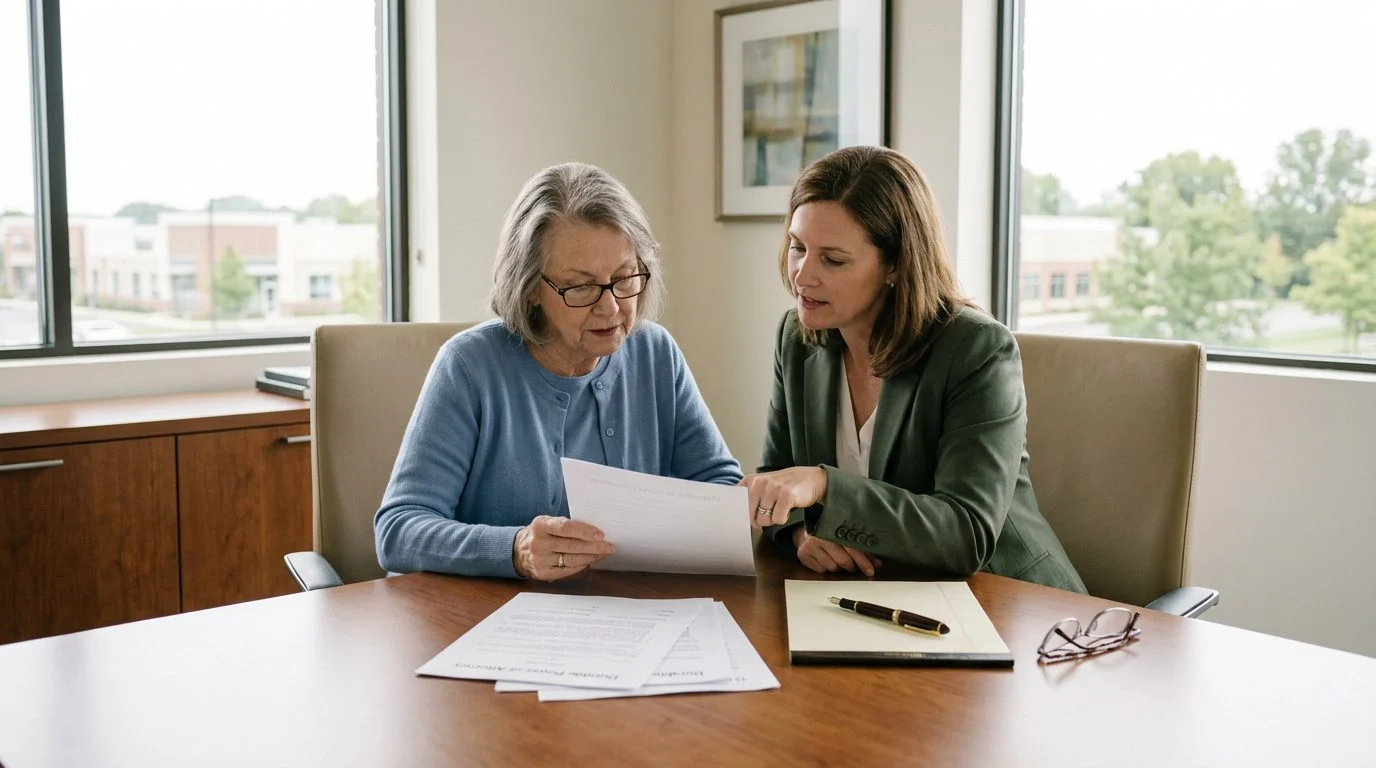
Elder law and estate planning | Serving families across Ohio
After a Move to a Nursing Home, Is Your Will and Power of Attorney Still Right?
When a parent or spouse moves into care, the paperwork often has to change too. We help families look at what is in place and decide what needs to happen next.
Serving Ohio families from three offices
3
Offices in Lancaster, Dublin and St. Clairsville
Ohio
Families served in every Ohio county
By Timothy Jarvis · Published November 28, 2026
When a spouse moves into a nursing home, the spouse at home usually needs to update their own will and powers of attorney. Those papers were often written for a life that has changed, and they may name the wrong person to act now.
You don’t have to work out these rules by yourself. Here is what to review, what planning can look like, and how Jarvis Law Office guides you through it.
When your spouse moves into a nursing home, your own papers need a second look
Yes, your own papers should be checked once your spouse enters long-term care. For example, imagine a couple, Ruth and Dale Kessler, in a small Ohio town. Dale moved into a nursing home after a long decline at home, and Ruth stayed in their house, afraid the monthly bill would drain their savings. Her will and power of attorney still named Dale to act for her, which no longer fit her life. Reviewing the plan helped Ruth see who could act for her now and what options existed for the home. Every family’s facts are different, and results depend on those details.
Your will and powers of attorney were probably signed when you both managed your own affairs. Now one of you needs care, and those papers may name the wrong person, or no one at all. Keeping up with these rules is the firm’s job, and we guide you step by step. This page is for you as the spouse at home. Your spouse in care has separate documents to review.
If your spouse has just moved into a nursing home, you don't have to sort out your own papers alone, and a first conversation with our team is a calm place to start. Talk it through with Jarvis Law Office — the first discovery call is free, confidential, and carries no obligation.
What updating your own documents covers
Updating your own documents means reviewing five papers that work together. They are your will, a financial power of attorney, a health care power of attorney, a living will and a HIPAA release.
- Your will. It decides who inherits what you own and who settles your estate. We check how it fits with the home and with your spouse’s Medicaid plan.
- General durable financial power of attorney. This is a key asset-protection tool in our plans. It names who can handle bank accounts, bills and property if you cannot.
- Health care power of attorney and living will. These guide care decisions if you can’t make them yourself, including choices about nursing homes and hospitals.
- HIPAA release. It lets the people you choose speak with doctors and facilities about your health information.
We explain each document in plain words and tie it to your household, not to a generic form.
Protecting the home and savings: what planning can look like for you
Planning looks at your savings, income and home together, so you can see what can be protected. After the month the institutionalized spouse is determined eligible for Medicaid, the community spouse’s resources are not treated as available to that spouse, for as long as eligibility continues without a break in coverage (Ohio Adm.Code 5160:1-6-04).
For 2026, the maximum community spouse resource standard is $162,660, according to CMS guidance on 2026 spousal standards.
Estate recovery is the other concern many spouses raise. Ohio may seek estate recovery only after the death of the individual’s surviving spouse, if any, and only when the other conditions of the rule are also met (Ohio Adm.Code 5160:1-2-07). Depending on your family’s facts, planning can often reduce that exposure for the home and other assets.
Depending on your facts, planning can often protect a significant part of the money that would otherwise be spent down on care. These are possibilities, not promises, and each plan is built around your own numbers.
Avoiding the Medicaid mistakes that cause delays or penalties
Most costly Medicaid mistakes come from moving money or property at the wrong time. A transfer of assets for less than fair market value made on or after the look-back date, which is sixty months (five years) before the baseline date, will be presumed improper and will result in a restricted Medicaid coverage period (Ohio Adm.Code 5160:1-6-06).
Gifts, retitled accounts or transfers to children made in that window can lead to a penalty period. Transfers between spouses are handled differently. Transfers of assets between the institutionalized spouse and his or her spouse, or to another person for the sole benefit of that spouse, are not considered improper (Ohio Adm.Code 5160:1-6-06). Even so, any change you make during your spouse’s application can affect eligibility, so talk with us before you move anything.
Ohio Medicaid can help pay for nursing home care, and the application is detailed, so accuracy and organization matter. Ohio Department of Medicaid explains how facility care is paid. Staying home longer is possible, which most families prefer, and a move later stays an option.
Nursing homes sometimes ask a spouse to sign a document accepting responsibility for the bill. Justice in Aging explains why that paper deserves careful review before you sign it. The exceptions and detailed rules are something we walk through with you in your own situation.
How the process works, step by step
Here is what to expect when you work with us.
- Discovery call. Start with a confidential discovery call, free and without obligation to continue, to talk about your home, your savings and your spouse’s care.
- Strategy meeting. You and the firm choose a plan that fits your home, income and your spouse’s care.
- Plan documents prepared. Your will, powers of attorney, living will and HIPAA release are drafted.
- Assets funded and coordinated. Titles and accounts are matched to the plan. This is more than paperwork.
- Medicaid application prepared. For your spouse in care, if it fits the plan.
- Ongoing guidance. We stay with you as needs change. Our fee is a flat fee, with no recurring insurance-style fees.
Why a plan set up and funded correctly helps your family skip probate
Probate is the court process for settling an estate. It can be expensive, drawn out and stressful for a grieving family.
Careful planning is what can help your family skip probate later. That means the right documents are in place and your assets are titled and coordinated to match. This is what careful planning can do, not a guarantee.
Many spouses at home want what remains to go to their children and grandchildren, not to a nursing home bill or the state. A plan built now can help you make that wish clear and easier to carry out.
Not sure what your next step is?
Talk it through with Jarvis Law Office — the first discovery call is free, confidential, and carries no obligation.
How Jarvis Law Office helps you
Jarvis Law Office guides you through each step, so you do not have to do this alone. Our team focuses on elder law, Medicaid planning and estate planning, and Timothy Jarvis is the lawyer responsible for this page’s content.
Your first conversation is about your situation. We listen to what your home, savings and income look like, and we explain the flat fee before any work begins.
Care Navigators can also help. They guide families through the health care system around a nursing home stay, on your behalf, when you need that help. Care Navigators are not lawyers and do not give legal advice. National Consumer Voice explains the rights families have in care decisions, and we help you think through those choices alongside your legal plan.
Common questions from spouses at home
Do I have to sell the house to pay for my spouse’s nursing home care?
It depends on your home, savings and income. Planning can often help you keep the home.
Does my own will still matter if my spouse is in a nursing home?
Yes. Your will decides who inherits what you own and who settles your estate.
Why does my financial power of attorney matter for protecting our savings?
It names who can manage your bank accounts and bills if you cannot. It is a key asset-protection tool in our plans.
What happens to the home after my spouse dies?
Ohio may seek estate recovery only after the death of the individual’s surviving spouse, if any, and only when the other conditions of the rule are also met. We review how that would apply to your home.
What should I avoid doing with money while my spouse’s application is pending?
Don’t move money, retitle property or make gifts before talking with us.
Can I keep my documents separate from my spouse’s?
Yes. Each spouse usually has their own will and powers of attorney, and we review them side by side.

Take the next step: a free discovery call
If your spouse has just moved into a nursing home, you may be worried about the savings, the house and your own future. Your papers may no longer match your life, and you don’t have to sort that out alone. Our first step is a conversation. The free discovery call is confidential and carries no obligation to continue. Contact Jarvis Law Office to talk through what you want for your spouse and for yourself.
How Jarvis Law Office helps your family update the plan
We review what is already signed
We start by reading the will, the power of attorney and the health care documents you already have, so you know which parts still fit your parent's or spouse's situation.
We update the documents to match
Once the decisions are clear, we prepare the changes and make sure the power of attorney and will work together with the way the family's assets are titled.
We explain each choice in plain words
You do not have to decide everything at once. We walk through each option step by step and answer your questions before anything is signed.
Care Navigators when the family needs help
Our Care Navigators can help your family find a way through the health care system on your parent's behalf. They do not give legal advice, and our attorneys handle the legal work.
Do not wait for the next crisis to review these papers
Documents that were signed years ago may no longer name the right person to make decisions or match the way the family is living now. Looking at them while there is still time to talk gives your family room to make careful choices.
Questions to bring to your first call
Who is acting under the power of attorney?
Ask whether the person named still can and still should handle money and property for your parent or spouse.
What does the will say about the home?
Find out what happens to the house and savings if a spouse or parent is in care and the will has not been updated.
Who speaks for health care decisions?
Check who holds the health care power of attorney and whether a living will is in place for the care ahead.
How does the plan fit the care that is coming?
Bring the bills, the care facility's paperwork and your questions, and we will look at them together.