
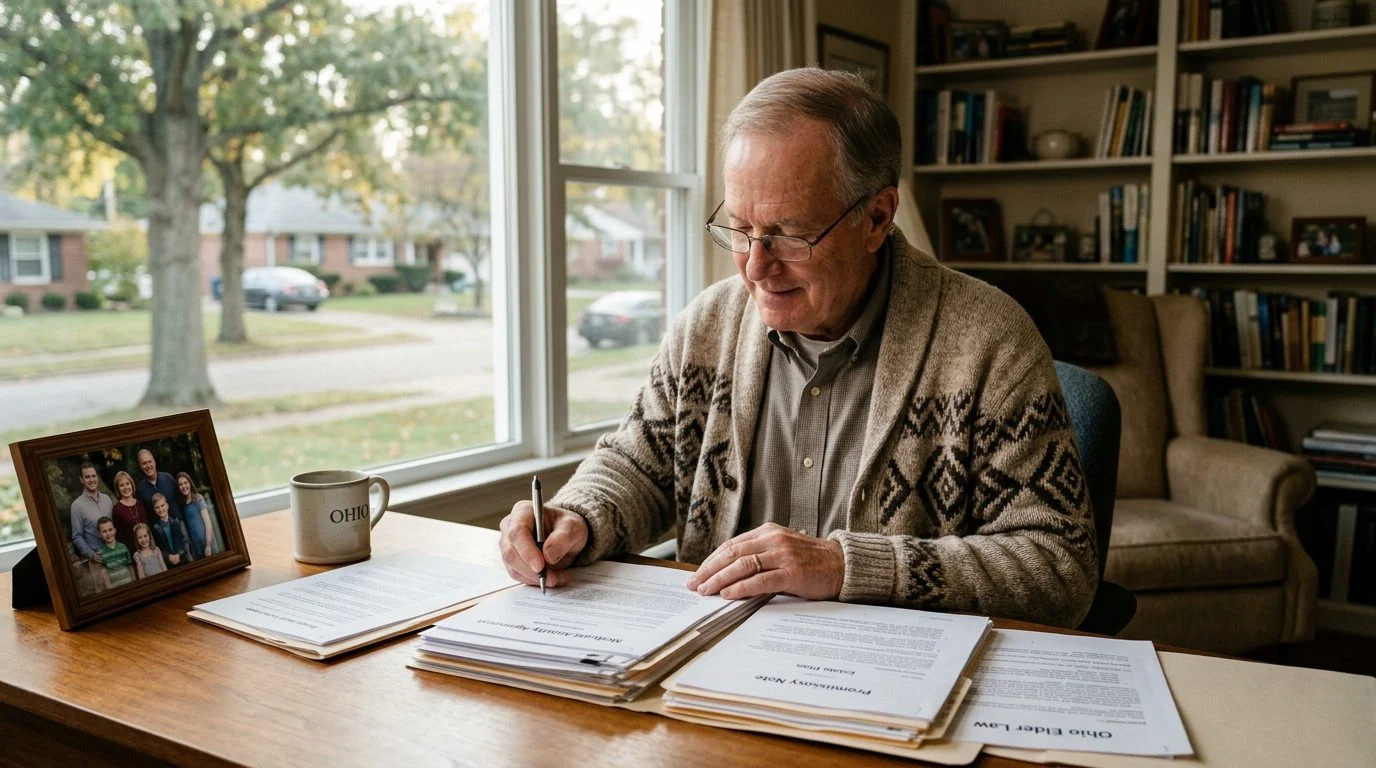
Medicaid planning · Ohio · Serving families in every Ohio county
Planning for the spouse who stays at home
Annuities and promissory notes are tools some Ohio couples use when one spouse needs care. Here is what they are, in plain words, and how we help you decide whether they fit your family.
3 offices
Lancaster, Dublin and St. Clairsville
Every county
We serve Ohio families across the state
Flat fee
Stated before we begin
By Timothy Jarvis · Published November 23, 2026
Your spouse is in a nursing home, and you’re worried about the money
Your spouse has moved into a nursing home, the bills keep arriving, and you’re at home wondering whether the savings and the house will be lost. You came here asking whether a Medicaid annuity or a promissory note could help. Short answer: both are planning tools families discuss when one spouse needs nursing home care and the other stays home, and whether either fits turns on your family’s own facts.
Many spouses in your place feel overwhelmed, and that’s understandable. Overwhelmed isn’t the same as stuck. Ohio Medicaid can help pay for nursing home care, and the way the couple’s money and home are arranged shapes what the spouse at home can keep. You don’t have to figure out those rules by yourself. Staying on top of them is the firm’s job, and we guide you one step at a time. This page explains both tools, what they mean for the spouse at home, and the questions worth asking.
If your spouse has just moved into a nursing home, you don't have to work out Medicaid's rules alone, and a free discovery call is a calm place to start. Talk it through with Jarvis Law Office — the first discovery call is free, confidential, and carries no obligation.
What a Medicaid annuity and a promissory note are, and who they fit
A Medicaid annuity is a contract that pays income over time. A promissory note is a written loan, repaid on set terms. Families consider both when one spouse needs nursing home care and the other stays at home, because each can change how money is arranged. They usually come up when the spouse at home wants to see every option before deciding anything.
Annuities come with strict conditions. Buying an annuity, including one bought by a spouse, is treated as an improper transfer that brings a restricted coverage period unless Ohio is named as a remainder beneficiary in the positions the law requires, and an annuity bought by the person applying for benefits must also meet further conditions that we walk through with you (Ohio Adm.Code 5160:1-6-06.1).
Those conditions are why an annuity is never a simple purchase. We review its terms closely with the family and explain each one in plain words before anything is signed. Promissory notes raise their own questions. Their terms, the people involved and the timing all matter, so a note that looks simple on paper still needs careful review.
For example, imagine a couple, Carol and Dale Hostetler, in a small town near Zanesville. Dale moved into a nursing home after his memory began to fail, and Carol stayed in their house. She was afraid the savings would run out and that she would have to sell the home to pay the bills. They met with a lawyer who explained which tools might fit their facts and which would not, and Carol left with a clear list of documents and a next step. Every family’s facts are different, and the Hostetlers’ story is not a forecast for yours.
Keeping the home and enough income to live at home
The first number to understand is the amount the spouse at home may keep. The amount of resources you may keep as the at-home spouse is the greatest of several amounts, and one of those amounts is one half of the couple’s combined countable resources or the maximum standard set annually by CMS, whichever is less (Ohio Adm.Code 5160:1-6-04). For 2026, the federal maximum for this standard is $162,660, according to Medicaid.gov guidance for 2026. When Ohio works out whether the spouse in the nursing home qualifies, it uses its own spousal calculation instead of the general income and resource deeming rules, and the spouse at home is allowed to keep a set amount of the couple’s savings. Before any money is moved, ask us to work out those figures for your situation.
Most people’s biggest fear is the house. The home equity limit is the number people hear most. For 2026, Ohio’s home equity limit is $752,000, and it rises every January. The home equity limit does not apply when the person needing care has a spouse who is lawfully living in the home (Ohio Adm.Code 5160:1-6-02.1). We look at your house with that in mind.
Planning can often keep the spouse at home in the home, financially secure, with quality of life intact. These are possibilities that depend on your facts, and we explain them as we go. You shouldn’t have to sign anything to hear what they could look like.
How the planning works, from the first call to the application
Planning moves through six steps, and each one builds on the last. First comes a first conversation, where we learn your family’s situation, your spouse’s care and what you have. Next is a strategy meeting, where we review the options and choose a plan together. Then we set up the plan documents, and we fund and coordinate the assets so they match the plan. That step takes more than paperwork, because titles and accounts must line up with the plan to work.
In our plans we include a general durable financial power of attorney, a health care power of attorney, a living will and a HIPAA release. The financial power of attorney is one of the key asset-protection tools in our planning, because it lets a trusted person handle money if you can’t.
The Medicaid application comes next. A missed document or a title that doesn’t match the plan can slow the file, so we prepare it with care. Once your spouse is in the nursing home and has been determined eligible for Medicaid, none of your resources may be counted as available to your spouse for as long as the stay continues (42 U.S.C. § 1396r-5). Last, we stay involved as needs change, since a family’s situation rarely stays still.
Timing, the look-back and estate recovery: what shapes the outcome
Timing is the part families most often underestimate. Money moved before an application is reviewed closely, so the order of steps matters as much as the steps themselves. Planning that starts well ahead of care can often give a family more room to protect savings and the home. These are possibilities, not outcomes.
When care is needed now, planning is still worth a conversation. Even with a tighter timeline, a significant part of the money a family expected to spend can often still be protected. Options remain well before everything is spent, but each path turns on your facts.
Many people fear estate recovery, the state’s claim for repayment after a Medicaid recipient dies. How it reaches a home turns on who lives there and what the family owns. Planning can often address how the home and savings pass, and we review that with you.
Careful planning can also help a family avoid probate later. Probate is often expensive, slow and stressful for a grieving family. A plan with the right documents, and with assets titled to match it, can help your family skip probate.
How Jarvis Law Office helps the spouse who stays home
Our firm concentrates its practice in elder law, Medicaid planning and estate planning. Our attorneys guide your family step by step, so you aren’t left to decode each form alone. Ohio Medicaid can help pay for nursing homes, many (not all) assisted living and memory care settings, and care at home. The Ohio Department of Medicaid’s nursing facility care page explains how income and allowances affect that care. Staying home longer is possible for many families, and a move later stays an option.
For older Ohioans who want to stay home, the Ohio PASSPORT waiver provides home- and community-based services. Our Care Navigators can help you find your way through a complicated, fragmented health care system when you need that help. They support your family with care decisions and do not give legal advice.
For you, that means a conversation first, then a plan, documents set up, assets funded to match the plan, and an application prepared with care.
Not sure what your next step is?
Talk it through with Jarvis Law Office — the first discovery call is free, confidential, and carries no obligation.
Questions people in your position ask
Will I lose the house if my spouse is in a nursing home?
Losing the home is not a foregone conclusion, and planning can often help you keep it. We review the home, your income and your spouse’s care together.
Can I keep enough income to live on at home?
The amount of resources you may keep as the at-home spouse is the greatest of several amounts, and one of those amounts is one half of the couple’s combined countable resources or the maximum standard set annually by CMS, whichever is less. We review your income and the couple’s assets together to see what fits your family.
What happens to our savings after my spouse dies?
Estate recovery is a real concern for many families. Planning can often address how the home and savings pass, and we walk through that with you.
Can a mistake on the application cause a problem?
Yes, a missed document or an unexplained transfer can slow or complicate an application. We prepare and review the file with you before it goes in.
Does a Medicaid annuity or promissory note work the same for every family?
No. Each family’s income, assets and timing decide whether either tool fits, and we explain this in the discovery call.
Do I have to choose a plan right away?
No. Planning happens in steps, and the first step is a conversation, not a commitment.
Talk with us about your spouse’s care and your home
You’re researching a situation you didn’t choose, perhaps while your spouse is in a nursing home and the bills keep coming. You don’t need to decide anything today. If you’d like to see how these tools might fit your family, schedule a free discovery call. The free discovery call is confidential, and it carries no obligation to continue. We work on a flat fee with no recurring insurance-style fees, and we explain it in plain words before you decide anything.
What we look at with you
Your spouse's care
We start with where your spouse is living now, the care they need, and what you hope the next few years look like.
Your home and savings
We review what you own together and how each piece would be treated, so you can see your options before you choose.
Care support when you need it
Our Care Navigators can help you find your way through the health care system on your spouse's behalf, when your family asks for that help.
Plain answers
We explain each tool in everyday language, and we walk through the details with you one step at a time.
Talk it through before you sign
An annuity or promissory note is a financial tool, and it has to fit your whole picture: your spouse's care, your income, your home and your plans. Please speak with us before you sign any agreement or move any money.
What to bring to your free discovery call
Your spouse's care plan
Where your spouse lives now, the facility or home care arrangements, and any bills you have received.
Your income and savings
Monthly income for each of you, bank and investment accounts, and any pensions or annuities you already hold.
Your home and property
Deeds, mortgage details and any other property you own, so we can see how each item fits into the plan.
Your family's goals
What matters most to you both, including your home, your children and how you want decisions made.