
Aging Parent Planning in Ohio | Jarvis Law Office
By Timothy Jarvis · Published November 22, 2026
Aging Parent Planning Consultation Ohio | Jarvis Law Office

Your parent is slowing down, and nothing is in writing yet
A free discovery call about aging parent planning is a confidential meeting where you, your parent, and any siblings your parent invites review the papers, wishes, and money questions that matter before a crisis. It’s for families who want answers now, not after the next fall.
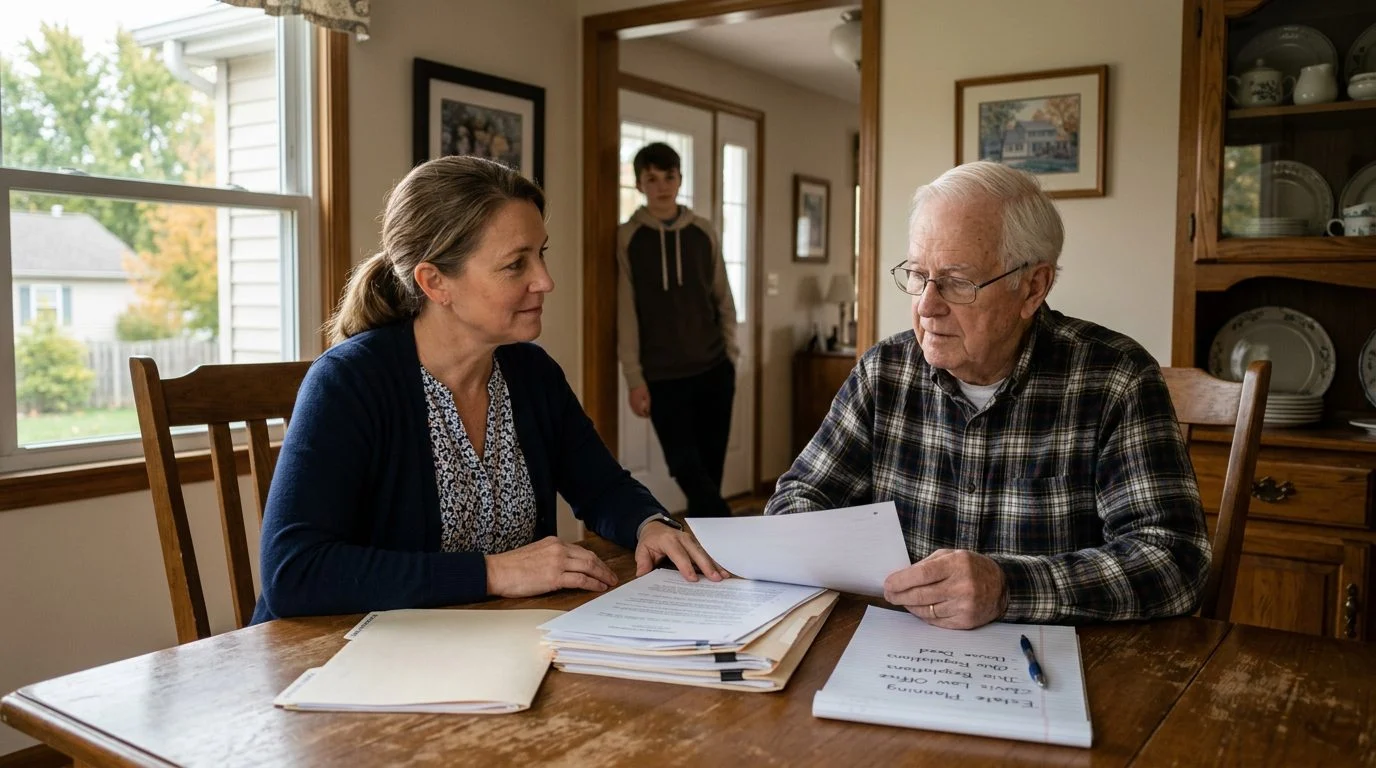
For example, imagine a woman in her 50s whose mother, in her early 80s, still lives at home, and each family’s facts are different. Most days your parent is sharp, but you can see that they are slowing down. Nothing is signed. Nobody knows who would pay his bills or talk to his doctor if he couldn’t. Meanwhile, here you are raising your own kids, working, and driving over on weekends.
This meeting fits you if your parent hasn’t named anyone to act for them. It also fits if you expect to help with care, bills, or decisions. Many adults wait for a hospital stay to start this talk. By then, hard choices feel even harder.
Your goal is simple. You want your parent’s wishes written down, the right papers signed, and a plan your whole family understands before anyone is rushed.
What the planning covers
The planning covers the documents that let a trusted person act, the wishes that guide care, and the money questions tied to your parent’s home.
- Financial power of attorney. A named person can pay bills, manage accounts, and handle your parent’s affairs if your parent can’t.
- Health care power of attorney and living will. A named agent can talk with doctors and make medical decisions your parent chose in advance. A living will records choices about life-sustaining treatment.
- Wills and trusts. These record what your parent wants done with property and the home. They also name who will settle the estate.
- Long-term care and Medicaid planning. This covers how nursing home or memory care would be paid for and how the home and savings may be treated.
- Guardianship. A probate court can appoint a guardian to care for and manage the person of someone who is incompetent (R.C. 1337.11). A court application on mental incompetency must include either a physician’s or clinical psychologist’s statement, or a statement that the prospective ward or their agent has refused to submit to or consent to an examination (Sup.R. 8.31).
Each piece is easier to set up while your parent can still make choices.
Why documents matter before an emergency
Hospitals, banks, and insurers may need a signed paper before they take direction from the person helping your parent.
Without a health care power of attorney, you may struggle to speak for your parent in a hospital. That’s true even when you’re clearly acting in their interest. Without a financial power of attorney, bills, insurance claims, and bank matters can stall while your parent is in the hospital or confused.
These papers must be signed while your parent can still understand what they’re signing. That’s why the timing matters.
A will follows strict signing rules too. Ohio requires two competent witnesses in your parent’s presence, who see the will signed or hear your parent acknowledge the signature (R.C. 2107.03). A video call does not count as presence.
Before the meeting, gather these:
- Photo IDs for your parent and for you
- A list of bank, retirement, and investment accounts
- Insurance cards, plus any long-term care policy
- Deeds for the home and any other property
- Any existing will, trust, or power of attorney
- Names and phone numbers of your parent’s doctors
Protecting the family home and paying for care
Care is paid from your parent’s income and savings, from long-term care insurance if there’s a policy, or from Medicaid if your parent qualifies.
Long-term care is a common need. Medicare’s skilled nursing facility coverage has limits, so plan for the rest now.
Ohio can exempt your parent’s home as their principal place of residence, but only up to a home equity limit. For 2026, Ohio’s home equity limit is $752,000, and it rises every January. The deed must be in their name or their spouse’s name, or the home must be deeded to a revocable trust so long as the trust’s principal remains a resource of your parent or their spouse (Ohio Adm.Code 5160:1-3-05.13).
Giving away the house or savings can cause a penalty. Ohio’s home rule (Ohio Adm.Code 5160:1-3-05.13) only describes how an individual’s home is treated for Medicaid eligibility; the presumption that a transfer for less than fair market value is improper on or after the look-back date is in Ohio Adm.Code 5160:1-6-06.
After death, the state shall seek recovery of Medicaid costs paid for a permanently institutionalized individual of any age, or for an individual fifty-five years of age or older who is not a permanently institutionalized individual, from the estate (R.C. 5162.21), subject to the statute’s limits, including a bar while certain survivors are alive and a waiver for undue hardship. The estate can include property passed through joint tenancy or a living trust.
If one spouse needs care, Ohio’s spousal rules set how much of the couple’s savings the spouse at home may keep (Ohio Adm.Code 5160:1-6-04).
Results turn on the facts: your parent’s income, health, and family details decide how each rule applies.
How the process works
Planning with an aging parent in Ohio begins with a free discovery call. From there, our team gets to know your parent’s situation, sits down with your family to choose a plan, prepares the documents, and coordinates your parent’s assets so they actually match that plan. If your parent needs care, we help with the Medicaid application, and we keep guiding your family as your parent’s needs change.
- Book the first call. Your first step is a free discovery call. It is free, confidential, and without obligation to continue.
- Gather documents. Bring the checklist above, plus your parent’s main concerns and wishes about care and where they want to live.
- Planning meeting. Options are reviewed in plain language with you and your parent. Siblings join only if your parent agrees.
- Drafting and signing. Documents are prepared for your parent’s review and signed the way Ohio law requires, with witnesses where the law needs them.
- Follow-up. You receive a written summary of who holds which authority and where the original documents are kept.
Gathering papers is often the slowest step, so start early. Each step is explained in plain words before you move on.
Getting siblings on the same page
Siblings agree more easily when your parent’s wishes are written down and each person knows their role.
Disagreements usually start with unclear roles, uneven caregiving, and no written record of what your parent wanted. One sibling may handle the doctor visits while another controls the money. That gap can breed tension.
Before a crisis, agree in writing on:
- Who acts for your parent under each power of attorney
- Who makes day-to-day care decisions and who takes the doctor’s calls
- How costs are shared, and how each payment is recorded
Siblings can join the planning meeting when your parent agrees. That keeps the plan centered on your parent’s wishes, not one child’s view.
A child who moved in to provide care may need paperwork later to prove it. Every sibling should know about that early.
Ask at the first call who the lawyer represents in the planning work. Ask for that answer in writing.
Why work with Jarvis Law Office
Jarvis Law Office handles elder law and estate planning for families across Ohio, with offices in Lancaster, Dublin and St. Clairsville.
Timothy Jarvis is the lawyer responsible for this page’s content. Support staff help families gather documents and schedule meetings.
The practice covers Medicaid and long-term care planning, powers of attorney and guardianship, wills and trusts, probate, and trust administration. The firm serves families in Fairfield, Franklin, Licking, Pickaway, Perry and Hocking counties.
Plain language is the firm’s approach. Each document and cost is explained in words you can repeat to your siblings.
Careful planning today can help your family skip probate later, because the papers and the titles on your assets are set up to match.
Common questions from adult children
Most adult children ask whether their parent must be sick, whether they can sign, and what Medicare covers.
Does my parent need to be sick to plan?
No. Documents work best when your parent is well enough to make their own choices.
Can I sign for my parent?
The answer depends on the documents your family already has and on your parent’s own wishes, and we can walk through those questions with you on a free discovery call. Most planning documents still need your parent’s own signature.
Will Medicare pay for nursing home or memory care?
Medicare’s coverage of nursing home stays has limits. The discovery call reviews your parent’s coverage and options.
Do Ohio wills need witnesses?
Yes. Two competent witnesses must be present with your parent when the will is signed, and a video call does not count.
What if my parent is already confused?
Call sooner rather than later, because the planning window may be narrower. The discovery call can review what’s still possible.

Book your parent’s free discovery call
The next step is to book your first call with Jarvis Law Office, while your parent can still make these decisions.
If your parent is slowing down, nothing is signed, and you may be the one who has to act, the time to plan is now.
Reach out through our contact page to book your first call, and bring the checklist from this page.
A first call is a first step, not a commitment, and no outcome is assured.