
Ohio long-term care planning
A parent's first month in a nursing home doesn't have to be a month of guessing
Admission day brings paperwork, bills and hard choices. Here is how to take them one step at a time, with a team beside you.
By Timothy Jarvis · Published November 15, 2026
If your spouse has just moved into a nursing home, the first month can feel like a stack of bills, forms and decisions you never planned for. This checklist covers the first 30 days after a nursing home admission in Ohio, and how to protect your savings and your home while you work through them.
The short answer: gather your papers, keep a dated record of every bill and payment, read the admission agreement before you sign, and check with us before you move any money or property. Each step protects you, and you do not have to take them on alone.
A family’s first month, as an example
One spouse at home found her footing by taking the first month one step at a time.
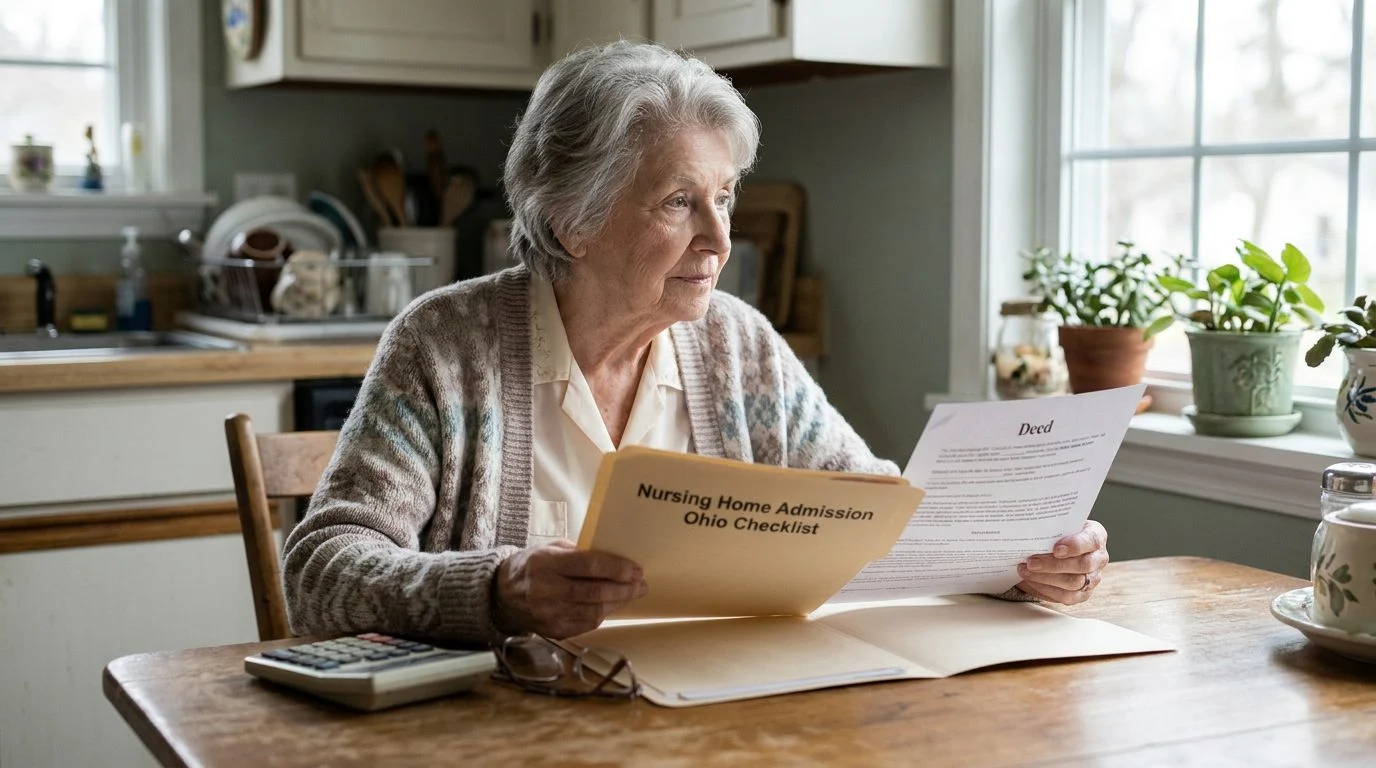
For example, imagine a couple, Ruth and Dale Kowalski, who live in Circleville. Dale moved into a nursing home this spring, and Ruth stayed in the home they had lived in for decades. She feared the monthly bill would empty their savings and force her to sell the house. The first weeks brought admission forms, bank statements and letters she did not understand. Ruth brought the papers to a planning conversation, where the team sorted out which steps came first and which decisions could wait. She left with a short list, a folder of records and a clear view of her options.
Every family’s situation is different, so your own details will shape what comes next.
If your spouse has just moved into a nursing home and the bills are weighing on you, you do not have to face the next steps alone, and our team can talk it through with you on a free discovery call. Talk it through with Jarvis Law Office — the first discovery call is free, confidential, and carries no obligation.

Week one: gather the papers and the questions
Your first job in week one is to gather what you have and write down what you still need to ask. Start one folder or binder, and keep copies of everything.
Collect identity documents, insurance cards, income statements, bank and retirement account statements, deeds, and any existing will, trust or power of attorney. If you cannot find one of these, write that down too. A missing paper is easier to chase when it sits on a list.
Next, contact the facility’s business office with a written list of questions. Ask for the monthly rate, what it includes, and which charges are billed separately. Write down each answer with the date and the name of the person who gave it.
Read the admission paperwork carefully. It shows who signs as the responsible party, so know what your spouse signed and what you signed. Families often find it helpful to ask the facility directly about its services, its charges and any plans for discharge, and we can help you think through those questions. The National Consumer Voice describes these resident rights.
Keep the folder for later, too. The same papers will be asked for during any Medicaid application.
Keep a simple record of every bill and every dollar
Keep a dated record of every bill, payment and withdrawal, starting this week. A clear record is the simplest way to answer hard questions later.
Save every receipt and bill. Note each withdrawal and what it paid for. Keep monthly bank and account statements so the record matches what the money actually did.
Your own money belongs in this record. Write down your income, your household bills and what you spend on your own needs. Planning looks at the whole household, so a record that shows only your spouse’s costs leaves a gap.
When an application asks where money went, a clear record makes the answer simple. Without one, families can spend weeks trying to rebuild the past from memory. A notebook page or spreadsheet, updated each week, is enough.
Before anyone signs: the admission agreement and the look-back
Read the admission agreement before you sign it, and bring any doubt to us first. Do not rush, and do not move money or property until you have checked it.
Ohio’s 60-month look-back is measured from a baseline date, generally the first day of a nursing home stay, not from the day a Medicaid application is filed: it reaches back five years from that date, and any transfer made from that point on, including a transfer made during the nursing home stay, can be reviewed. Medicaid presumes improper any transfer of assets for less than fair market value made by the nursing home spouse or the at-home spouse on or after the look-back date, which is sixty months (five years) before the baseline date, and such a transfer can bring a restricted coverage period (Ohio Adm.Code 5160:1-6-06).
That is why a transfer made in a hurry deserves a pause. Handing savings to children to keep it out of reach can feel like protection today, yet it can become a problem when an application is reviewed. Ask us first.
Many families feel pressure to act fast. Please don’t. There are exceptions to these rules, and we walk through them with each family in person or by phone, not on a web page. Bring your questions to the free discovery call, and we will take them one at a time.
Protecting the spouse at home: community spouse rules and the house
Ohio’s Medicaid rules include protections for the spouse who stays at home, and planning is how you put them to work. Start with the savings. The at-home spouse may keep a share of the couple’s combined countable resources, called the community spouse resource allowance, and the nursing home spouse is resource eligible when what remains after that allowance is subtracted is two thousand dollars or less (Ohio Adm.Code 5160:1-6-04).
Federal figures for 2026 set the maximum community spouse resource standard at $162,660, according to the CMS Informational Bulletin. What applies to your family depends on the facts, so ask us to run your numbers.
Income works differently from savings. During any month the nursing home spouse is eligible for long-term care services, none of the at-home spouse’s income counts as available to the nursing home spouse (Ohio Adm.Code 5160:1-6-04).
Your home is covered by its own rule. For 2026, Ohio’s home equity limit is $752,000, and it rises every January. The home equity limit does not apply when the nursing home resident’s spouse is lawfully living in the home (Ohio Adm.Code 5160:1-6-02.1).
Planning can often keep the spouse at home in the home, financially secure, with quality of life intact. Options often remain well before all savings are spent, so an early look helps.
Planning also looks ahead to what happens to the house and savings after a spouse dies. Some planning can often protect assets from later claims, and the details turn on each family’s situation.
The Medicaid application: what to gather and when to ask for help
Ohio Medicaid can help pay for nursing home care, and the application is where your family’s papers get reviewed. Staying home longer is possible for many families, and a move later stays an option.
Expect the application to ask for income for both spouses, bank and investment accounts, property and vehicles, insurance, the admission agreement, monthly bills and medical records. Your folder from week one covers most of this. A complete application helps avoid delays, and mistakes on it can lead to a denial.
Even when care is already needed, a significant part of the amount to spend down can often still be protected. Do not sign over accounts or move property to speed things up. Call us first.
Not sure what your next step is?
Talk it through with Jarvis Law Office — the first discovery call is free, confidential, and carries no obligation.
Care decisions and the Care Navigators
The Care Navigators can help you find your way through the health care system when you need that help. That matters in the first month, when care decisions and changes in your spouse’s condition come quickly.
Care Navigators are not lawyers and do not give legal advice. They guide families through a health care system that can feel fragmented and hard to follow, on the family’s behalf, if and when that help is needed.
Legal documents matter here too. A health care power of attorney and a living will help decide who speaks for your spouse when a medical decision must be made.
During a stressful month, be wary of anyone who pressures you to pay or sign quickly. The Ohio Attorney General’s seniors resources cover scams and financial exploitation.
The documents that keep the plan moving, and avoiding probate later
The right documents keep decisions moving, and planning done well can help a family avoid probate later. In our plans, we include a general durable power of attorney for finances, a health care power of attorney, a living will and a HIPAA release.
Every plan we prepare includes a strong financial power of attorney, and in our planning it is one of the key tools for protecting a family’s assets. We call the health care power of attorney and the living will the advance directives.
Probate is the court process for settling an estate. It can be expensive, slow and stressful for a grieving family. A plan set up and funded correctly, with the right documents and assets titled to match, is how a family can skip probate later. That is the goal we work toward with each plan.

How Jarvis Law Office helps, and your next step
You do not have to figure out this whole system yourself. Staying on top of the rules is our job, and we act as your guide through each step.
Our work starts with a conversation to understand your family’s situation. From there, we meet to choose a plan, set up the documents, and coordinate your assets so they match the plan. Where it applies, we prepare the Medicaid application, and we keep helping as your needs change.
We work for a flat fee, with no recurring insurance-style fees. We have offices in Lancaster, Dublin and St. Clairsville, and we serve families in every Ohio county.
Who signs the nursing home admission papers?
The admission paperwork names the responsible party, so read it and ask questions before you sign.
Can the spouse at home keep income and savings?
The at-home spouse may keep a share of the couple’s combined countable resources, called the community spouse resource allowance, and the nursing home spouse is resource eligible when what remains after that allowance is subtracted is two thousand dollars or less. Ask us to check how that applies to your family.
What is the look-back period in Ohio?
Medicaid presumes improper any transfer of assets for less than fair market value made by the nursing home spouse or the at-home spouse on or after the look-back date, which is sixty months (five years) before the baseline date, and such a transfer can bring a restricted coverage period. Keep a record of every transfer and check with us before you move any money.
If your spouse has just entered a nursing home and you are juggling bills and papers, you do not have to sort it out alone. The free discovery call is confidential and comes with no obligation to continue. Book your free discovery call and we will start with your situation, one step at a time.
How the firm helps your family through the first 30 days
Reading the admission papers with you
Before anyone signs, we can walk through what the paperwork commits your family to, and which questions are worth asking the facility.
Protecting the spouse at home
When one spouse moves into a nursing home, we look at how the couple's home and savings can be handled so the spouse who stays home keeps a secure footing.
Care Navigators on your side
Our Care Navigators can help your family find its way through a complicated health care system and keep track of appointments, providers and questions. They do not give legal advice.
A plan that fits your family
Every family's facts are different. We take the time to understand your situation before recommending any steps, and we explain each option in plain words.
Before you sign anything
Admission paperwork can be long and it is easy to sign in a hurried moment. Take a copy home, note any question, and ask us to review it with you before you commit your family to anything.
What the first 30 days can look like
The first few days
Settle the immediate needs, gather the key documents, and identify who will speak for your loved one if they cannot speak for themselves.
The first week
Review the costs and the care plan, sort out what is needed right away, and start a simple list of questions for the facility and for us.
The first few weeks
Look at the family's finances with an eye toward long-term care costs, and decide whether a planning conversation should happen now rather than later.
By the end of the month
Set a steady routine for ongoing guidance, so that changes in your loved one's needs lead to planned decisions rather than emergency ones.