
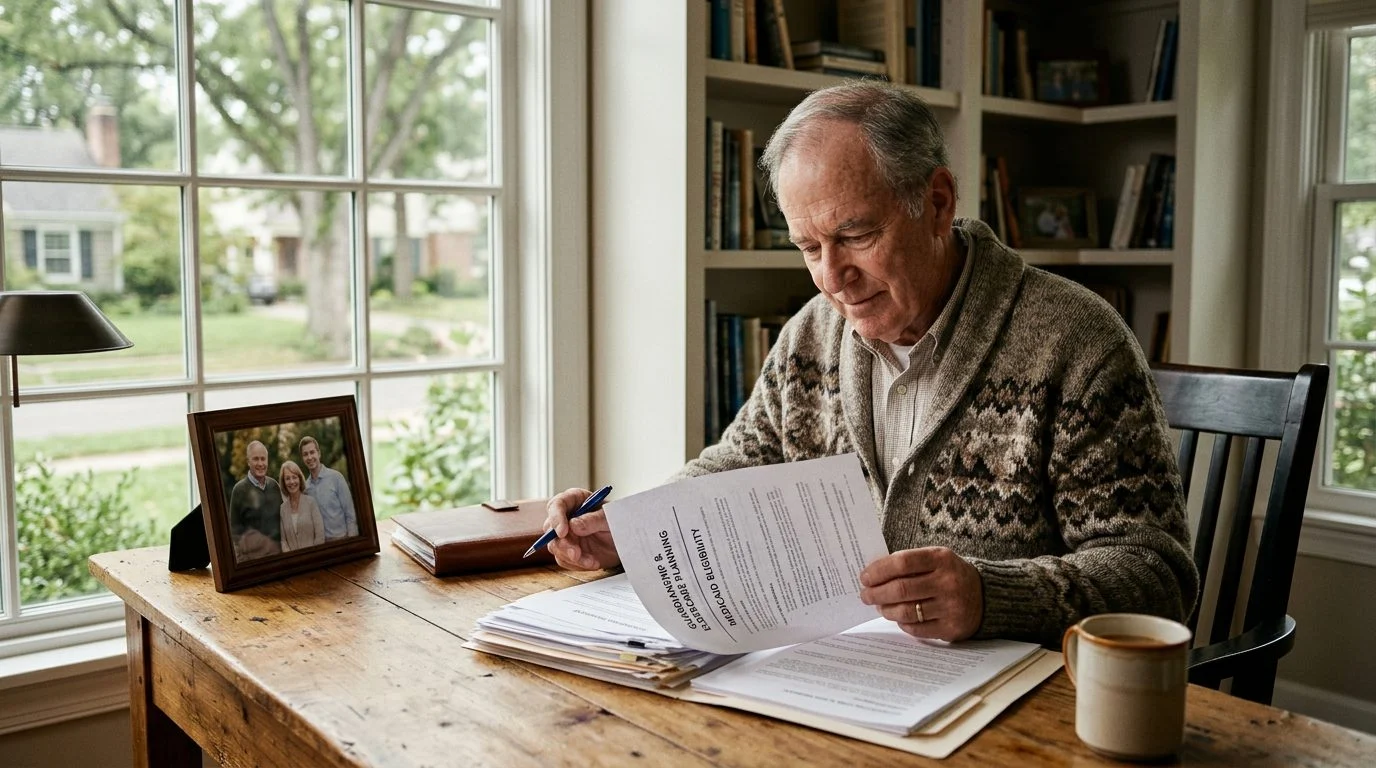
When your spouse's dementia needs supervision around the clock and you are the one providing it, you may be wondering when a move to professional care makes sense and how Medicaid could help pay for it in Ohio.
By Timothy Jarvis · Published November 15, 2026
Do You Need Guardianship for Medicaid With Dementia in Ohio?
Do you need guardianship for Medicaid with dementia in Ohio? The answer turns on the documents already in place and on what your spouse can still take part in, and a court appointment is not the only tool to consider. The first step is usually learning what your family already has.

Where you are right now
You are probably tired, and you may be giving care at home for most of the day and night. You may also be afraid of a costly mistake with the bills, the house or the savings. Many spouses in your position feel this way, and feeling guilty about asking hard questions does not mean you are failing. You are asking two hard questions: whether a court must be involved before Medicaid can help, and when and how to move your spouse to professional care. You do not have to work out these rules by yourself. Staying on top of them is the firm’s job, and we want you to feel guided one step at a time, not frozen.
Guardianship, in plain words
A guardian can be asked to handle a person’s care, money, or both, and the details matter a great deal. If your spouse can still say what they want, that matters for any plan, and it is one reason to act early.
Why the question comes up when Medicaid is involved
A Medicaid application asks for paperwork that someone must sign and speak to on your spouse’s behalf. When memory loss progresses, your spouse may no longer be able to sign or take part, and that is when families start asking who can act for them. Whether a court appointment is needed depends on the facts: which documents your spouse signed earlier, how much they can still take part in decisions, and what the application requires at that point. Gather the papers you already have, such as the deed, bank statements and any documents your spouse signed in the past. We review those facts with you on the free discovery call, rather than guessing from a web page. As the window for your spouse to choose their own helper narrows, timing matters, and waiting until a crisis can leave fewer choices.
The planning documents that can be in place before a crisis
Plans work best when they are in place before a crisis, while your spouse can still take part. In our plans, we include a general durable power of attorney for finances, a health care power of attorney, a living will and a HIPAA release. Each document answers a different question: who handles money, who speaks for medical care, what your spouse wants at the end of life, and who can receive health information. In our plans, the financial power of attorney is one of the key tools we use to help protect a family’s assets. The health care power of attorney and the living will speak to medical decisions. The HIPAA release lets doctors and care facilities share your spouse’s health information with the people you name. If your spouse can still sign and make choices, that window is worth using. We walk through each document with you, so you know why it matters for your family.
For example, imagine a couple in Zanesville
For example, imagine a couple, Ray and Joan, in Zanesville. Ray is a retired machinist, and he has cared for Joan at home since her memory loss grew worse. He lies awake worrying that one wrong signature, at the bank or at a care facility, will cost them the savings they worked decades to build. A planning conversation showed him what could be put in place now and what a Medicaid application would involve later. Ray learned that the documents could be ready before he needed them, and that he did not have to decide everything in one week. Every family’s facts are different, so each path looks different, too.
Paying for care, and staying home longer where possible
Ohio Medicaid can help pay for nursing home care, care at home, and many, but not all, assisted living and memory care settings. Staying home longer is possible for many families, and many prefer it when it can be done safely. Choosing between home, assisted living and a nursing home is a decision many families make in stages, and it can change as needs change. A move to a facility later remains an option if home stops being workable. Respite, meaning short breaks from caregiving, is a real part of the plan, not a failure, because you cannot keep giving care without rest. Our Care Navigators can help you find your way through the health care system when care decisions come. They are not lawyers and do not give legal advice. Administration for Community Living explains how much care people may need as they age, so planning ahead makes sense for many families.
Protecting the home and savings for the spouse at home
Planning can often keep the spouse at home in the house, financially secure, with quality of life intact. Many families fear that all their savings will go to care first. Planning that starts well before care is needed usually leaves more options. Even when care is needed now, a significant part of the spend-down amount can often still be protected, depending on the family’s circumstances. The amount the spouse at home can keep is worked out through a calculation.
At any time, either spouse, or someone with the legal ability to act for the spouse in care, can ask for a calculation of the community spouse resource allowance (Ohio’s rule on the community spouse resource allowance).
Ask for that calculation early, so the numbers are clear before any decision is made.
For any month your spouse qualifies for Medicaid-paid long-term care, the income of the spouse at home is not counted as available to the spouse in care (Ohio’s rule on spousal income).
After the month in which your spouse is determined eligible for Medicaid, the resources of the spouse at home are not counted as available to your spouse, as long as your spouse stays eligible without a break in coverage (Ohio’s rule on resources for a spouse at home).
The figures used for the spouse at home are updated, so we check the current ones for your family against official CMS guidance.
We check those details with you in planning (Ohio’s rule on the family home).
How the deed is titled is part of what we review with you.
What careful planning can keep out of probate later
Careful planning can help your family skip probate later. A death in the family can bring a court process that many grieving families find stressful, which is one reason planning ahead matters. You may want something left for your children or grandchildren, rather than used up on care costs. A plan set up and funded correctly, with the right documents and assets titled to match, can help your family avoid probate. We describe that as what careful planning can do, not as a promise, because every family’s assets are different. Planning in this area can also help the decisions you make now stay in line with what your family wants later. This part is easy to put off while you are busy at home, but it is worth a conversation now.
How Jarvis Law Office helps you take the next step
We guide families step by step, and the first step is a conversation about your situation. In that first conversation, we listen to what is happening at home and what you want for your spouse, your savings and your own rest. A strategy meeting then helps you choose a plan that fits your family. We set up the plan documents, and we fund and coordinate your assets so they match the plan, which is more than paperwork. If a Medicaid application is needed, we guide you through it, and we stay with you as needs change. We work on a flat fee, with no recurring insurance-style fees. Our Care Navigators can also help with the health care side when your family needs that help.
Frequently asked questions
Do you need guardianship for Medicaid with dementia in Ohio?
Often the answer turns on the papers your spouse already signed and how much they can still take part, and we review both with you.
Is a power of attorney the same as guardianship?
Can the spouse at home keep the house?
Often the home can be protected when the spouse at home lives there and the ownership is set up correctly. We look at the details with you in a conversation.
Talk with us about your situation
If your spouse’s dementia now needs close supervision around the clock, and you cannot tell when or how to move them to professional care, you do not have to decide that alone. Book a free discovery call with our team, and bring your questions about home, money and care. The free discovery call is confidential and carries no obligation to continue. We serve families in every Ohio county from our offices in Lancaster, Dublin and St. Clairsville. Timothy Jarvis is responsible for this page’s content.
Ready to take the next step?
Related practice areas
- Long-Term Care and Memory Care Planning in Ohio
- Can a Parent With Dementia Still Sign Power of Attorney