
Medicaid planning | Serving families in every Ohio county
Your Parent Has Dementia and No Power of Attorney. You Still Have Options.
Here is how families in our practice think through Medicaid, care costs and the decisions that come next, one step at a time.
Where we work from
3
Offices: Lancaster, Dublin and St. Clairsville
By Timothy Jarvis · Published November 21, 2026
Your mom has dementia and no power of attorney: can Medicaid still help?
If your mom has dementia and no power of attorney in place, you may be asking whether Ohio Medicaid can still help pay for her care. In many cases, it can still be possible. A missing power of attorney makes the path harder, but it does not always close it. The next step depends on what your mom can still understand and sign.
You are probably juggling work, your own kids and a lot of worry. You don’t have to figure this out by yourself. Staying on top of the rules is the firm’s job, and we guide your family step by step.
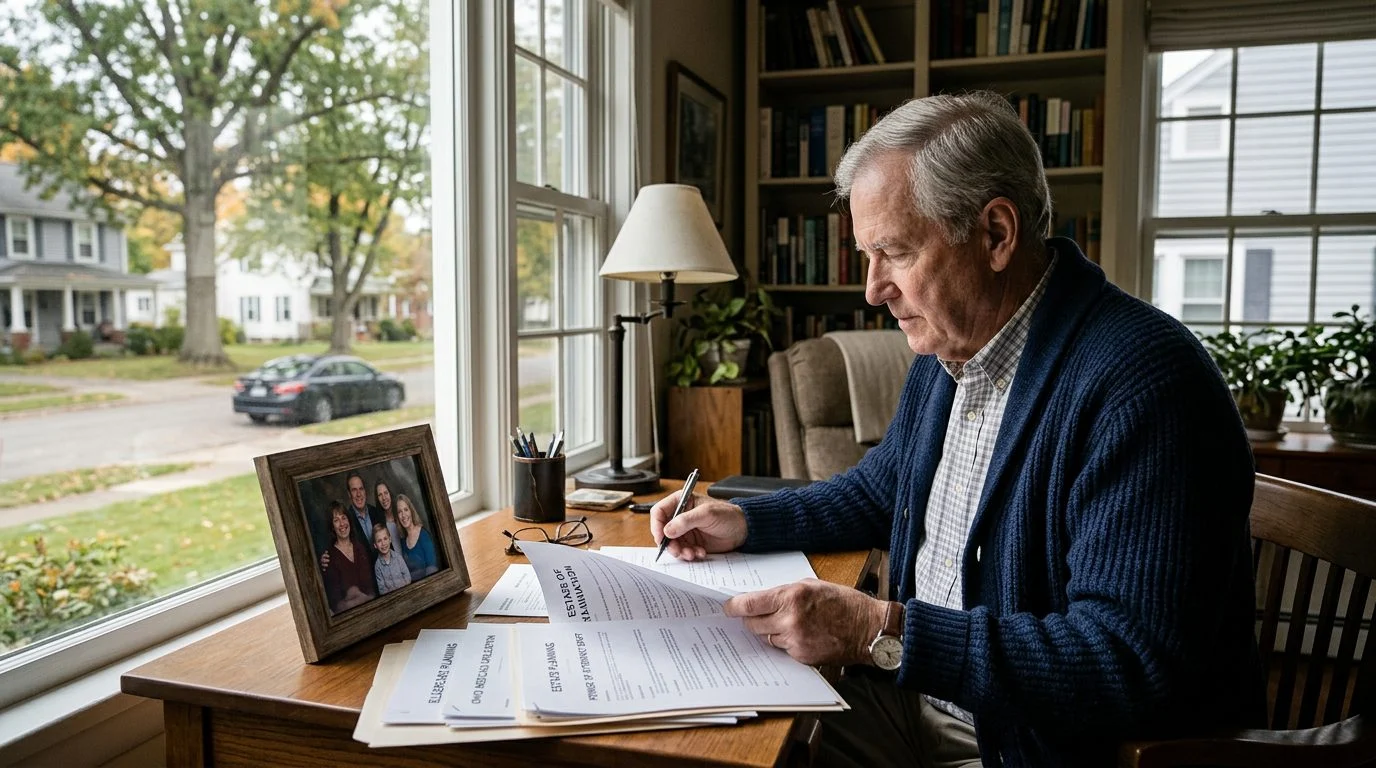
For example, imagine a son, Dan, and his father, Walt, in Newark. When Walt’s memory began to slip, Dan worried about missed bills, a fall in the night and savings that could run out. Walt had never named anyone to act for him, so Dan wondered whether it was still possible to help. A conversation with an attorney helped Dan sort out what Walt could still decide and sign, and the two of them began to see their options. Every family’s facts are different, so what planning looks like for yours will depend on your own circumstances.
If you're worried about your mom's safety and her money, you don't have to sort it out alone, so reach out to us for a free discovery call. Talk it through with Jarvis Law Office — the first discovery call is free, confidential, and carries no obligation.

Why a missing power of attorney slows things down
A missing power of attorney can slow down bills, bank accounts and Medicaid forms, because someone has to be able to act for your mom. A financial power of attorney is a document where a person names someone they trust to handle money and paperwork.
In our plans, a strong financial power of attorney is one of the main tools we use to protect a family’s assets. Every plan we prepare includes a general durable power of attorney for finances, a health care power of attorney, a living will and a HIPAA release. We explain each one in plain words, so you know what it does.
Whether your mom can still sign these papers depends on how well she understands them today. That is a question we work through with you in a conversation, looking at what she can understand right now.
When a court-supervised guardianship may be part of the answer
If your mom can no longer choose and sign a power of attorney, a court-supervised guardianship may be part of the answer. A guardian is a person a probate court appoints to make decisions for someone who can no longer make them. The key difference is timing. A power of attorney is set up by the person while they can still choose. Planning while your mother can still choose her own decisions-makers often leaves a family with more options than waiting until a crisis, and we can walk you through those choices.
When the probate division of a common pleas court sets up a guardianship, it must consider a limited guardianship before it establishes a plenary (full) guardianship (Sup.R. 8.34).
Many families worry that a guardianship takes away a parent’s voice. The National Guardianship Association supports less restrictive alternatives and orders tailored to protect a person’s independence. We walk through how a guardianship works, and what a court would expect from your family, during the discovery call. Bring your mom’s diagnosis dates, bank statements and benefit letters to that first conversation.
How Ohio Medicaid can help pay for your mom’s care
Ohio Medicaid can help pay for nursing home care, many (though not all) assisted living and memory care settings, and care at home. Many families want a parent home as long as it is safe. Staying home longer is often possible, and a move to a care setting later stays an option.
The Administration for Community Living reports that almost 70% of people turning 65 are likely to need long-term care. Planning ahead gives your family more choices, even while your mom is still doing well. Many families also worry about safety in a facility. Federal nursing facility guidance describes protections for residents, including those with dementia.
What planning can look like for your family
Planning can often protect some of what your family has built, and timing matters most. Starting to plan early often gives a family more room to choose how to protect the home and savings, and we can review what that could look like for your situation.
A transfer of assets for less than fair market value made on or after the look-back date, which is five years before the baseline date, is presumed improper and results in a restricted Medicaid coverage period (Ohio Adm.Code 5160:1-6-06).
That is why timing matters, and why we look at any past transfers with you early on. Options often remain well before everything is spent.
A plan set up and funded correctly, with the right documents and assets titled to match, is how families can often avoid probate later. Probate can be expensive, slow and stressful for a grieving family. Careful planning now can help keep your mom’s home and accounts out of that process.
How the Medicaid application moves forward with the firm
Our work moves through six steps, from the first conversation to ongoing help as needs change. We start by understanding your mom’s situation and the paperwork you already have. A strategy meeting then helps you choose a plan. Next, we set up the plan documents and fund your mom’s assets so they match the plan, which is more than paperwork. When her care calls for it, we prepare the Medicaid application with you, and we stay in touch as her needs change.
We work on a flat fee, with no recurring insurance-style fees.
Health care can feel like a maze of providers, appointments and forms. Our Care Navigators can help you find your way through that system on your mom’s behalf when you need the help. Care Navigators are not lawyers and do not give legal advice. Our attorneys handle the legal side.
Not sure what your next step is?
Talk it through with Jarvis Law Office — the first discovery call is free, confidential, and carries no obligation.
Common questions about guardianship and Medicaid for a parent with dementia
Can I apply for Medicaid for my mom if she has no power of attorney?
The path depends on what she can still decide and sign, so we look at that first. We review it with you in the discovery call.
Do I have to be my mom’s legal guardian to help with her Medicaid?
The answer turns on what your mom can still decide and what authority your family needs. We can talk through that with you in a conversation.
Will my mom have to move out of her home?
Staying home longer is often possible, and a move to a care setting later remains an option. When Ohio seeks estate recovery against a parent who was permanently institutionalized, it cannot recover against the parent’s home while certain relatives still lawfully live there, including a son or daughter who lived there for at least two years immediately before the parent was admitted to the institution, has lived there continuously ever since, and gave care that delayed the parent’s institutionalization. That protection is not automatic, because the family must meet other conditions and back up the move-in date and the care with written proof, and we will walk through with you whether it could fit your family (Ohio’s Medicaid estate recovery rules).
Do I need a lawyer for this?
Medicaid and court paperwork can be hard to get right on your own. Our team guides you step by step, starting with the first conversation.

How Jarvis Law Office helps your family take the next step
The firm concentrates its practice in elder law, Medicaid planning and estate planning. Timothy Jarvis is the responsible lawyer for this page. We serve families in every Ohio county from our offices in Lancaster, Dublin and St. Clairsville.
Your first conversation is a time to understand your mom’s situation, her current ability to understand and sign papers, and the paperwork you already have. That is when the next steps usually become clearer.
You are carrying a lot right now, and you don’t have to carry the legal side alone. Book your free discovery call with us. The call is confidential and carries no obligation to continue.
How we guide your family
You do not have to sort this out alone
Dementia changes decisions quickly. Our team walks your family through each step, and keeping up with the rules is our job, not yours.
Care Navigators on your side
The health care system can be hard to follow. When your family needs help finding the right care, our Care Navigators can help. They do not give legal advice; our attorneys do.
Planning matched to what your parent can still do
We start with what your parent can still decide and sign, then set up the right documents and coordinate the family's assets so the plan fits.
A free discovery call to begin
The free discovery call is confidential and comes with no obligation to continue. It is a calm place to ask questions and decide what comes next.
Time can matter
The sooner a family talks through its options, the more choices may still be open. A conversation now costs nothing and can make the next months much clearer.