
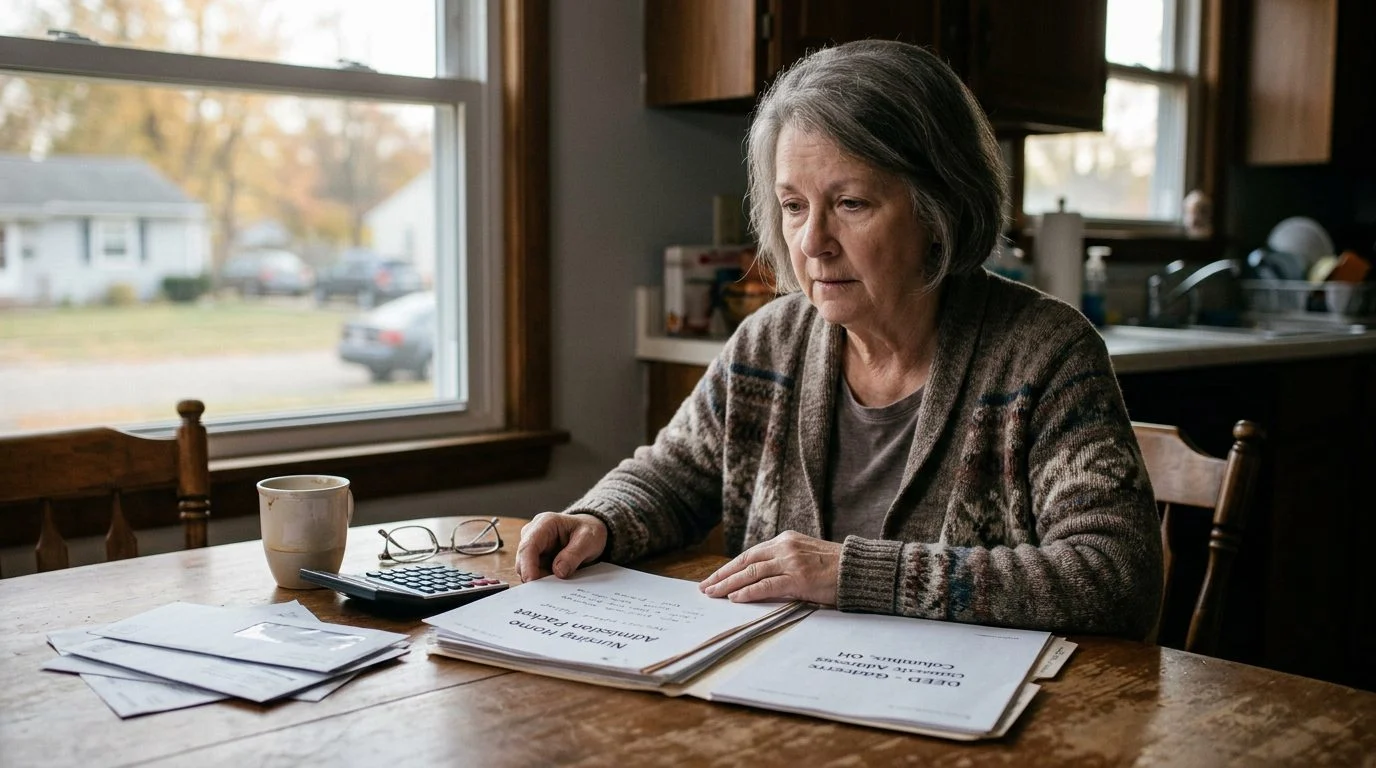
Medicaid planning for Ohio families
Nursing Home Next? You Don't Have to Work Out Medicaid Alone
Clairsville.
Where we serve families
3
Offices: Lancaster, Dublin and St. Clairsville
By Timothy Jarvis · Published November 20, 2026
When the hospital says nursing home next, the bills, the savings and the house can all start to feel uncertain at once. You are at home, and you want to know what Ohio Medicaid can help pay for and what you may be able to keep. Ohio Medicaid can help pay for nursing home care for a spouse who qualifies, and the spouse at home has protections that depend on the couple’s own facts. This page walks through those answers in order so you can see your options before you decide anything.
The hospital says ‘nursing home next.’ Here is what that means for you
A hospital discharge to a nursing home means your spouse needs daily care for a longer stretch than the hospital can offer. Medicare skilled nursing facility care explains how that coverage works.
For example, imagine a couple, Dale and Ruth. After a hospital stay, Dale can no longer manage safely at home, and his discharge plan names a nursing home. Ruth stays in the house they have lived in for decades, and she lies awake over the bills. She fears the savings will run out and that she will have to sell the house. A planning meeting helps them separate the money questions from the care questions and see their options. Every family’s facts are different, so results will vary from one family to the next.
A hospital discharge planner can explain the care your spouse needs next. The money and home questions need their own answers, and that is what this page covers. You do not have to work all of this out yourself. Our team guides families step by step, and keeping up with the rules is our job.
If your spouse has just moved to a nursing home and you are wondering about your savings and your house, you do not have to sort it out alone; a free discovery call is a calm place to start. Talk it through with Jarvis Law Office — the first discovery call is free, confidential, and carries no obligation.

How Ohio Medicaid can help pay for your spouse’s care
Ohio Medicaid can help pay for nursing home care and for care at home. It can also help pay for many, though not all, assisted living and memory care settings.
For many families, staying home longer is possible and preferred. If a move to a care setting comes later, that option is still there.
Eligibility depends on income and assets. We look at your situation as a whole, including what each spouse owns and earns, and we explain the details on your discovery call.
Ohio also sets a home equity limit. This matters because the home is often a family’s largest asset.
For 2026, Ohio’s home equity limit is $752,000, and it rises every January.
The home equity limit does not apply to an individual when the individual’s spouse is lawfully residing in the individual’s home (Ohio Adm.Code 5160:1-6-02.1).
That is why the house needs a plan, not a fear. How the home is titled and who lives in it can change the picture.
What the spouse at home may be able to keep
Medicaid planning looks at two people, not one, and the spouse at home has real protections.
After the month the institutionalized spouse is determined eligible for medical assistance, none of the spouse at home’s countable resources are considered available to the institutionalized spouse, as long as that spouse stays eligible without a break in coverage (Ohio Adm.Code 5160:1-6-04).
Income follows a similar path.
In any month in which the institutionalized spouse is eligible for long-term care services in a medical institution, HCBS waiver, or PACE, none of the spouse at home’s income is considered available to the institutionalized spouse (Ohio Adm.Code 5160:1-6-04).
For example, imagine a couple, Sam and Lois. Figures like this change each year, so planning starts with current numbers, and results vary with each couple’s facts. Medicaid.gov 2026 spousal figures lists the current amounts.
The spouse at home’s income and the nursing home bill are different things. How they fit together is one of the first things we work through with you.
Your fears, answered plainly
Each fear has a plain answer, and the answer depends on timing and on your family’s records.
Running out of savings. The spend-down is the stretch when savings go toward care before Medicaid helps. Planning can often protect a significant part of the couple’s assets, and the timing decides how much.
The rule has other limits as well, and we walk through how they apply to each family.
That gives you time to plan how the home is titled, which still matters.
Plan before anything moves. Moving assets without a plan can create problems later, so we review your records with you before anything is transferred.
Nothing left for the children. Careful planning aims to leave something for your family rather than the nursing home. What that looks like depends on your assets, your spouse’s care and the rules at the time.
How planning can protect what you have built
Planning works best when it starts early, but options can often still be protected once care has begun.
Planning done well before care is needed gives a family more options, and we can talk through what that could look like for your situation. If care is needed now, a significant part of the spend-down can often still be protected. Options can remain well before the savings are gone.
In our plans, we include a general durable power of attorney for finances, a health care power of attorney, a living will and a HIPAA release. A strong financial power of attorney is one of the tools we use to protect a family’s assets, because it lets a trusted person manage money if your spouse cannot.
Probate is the court process for settling a person’s estate after death. It can be expensive, slow and hard on a grieving family. Careful planning, with the right documents and assets titled to match, can help your family skip it later.
How the process works, step by step
The process starts with a free discovery call and moves through a plan, documents, funding and the Medicaid application. The first discovery call is free, confidential, and carries no obligation to continue.
In the strategy meeting, we help you choose a plan. Then we prepare the plan documents. After that, we fund and coordinate your assets so they match the plan, which takes more than paperwork.
The Medicaid application comes next. We assemble the file carefully before it is submitted. Timelines depend on your facts and how the application is processed, so we will tell you what to expect as we go.
Ongoing guidance continues as your spouse’s needs change. Our Care Navigators can also help your family find their way through a complicated health care system when that help is needed. They are not lawyers and do not give legal advice.
Not sure what your next step is?
Talk it through with Jarvis Law Office — the first discovery call is free, confidential, and carries no obligation.
Questions families ask about the spouse at home
Here are short answers to questions families often ask about a spouse at home, with the details saved for your discovery call.
Can the spouse at home keep the house?
The home equity limit does not apply to an individual when the individual’s spouse is lawfully residing in the individual’s home.
Whether your home is protected depends on how it is titled and on the planning, and we review both on your discovery call.
Does Ohio Medicaid pay for a nursing home?
It can help pay for nursing home care for people who qualify. It does not cover every facility or every setting, so the details matter.
Is it too late if your spouse is already in a nursing home?
Options can often remain after a move. A significant part of the assets can often still be protected, and timing matters.
Will Medicaid take the house after your spouse dies?
Ohio estate recovery may be sought against a permanently institutionalized individual’s estate only after the death of that individual’s surviving spouse, if any.
Will the children inherit anything?
Careful planning aims to leave something for your family, though outcomes change with each family’s facts.

How Jarvis Law Office helps you through this
Jarvis Law Office helps families through this decision one step at a time. You do not have to face it alone, and the attorneys and team guide you through each part. Timothy Jarvis is the responsible lawyer for this page. Our offices are in Lancaster, Dublin and St. Clairsville, and we serve families in every Ohio county.
For a spouse at home, that means hearing your situation first. Then we help you choose a plan aimed at protecting your home and income, as your facts allow, prepare the documents, set up your assets and handle the Medicaid application with care. We also stay with you as your spouse’s needs change.
If you are still weighing your options, that is a normal place to be. A calm first step is to book a free discovery call and talk through your spouse’s situation, with no pressure to decide anything that day.
Good to know before you decide
Ohio Medicaid can help pay for nursing home care for people who qualify, and for some assisted living, memory care and care at home. It does not cover every facility or setting, so the details of your situation matter.
How we guide your family
Protecting the home you share
We look at what the spouse at home needs to stay in the home, financially secure and living well, and we explain which options fit your family's situation.
Timing makes a difference
Planning started years before care is needed often has more options. Even when care is needed now, a significant part of the savings may still be protected. We will walk through what is possible for you.
The documents behind the plan
Every plan we prepare includes a financial power of attorney, a health care power of attorney, a living will and a HIPAA release. Our financial power of attorney is one of the tools our planning uses to protect your assets.
Care Navigators on your side
Our Care Navigators can help you find your way through a complicated health care system when you need that help. They do not give legal advice, and our attorneys handle the legal side.
Questions spouses ask us first
Can I keep the house?
Ohio's rules for the home are detailed, and whether you can keep it depends on your situation.
Will my savings be used up?
Planning can often help protect part of what you have built together, so the at-home spouse keeps financial security. We look at your savings, income and goals before we suggest anything.
Does Medicaid pay for every nursing home?
No. Ohio Medicaid can help pay for care in many settings for people who qualify, but not every facility takes Medicaid. We help you ask the right questions before a decision has to be made in a hurry.