
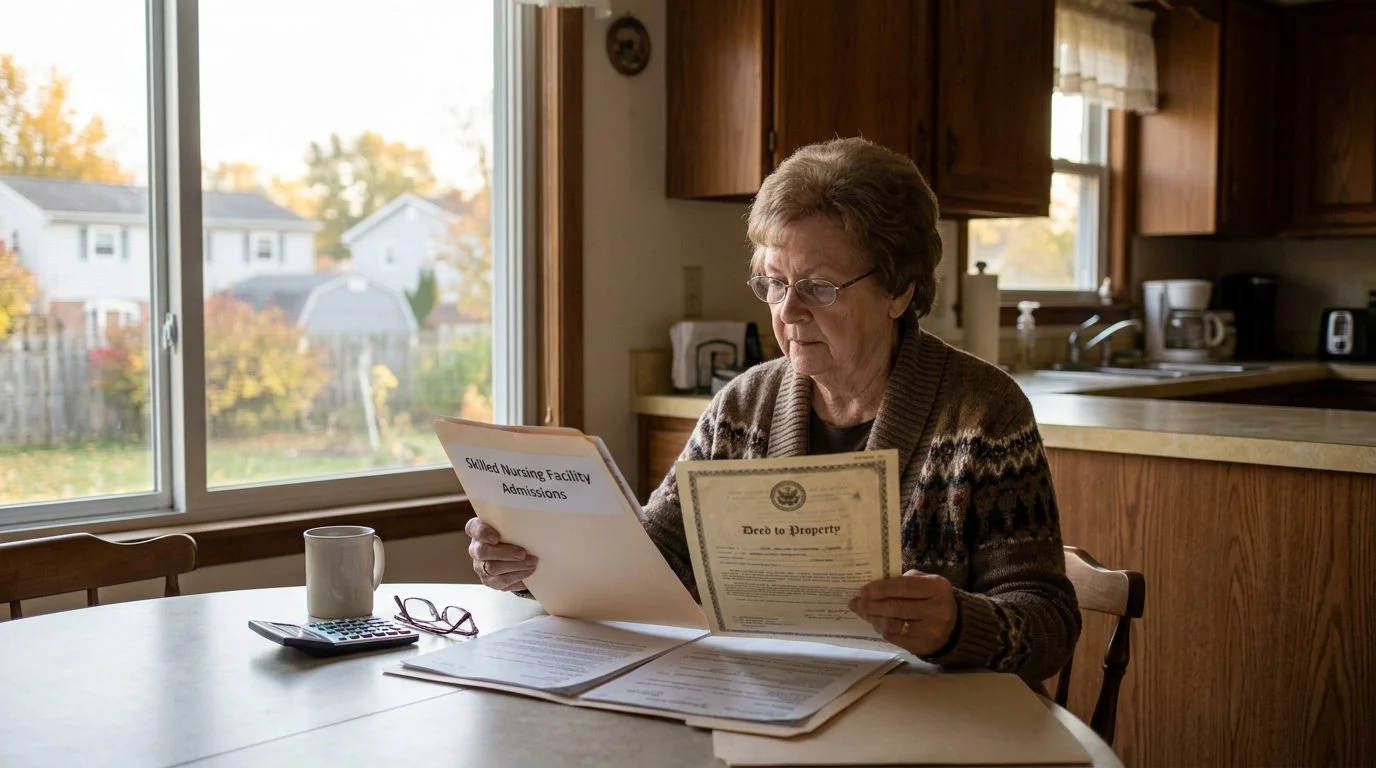
Medicaid Planning for Ohio Families
Pension Over the Medicaid Limit? Ohio Spouses Have Options
When your spouse needs care and your household income is higher than you expected, you do not have to work out the rules alone. We will walk through them with you, step by step.
Where we serve families
3
Offices in Lancaster, Dublin and St. Clairsville
Every Ohio county
We serve families across the state
By Timothy Jarvis · Published November 22, 2026
A monthly pension can make it harder for a nursing home application to qualify for Medicaid in Ohio. Whether your family’s income is too high depends on your own numbers, how the pension is paid, and the savings and home that sit alongside it.
Why a spouse’s pension can make the Medicaid nursing home application harder
The first thing to understand is the rule on regular pension payments.
A retirement fund from which the individual has the legal ability to receive regular, periodic payments, or lifetime payments that are assured, is treated as unearned income, and if the individual can choose between regular payments and a lump sum, the individual must choose regular payments for the funds to be treated as unearned income (Ohio Adm.Code 5160:1-3-03.10).
That rule matters because a pension that arrives every month looks like ordinary money. For Medicaid, it is income that can be counted toward the nursing home bill. Being counted does not decide the application on its own. It means the pension gets reviewed alongside everything else your family owns and receives.
Income is only one piece of the picture. Savings, the home and the needs of the spouse who stays home are part of the same review. We work through your exact numbers with you in the planning conversation, not with guesses on a web page.
If your spouse's care and your home are weighing on you, you don't have to sort out the Medicaid rules alone, and our team can talk it through with you on a free discovery call. Talk it through with Jarvis Law Office — the first discovery call is free, confidential, and carries no obligation.

What planning can look like for one family
Planning can help a spouse at home see the options clearly, even when a pension is involved. For example, imagine a couple, Gene and Marlene, in Chillicothe. Gene’s heart failure slowly wore away his strength until he moved into a nursing home. Marlene stayed in their house, worried that his pension and the monthly bills would drain the savings she needed to live on. She feared she would have to sell the home they had kept for decades. A planning conversation helped them see which steps could protect what Marlene needed and prepare a clean application. Every family’s facts are different, so results vary with each family’s own situation.
What you are worried about, and what can be done about each worry
Your worries are real, and each one has planning options worth reviewing.
Savings running out. Financial eligibility for the institutionalized spouse cannot be approved until the couple’s combined countable resources, when the institutionalized spouse is subject to a resource limit, are equal to or less than the community spouse resource allowance plus two thousand dollars (Ohio Adm.Code 5160:1-6-04).
Planning looks at which assets count and how they can be arranged, so you have a clear picture of what can be kept for daily life.
During any month in which the institutionalized spouse is eligible for long-term care services in a medical institution, home and community-based services waiver, or PACE, no income of the community spouse is considered available to the institutionalized spouse (Ohio Adm.Code 5160:1-6-04).
This is one reason the income of the spouse at home gets its own careful review.
The house after your spouse dies. In Ohio, the attorney general may seek to recover all Medicaid benefits correctly paid from the estate of a permanently institutionalized person of any age, but only after the death of that person’s surviving spouse, if there is one (Ohio’s Medicaid estate recovery rules). The details depend on your family’s facts, so we review them with you.
A Medicaid mistake. Mistakes on an application or its documents can slow everything down. We help you prepare an accurate application so it can move forward without avoidable delays.
Leaving something for the children. Many families want something left for their children and grandchildren, not for care costs. Planning can help more of the family’s money stay with the family, depending on the facts.
How Ohio Medicaid can help pay for your spouse’s care
Ohio Medicaid can help pay for nursing home care, and it can help pay for care at home too. Many, though not all, assisted living and memory care settings are also covered, so each setting has to be checked against your family’s situation.
Staying home longer is possible for many families, and most prefer it. A move to a care setting later stays an option, so the decision does not have to be made all at once.
The Administration for Community Living reports that almost 70% of people turning 65 will need some long-term care. That is why it helps to know these options before a crisis forces a decision.
Care Navigators can also help you find your way through the health care system on your spouse’s behalf when that help is needed. They guide families through care decisions. They do not give legal advice.
Protecting the home and the spouse who stays home
Planning can often keep the spouse at home in the home, financially secure, with quality of life intact.
Ohio sets a home equity limit, and it matters for couples deciding what to keep. For 2026, Ohio’s home equity limit is $752,000, and it rises every January. How the deed is titled also matters, so we review it with you.
We also help families avoid probate. Probate can be expensive, slow and stressful for a grieving family. In our plans, when the documents are right and assets are titled and coordinated to match, a family can often skip probate later. Getting that set up correctly is part of the planning we do with you.
In our plans, a strong financial power of attorney is one of the key tools we use to protect a family’s assets.
How the planning and the Medicaid application work, step by step
Planning moves through six steps, from the first conversation to ongoing guidance as your needs change. The first conversation focuses on your family’s situation. The strategy meeting is where you choose a plan with our guidance.
Next, we prepare the plan documents: a general durable financial power of attorney, a health care power of attorney, a living will and a HIPAA release. After that, we fund and coordinate your assets so they match the plan. That takes more than paperwork.
The Medicaid application comes after the plan is in place. The Ohio Department of Medicaid explains who qualifies, and we check your family’s situation against those requirements. Ongoing guidance continues as needs change.
The timeline depends on your family’s facts and documents. We explain what to expect for your situation in the strategy meeting.
Not sure what your next step is?
Talk it through with Jarvis Law Office — the first discovery call is free, confidential, and carries no obligation.
Common questions about pension income and Medicaid in Ohio
Short answers come first, and each one depends on your family’s own figures.
Does the pension count as income?
A retirement fund from which the individual has the legal ability to receive regular, periodic payments or guaranteed lifetime payments is treated as unearned income. If the individual can choose between regular payments and a lump sum, the individual must choose regular payments for the funds to be treated as unearned income. When a retirement fund requires RMDs, the individual must take RMDs in accordance with IRS rules for the funds to be considered unearned income.
Can planning help if my spouse is already in the nursing home?
Options may still exist after a spouse has entered a nursing home. We review each situation on its own facts.
Could the pension cause a denial?
We cannot predict that for your family. An accurate application with complete documents is how we work to avoid delays and problems.
How Jarvis Law Office helps the spouse at home
You don’t have to sort out Medicaid rules alone. We take this one step at a time, starting with a conversation about your spouse’s care, your income, your savings and your home.
From there, our team lays out the choices in plain words and guides each decision. We plan around what you want: your spouse’s care covered by Medicaid, your home kept, enough income to live at home, and an application that moves without delays. We cannot predict the result for your family, but we work toward those goals with you.
Our offices in Lancaster, Dublin and St. Clairsville serve families across Ohio. We charge a flat fee, with no recurring insurance-style fees.

Take the next step toward a clear plan
You may be reading this in the middle of a hard change, often on your spouse’s behalf, with bills arriving and no clear answer yet. A monthly pension, a nursing home bill and a home at stake are good reasons to talk with us before the application is filed.
Book a free discovery call with our team. The first call is free, confidential, and carries no obligation to continue.
What to gather before your call
Pension statements
Bring the most recent statement that shows the monthly payment amount and how the plan pays out.
Payment choices
Note whether the plan offers a lump sum or regular payments, and any paperwork you received about the choice.
Your household picture
List your savings, your home, and the income you each receive, so we can see the whole picture together.
How Jarvis Law Office helps your family
We look at the whole picture
A pension is one piece of what a couple owns and earns. We review it alongside your home, savings and care needs so nothing is overlooked.
Plain words, no pressure
We explain each option in everyday language and let you decide at your own pace. The first step is a conversation, not a commitment.
Plans put in writing
When a plan is chosen, we prepare the documents and help line up your accounts so the plan works the way you intend.
Care Navigators when you need them
Our Care Navigators can help your family find a way through the health care system, so the at-home spouse is not left to manage every call alone.
Keep the paperwork together
Pension rules can be detailed, and small differences in how a payment is set up can matter. Bring the plan documents to your free discovery call so we can review them with you.