
Caregiving and family planning in Ohio
Can an Adult Child Be Paid to Care for a Parent in Ohio?
Many families want a child to be the one who provides daily care, and they want that help to be fair to everyone. Here is how to think it through, one step at a time.
By Timothy Jarvis · Published November 25, 2026
Can an adult child be paid to care for a parent in Ohio?
You already drive your mom or dad to appointments, fill prescriptions and sort out the bills, so you may wonder whether that work could be paid. Some families do set up paid caregiving by an adult child, and it can be put in writing. Whether it works for your family depends on the facts, the terms and the records you keep.
The usual name for this arrangement is a personal care agreement. It is a written plan between a parent and an adult child that describes the care, the schedule and the pay. The Family Caregiver Alliance explains that an adult child may be compensated this way when future services and reasonable pay are clearly documented. You don’t have to work out every detail on your own. Our firm walks families through this question step by step, starting with what your parent wants and what care looks like today.
If your parent still lives at home and you're already doing much of the care, our team can talk through your options on a free discovery call. Talk it through with Jarvis Law Office — the first discovery call is free, confidential, and carries no obligation.

For example, imagine a daughter named Dana in Newark
For example, imagine a daughter named Dana in Newark. Her father, Walt, has early memory loss and still lives alone in his own house. Dana handles his medications, his driving and his bills while she works full time and raises two kids. She has started to wonder how long she can keep going, and whether she could be paid for the hours she gives. Her brother lives out of state and sees things differently, and the two of them have never talked about money. Once Walt’s wishes were written down and the family talked through the options, Dana could see what she might ask for. Every family’s facts are different, and results vary with each family’s own situation.
What a personal care agreement is, in plain words
A personal care agreement puts the arrangement on paper. It names the care the child will give, the schedule, the pay and how each payment is recorded. Written terms give everyone one set of facts to rely on. A verbal promise is hard to check years later, when memories have faded and siblings may remember things differently. Many families also agree on when they will review the terms, so the plan can change as your parent’s needs change.
Think of the agreement as a way to be fair to everyone, including the parent, the child and the siblings. The right terms depend on your parent’s needs, your work hours and your family’s situation. That is why we build them with you in a conversation, one question at a time, rather than handing you a generic form.
Putting your parent’s wishes and the family’s understanding in writing
Brothers and sisters often disagree about who does the care and who gets paid. Writing things down early can prevent a fight later, when everyone is tired and scared. Start with your parent. Ask your mom or dad what they want if living alone gets harder, and who they trust to speak for them. Their own decisions and wishes should lead the conversation while they can still take part.
Then bring in your siblings. A short family meeting, with notes, can help. Agree on who does what, what is paid, and how the family will revisit the plan each year. Let your parent correct anything that is wrong. What many families want most is simple: their parent’s wishes honored, good care, the house and savings protected, and a plan the whole family understands before a crisis arrives.
How payments to you can look later if your parent needs nursing home care
If your parent later applies for Medicaid to pay for nursing home care, a look-back review may examine past transfers and payments. If a parent or the parent’s spouse gives away or sells assets for less than fair market value on or after the look-back date set by Ohio law, that transfer is presumed improper, and the presumption can be rebutted. A presumed improper transfer can lead to a restricted Medicaid coverage period, and the rule also lists transfers that are not considered improper, which we walk through with each family (Ohio Adm.Code 5160:1-6-06). Timing matters. Planning years before care is needed can often protect more of a family’s assets, and waiting can narrow the options, though options often remain.
If money has moved from your parent to you, the family may need to explain it. To rebut the presumption, the parent or someone acting for them must give the agency a written explanation with supporting documentation, which may include, among other things, a contract, sworn statements, and financial records (Ohio Adm.Code 5160:1-6-06). Keep a signed agreement, payment records, bank statements and a simple log of the care you give. A joint bank account or past payment is worth talking through early, not after a crisis. Every family’s situation is different, so an early conversation helps you understand your options before you need them. We review the details with you in a conversation, so the plan fits your parent’s situation.
Staying home longer, and where Ohio Medicaid can help pay for care
Ohio Medicaid can help pay for nursing homes, many (but not all) assisted living and memory care settings, and care at home. Staying home longer is possible, and most families prefer it. Moving to a care setting later remains an option, so you don’t have to decide everything today.
Some Medicaid home and community-based waiver participants may self-direct services, which means they can hire and manage their own caregivers within a budget (Ohio Medicaid self-direction). Whether any family caregiver arrangement fits your parent’s care plan is a question for a conversation. If care needs grow, the plan can be updated to match.
Many families begin to wonder about long-term care as their parents age, and the Administration for Community Living offers a plain overview of how much care people may need. Care Navigators can help your family find a way through a health care system that is often fragmented. They are not lawyers and do not give legal advice; the legal side stays with our attorneys.
Not sure what your next step is?
Talk it through with Jarvis Law Office — the first discovery call is free, confidential, and carries no obligation.
The documents that let you act for your parent
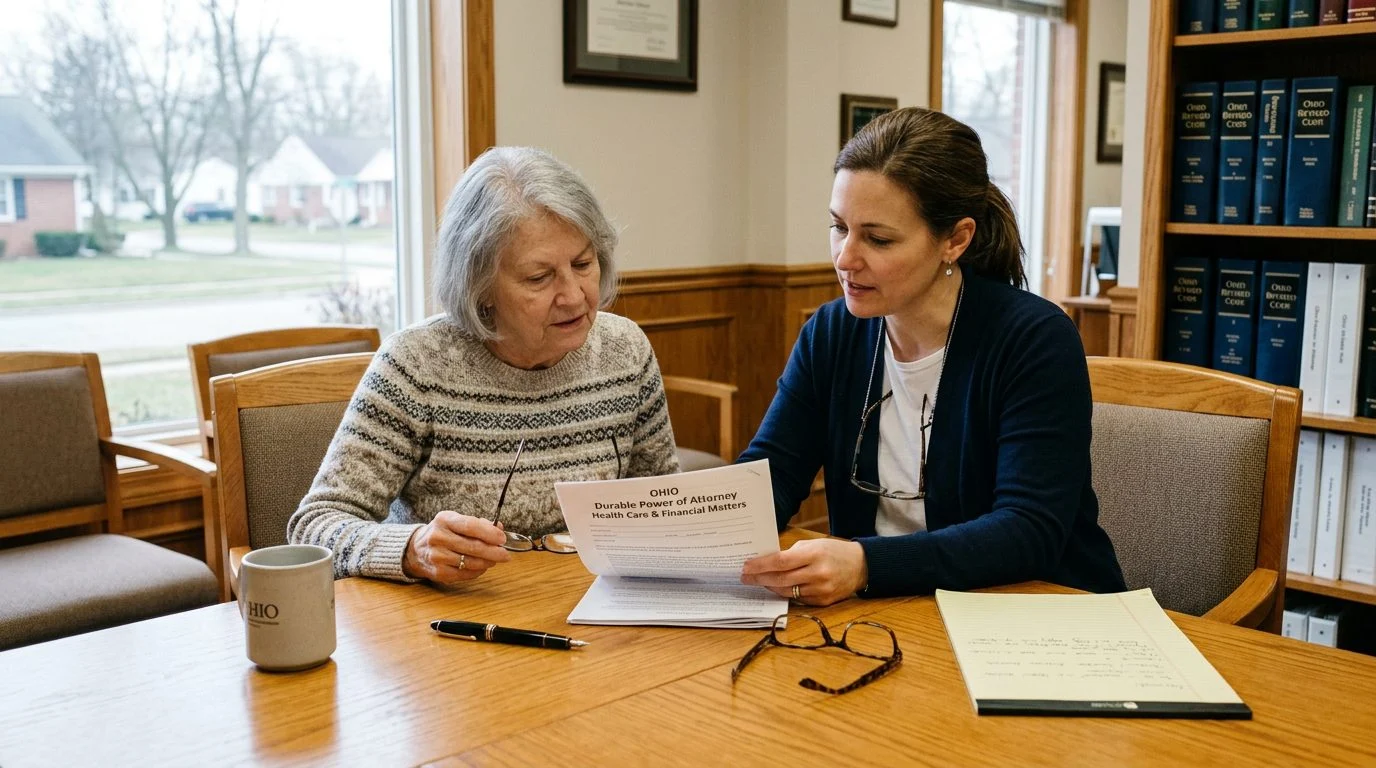
In every plan we prepare, we include a general durable power of attorney for finances, a health care power of attorney, a living will and a HIPAA release. A strong financial power of attorney is a key tool in our planning. It names someone to handle banking, bills and other money matters if your parent can no longer manage them alone. Without it, you can end up with no clear way to act when a bill is due and your parent cannot sign.
Under Ohio law, the health care power of attorney and the living will are the advance directives. Our plans also include a financial power of attorney and a HIPAA release, and we walk you through what each one is for. Careful planning also helps a family avoid probate later. Probate is the court process for settling a person’s estate, and it can be slow and costly for a grieving family. A plan set up and funded correctly can help your family skip it.
How Jarvis Law Office helps families in this situation
You don’t have to figure this out alone. Our team guides your family step by step, starting with a free discovery call. That first conversation is confidential, and it carries no obligation to continue. From there, we meet to talk through the options and choose a plan that fits your parent’s wishes and your family’s situation.
We then set up the plan documents and coordinate your parent’s assets so they match the plan, which takes more than paperwork. We stay with you for ongoing guidance as needs change. We work on a flat fee with no recurring insurance-style fees. Our offices are in Lancaster, Dublin and St. Clairsville, and from them we serve families in every Ohio county, including Fairfield and Franklin counties.
Take the next step toward a plan your family understands
If your mom or dad still lives at home, you’re already doing much of the care, and the papers that would let you act aren’t in place yet, you’re not alone in that spot. The next step can be a simple conversation about what your parent wants. Bring a list of the questions that worry you most, such as who would pay the bills if your parent couldn’t, and we’ll start there.
Our page on Medicaid planning in Ohio gives the wider picture. When you’re ready, schedule a free discovery call and bring your questions about a personal care agreement and the documents your family needs.

Frequently Asked Questions
What is a personal care agreement between a parent and an adult child?
A personal care agreement is a written contract in which a parent agrees to pay an adult child for caregiving help, such as daily support, errands or hands-on care. Putting the tasks, pay and schedule in writing helps everyone know what is expected.
Can an adult child be paid for caring for a parent in Ohio?
The answer depends on your family’s facts, so it is worth reviewing your situation before you begin.
Why should a personal care agreement be in writing?
A written agreement records what was agreed, when, and why payments were made, which can prevent misunderstandings among family members. It can also matter later if your parent needs help paying for care. We can walk through how the terms should be written for your family.
What should I do first if I want a personal care agreement with my parent?
Start by scheduling a free discovery call with Jarvis Law Office, which is confidential and carries no obligation to continue. Bring a rough picture of the care your parent needs and the help you already give, and we will help you think through the next steps.
Talk with us before the first payment
Before you sign anything or write the first check, bring the arrangement to us. We will walk through it with your family alongside your parent's full plan, so that the payments fit the bigger picture.
Questions to settle before you start
Put the work in writing
Describe the tasks, the pay and the schedule in one written agreement. A clear record helps everyone know what is expected, including siblings who were not there day to day.
Look at the whole picture
Caregiving pay affects more than one paycheck. It can touch your parent's money, your own taxes and the plan for the home, so it belongs alongside the rest of your family's planning.
Protect your parent's money
Your parent's income and savings should be managed in a way that serves your parent first. Clear records and a sound power of attorney help keep those decisions transparent.
Plan for the future
Needs change over time. A plan that is reviewed as your parent's health changes keeps the arrangement working for your family and avoids surprises later.
How Jarvis Law Office helps your family
A first conversation
We start by listening to your family's situation, including what your parent wants and what you are able to take on.
Plan documents in place
We put the documents for your parent's plan in order, including the financial power of attorney, health care power of attorney, living will and HIPAA release that are part of our plans.
Care Navigators when you need them
Our Care Navigators can help your family find a way through the health care system on your parent's behalf, whenever that help would make things easier.
A flat fee
We work on a flat fee, with no recurring insurance-style charges, so you know the cost before the work begins.