
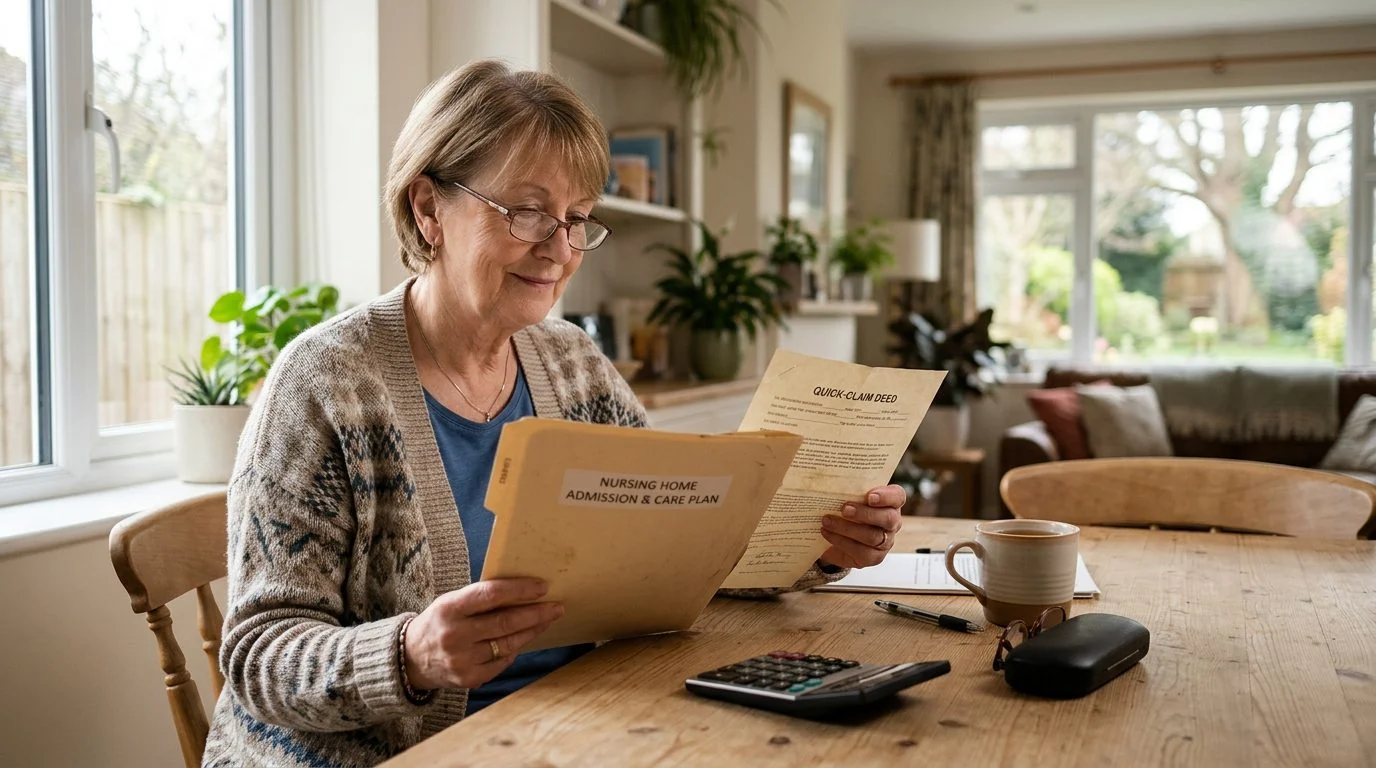
Medicaid planning | Serving families in every Ohio county
Does the land next to your home count for Ohio Medicaid?
A neighboring lot or a few extra acres can change how Medicaid sees your home. Here is how to sort out what applies to your family.
By Timothy Jarvis · Published November 13, 2026
For a family like yours, the answer depends on the details of the land, the home and the savings involved, and no single rule settles it for every family. The answer turns on the deed, the acreage, how the land is used and your family’s facts.
This page explains what decides the answer, the planning steps that can help and what we would review with you. You do not have to figure all of it out on your own.
Your home and the land beside it, in your own words
You may be asking it this way: if memory care becomes necessary, will the house and the land beside it be used up to pay for it? You want those places kept for your children, without a court process and without a fight over the land. That is a fair thing to want.
Land beside a home is not automatically treated the same as the house, and it is not automatically treated as separate. Every family’s land and deed raise their own questions, and we would go over the details of your parcel with you during a discovery call. A wooded parcel behind a neighbor’s field raises a different question than land that runs right up to your back door.
The honest short answer is that it depends on several facts, and no one can give a yes or no from the outside. Our team reviews those facts with you, one at a time, and explains what each one means for your plan. You do not have to sort out the rules by yourselves.

For example, imagine a couple with a home and family land
Planning helps most when a couple sees their options before a crisis makes the choice for them.
For example, imagine a couple, Walt and Ruth Kessler, who live outside New Lexington in Perry County. Their farmhouse sits beside a wooded parcel that Walt’s father left them. Walt has started forgetting appointments, and one evening he got lost driving home from town. Ruth is afraid that a memory care move would use up every dollar and that the land would have to be sold. They also worry their two sons will argue over the parcel if something happens to either of them without a plan. Planning let them see their options one step at a time: how the house and the land are titled, what they want for each son and which care settings might fit. Every family’s facts are different, and results turn on each family’s own deed and circumstances.
Why land beside the house raises Medicaid questions
Medicaid looks at what you own when it reviews an application for long-term care, so your home and any land are part of the picture. Ohio also sets a limit on the equity a home can carry, and that limit shapes the whole review.
For 2026, Ohio’s home equity limit is $752,000, and it rises every January.
The limit does not always apply.
The home equity limit does not apply when the individual’s spouse is lawfully living in the home (Ohio Adm.Code 5160:1-6-02.1).
That is why we always ask who lives in the home today, and who will live there next. Ohio Medicaid lists its residency and financial requirements. Rules also vary from state to state.
What the deed, the acreage and the use of the land ask us to look at
The first question is whether the land touches your home’s land, with no property owned by others in between.
Land beside the home is treated as part of the home only when it adjoins the home’s land and is not separated from it by land owned by others (Ohio Adm.Code 5160:1-3-05.13).
That one point is where many families need the most careful review. We also look at these five areas:
- Title. Who holds the house and each parcel: the individual, the individual’s spouse, the parent of an eligible child who lives with them, or a revocable trust, as long as the principal of the trust remains a resource of the individual or the individual’s spouse.
- Layout. Whether the land is part of the home parcel or a separate parcel, and how the deed describes it.
- Acreage. How many acres there are, and whether they form a home site, farmland, woods or a mix.
- Use. Whether the family lives on it, farms it, rents it out or keeps it for the family, and how it has been used over time.
- Family. Who has lived on the land and helped care for a parent, and what each child hopes for and whether they can work together.
Write down what you know about each one before your first conversation with us, even if some answers are rough.
Memory care, Ohio Medicaid and keeping your loved one at home longer
Ohio Medicaid can help pay for nursing homes, for many but not all assisted living and memory care settings, and for care at home. Staying home longer is possible for many families, and a move to a care setting later stays an option. According to the Administration for Community Living, almost 70% of people turning 65 will need some long-term care, so it makes sense to plan before a crisis.
When care decisions come up, our Care Navigators can help your family find their way through a complicated, fragmented health care system. They are not lawyers and do not give legal advice. Where your spouse lives, and for how long, can change what your family needs to protect. A plan made before that decision can give you more room to choose.
Planning ahead can help protect the land and keep it out of probate
A plan set up and funded correctly can help your children receive the land without probate. Probate is expensive, drawn-out and stressful for a grieving family, so it is worth planning around. Planning done well before care is needed can often shield assets from the spend-down and from estate recovery. Even when care is needed sooner than planned, planning may still protect part of what a family has built, depending on that family’s situation. Options can also remain well before the savings are spent.
Giving the land or the house to the children early is not a simple fix.
When a person in long-term care, or their spouse, gives away assets for less than fair market value on or after the look-back date, which is five years before the person’s baseline date, the transfer is presumed improper and results in a restricted Medicaid coverage period (Ohio Adm.Code 5160:1-6-06).
Quick transfers can create problems that are hard to undo, so we review every option before anything is signed. These are possibilities that turn on your family’s own situation. Our job is to get the planning right so your family can skip probate later.
The documents that keep the plan working
In every plan we prepare, the documents include a general durable power of attorney for finances, a health care power of attorney, a living will and a HIPAA release.
The financial power of attorney matters most for the land and the savings. In our plans, it is one of the key tools we use to protect a family’s assets. If one spouse can no longer manage money alone, a trusted person has a clear way to handle bills, the house and the land. The health care power of attorney and the living will guide medical decisions. The HIPAA release lets doctors and hospitals share health information with the people you name.
Documents work only when the deed and the accounts are titled to match them. Making sure that happens is part of our work, not something you have to track alone.
How Jarvis Law Office helps with the land question
We guide you through each step, so your family does not have to work out the land question alone. The first conversation is about understanding your family: the house, the land, the deed and what each person hopes for.
At a strategy meeting, you choose a plan with us. After that, we set up the plan documents and fund the plan, which means titling the house and the land so they match what you chose. Funding is more than paperwork. It is what lets the plan work when it is needed. We handle a Medicaid application only if your family needs one. Ongoing guidance continues as needs change, because health and family circumstances shift over time.
We charge a flat fee, with no recurring insurance-style fees. Our Care Navigators can help with the health care side when that help is needed.
Quick answers
Does land next to your house count for Medicaid in Ohio?
Land beside the home is treated as part of the home only when it adjoins the home’s land and is not separated from it by land owned by others. Whether the rest of your land counts turns on the deed, the acreage and how it is used.
Can we give the land to our children now?
When a person in long-term care, or their spouse, gives away assets for less than fair market value on or after the look-back date, which is five years before the person’s baseline date, the transfer is presumed improper and results in a restricted Medicaid coverage period. Talk with us before any transfer, because timing and form matter.
Will the land have to go through probate?
A plan set up and funded correctly can help land pass to your children without probate, and we review the titles with you.
Your next step: a free discovery call
Booking a free discovery call is the next step, and it is confidential with no obligation to continue. If memory care is on your mind and you want your home and family land kept for your children, that is where we can start. We have offices in Lancaster, Dublin and St. Clairsville, and we serve families in every Ohio county.
Bring the deed, a list of the parcels and a note of what each child hopes for. That way the first call can start with your real facts. We cannot predict how your land will be treated, but we can review your facts with you clearly and calmly.
How we help families with land and Medicaid
We look at the whole picture
We review the deed, the acreage, how the land is used and where it sits relative to the house, so you can see which parts may matter for Medicaid.
We set up the right plan documents
Every plan we prepare includes a general durable power of attorney for finances, a health care power of attorney, a living will and a HIPAA release. A strong financial power of attorney is one of the tools we use to protect your family's assets.
We coordinate the land with the plan
A plan works only when the property is titled and arranged to match it. We walk through each step with you so the paperwork fits your goals.
Care Navigators help with the care system
When the health care system feels fragmented, our Care Navigators can help your family find their way through it. They do not give legal advice; our attorneys handle the legal side.
A flat fee with no insurance-style charges
We work for a flat fee, with no recurring insurance-style fees, so you know the cost before the work begins.
Ask us before you move any land
Deeding land to a child or anyone else can change how Medicaid sees it. Please talk with us before you sign anything, so we can walk through your options first.
Bring these to your free discovery call
Your deed and property records
Copies of the deed and any survey or tax records help us see exactly how the land is titled.
The acreage and how it is used
Tell us how much land you own, whether it is farmed, rented or left open, and whether it is used for income.
Land between your home and other parcels
Note whether any land separates your home from the rest of your property, since that can change how it is viewed.
Your family's goals for the land
Think about whether you want to keep the land in the family, sell it someday or pass it on, so the plan can reflect what matters most to you.
You do not have to sort out your land alone. Start with a free discovery call, which is confidential and carries no obligation to continue.
Related practice areas
- Long-Term Care and Memory Care Planning in Ohio
- Mom Has Dementia and No Power of Attorney
- Dad Just Had a Stroke
- Ohio Home Equity Limit and Memory Care for a Paid-Off Home