
Ohio elder law and Medicaid planning
Paying for a Parent's Nursing Home? Let's Sort Out Ohio Medicaid Together
Long-term care bills can arrive faster than a family can make sense of them. We help families in every Ohio county see their options, one step at a time.
By Timothy Jarvis · Published November 21, 2026
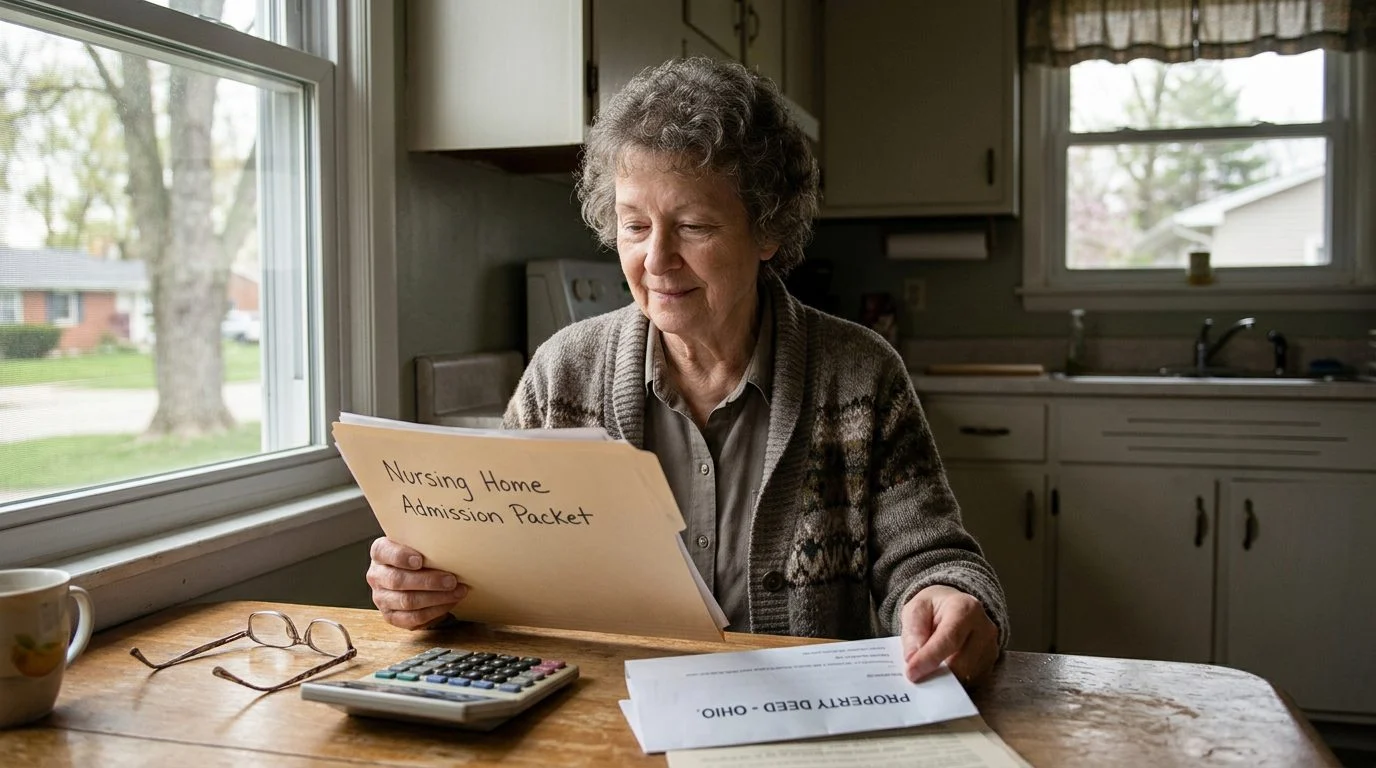
You’re paying part of a parent’s nursing home or care bill from your own account, and you wonder whether that puts your parent at risk.
This page explains how Ohio Medicaid treats that money, what it can help pay for, and what planning can look like for your family. You don’t have to work this out by yourself. Keeping up with the rules is our job, and we take it one step at a time with you.
Why you are reading this, and what this page answers
Many adult children start covering bills quietly, one check at a time, before anyone sits down to make a plan. This page answers one question: how does Ohio Medicaid look at money a child spends on a parent’s care, and what can a family do about it before a crisis?
You probably want your parent’s wishes written down, the family home protected, and a plan everyone understands. You also want to avoid a costly mistake made in a hurry. Those are sensible goals, and we help families reach them step by step.
If you're covering a parent's care bills from your own account, you don't have to figure out Ohio Medicaid alone; our team can help you take the first step. Talk it through with Jarvis Law Office — the first discovery call is free, confidential, and carries no obligation.

For example: a daughter covering her father’s bills
For example, imagine Denise, who lives in Chillicothe with her two teenagers and works full time. Her father, Harold, moved into a nursing home after months of slipping at home, and his pension no longer covered the bill. Denise began paying the difference from her savings, and no one had signed a power of attorney for him. She feared losing the house Harold had worked to pay off, and she couldn’t sign anything for him at the bank when he was confused. Her brother disagreed about whether to sell. A planning conversation helped the siblings list their choices and gather written records, so they could decide together. Every family’s facts are different, so your family’s path will look different from Denise’s.
What Ohio Medicaid can help pay for
Ohio Medicaid can help pay for nursing home care, and for many assisted living and memory care settings, though not every one. It can also help pay for care at home. Ohio Medicaid can help pay for nursing home care, and for many, though not all, assisted living and memory care settings.
Many families would rather stay home longer, and that is often possible. A move to a care setting later stays an option. If your parent has dementia, there are many care choices, and you do not have to sort through them alone.
Medicaid eligibility looks at your parent’s own income and assets. That is why the choices made with their money matter so much, and why the timing of those choices matters too.
When your own money goes toward Mom’s care
Many adult children help pay a parent’s bills, and how that money is recorded can matter later. Money moved out of your parent’s accounts is a different question, and we can walk through it with you.
The look-back period is sixty months (five years) before the baseline date, and for a parent who is already eligible for Medicaid when first institutionalized, the baseline date is the first date of institutionalization (Ohio Adm.Code 5160:1-6-06).
If a parent, or the parent’s spouse, disposes of assets for less than fair market value on or after the look-back date, Ohio presumes the transfer is improper, and that results in a restricted Medicaid coverage period (Ohio Adm.Code 5160:1-6-06).
Practical habits help a great deal. Keep a written record of every payment: the date, the amount, the purpose and who was paid. Keep the receipts and bank statements together in one folder. Talk with us before you move a large sum for your parent, even when it feels urgent. How these rules apply to your family’s money is something we walk through with you in a conversation, not something to settle from a web page.
What planning can look like for your family
Planning started early can often protect more of a family’s assets. Here is what that can look like. Each point is a possibility, and what fits your family depends on your situation.
- Planning started five or more years before care is needed can often shield assets from the spend-down (the money a parent uses toward care before Medicaid starts paying) and from estate recovery (Ohio’s claim against an estate after a parent’s death).
- When care is needed now, a significant part of the spend-down amount can often still be protected.
- It is not too late for many families. A parent can often qualify for Medicaid-paid care well before spending everything.
If you lived with your parent and provided care that delayed a move to a facility, the home may be treated differently under Ohio’s rules.
A transfer of the parent’s home to an adult child is not treated as improper if that child provided care that let the parent live at home instead of in a long-term care facility, lived in the home for at least two years immediately before and continuously since the parent became institutionalized, and documents this with a notarized ODM 10271 “Affidavit of Child Caregiver” and an ODM 10272 “Physician Certification” or other written statement from the attending physician (Ohio Adm.Code 5160:1-6-06).
Paperwork decides this area, so we walk through each document with you before anything is signed.
Protecting the family home and avoiding probate later
A plan set up and funded correctly can help your family skip probate later. Probate is the court process for settling a person’s estate after death. It can be expensive, drawn out and stressful for a family that is already grieving.
Careful planning means the right documents are in place, and assets are titled and coordinated to match the plan. That is what helps keep a family out of probate. Results depend on each family’s situation, and getting the planning right is part of our work. Ask us what happens to your parent’s home and savings, and we’ll show you how the pieces fit.
Not sure what your next step is?
Talk it through with Jarvis Law Office — the first discovery call is free, confidential, and carries no obligation.
The documents your family needs before a crisis
The plans we prepare include four documents. Each one has a job in an emergency:
- A general durable power of attorney for finances lets a trusted person handle bills, the bank and benefits. It is one of the key asset-protection tools in our planning.
- A health care power of attorney lets a trusted person speak for your parent about medical decisions if your parent cannot.
- A living will records your parent’s wishes about end-of-life care.
- A HIPAA release lets doctors and facilities share health information with the people your parent names.
Writing these down helps brothers and sisters agree on one plan instead of arguing from memory. Our Care Navigators can also help families find their way through the health care system on the client’s behalf when that help is needed. Care Navigators are not lawyers, and they do not give legal advice.
How Jarvis Law Office helps your family
Your family does not have to do this alone. The first step is a conversation, where we learn your family’s situation. The first discovery call is free, confidential and carries no obligation to continue.
From there, we meet to choose a plan. We set up the documents and coordinate your parent’s assets so they match the plan. If Medicaid applies, we handle the application when it is time. We stay with you as needs change. We charge a flat fee, with no recurring insurance-style fees. Our offices are in Lancaster, Dublin and St. Clairsville, and we serve families in every Ohio county.
Questions adult children ask before they call
Do I have to keep paying the nursing home myself?
Whether you must keep paying depends on your parent’s situation and any agreement you signed. We review that with you in the first conversation.
Can I act for my parent without a power of attorney?
Without signed documents, banks and doctors may hesitate to take direction from you. Setting up the documents before an emergency is much easier.
Does Medicaid cover every nursing home?
No. Medicaid can help pay for many settings, but not every one. We check each facility with you.
Can I use my own money without hurting my parent’s Medicaid eligibility?
If your parent is applying for Medicaid to pay for long-term care in a nursing home or similar care setting, the agency starts from the presumption that any gift or below-value transfer your parent or your parent’s spouse made on or after the look-back date was improper. Some kinds of transfers are not counted as improper at all, which we can walk through with you, and the presumption can be overcome by making a satisfactory showing to the agency that your parent or your parent’s spouse intended either to transfer the asset for fair market value or for other valuable consideration, or to transfer it exclusively for a purpose other than to qualify for medical assistance, backed by a written explanation and supporting documentation (Ohio Adm.Code 5160:1-6-06).
Will my brother and sister have a say?
A shared written plan helps everyone understand what your parent wants. That clarity can ease disagreements before they start.

Take the next step toward a plan your family understands
If you’re covering a parent’s bills while still looking for answers, you’re in a hard spot you didn’t choose. When the bills keep coming and no document yet lets you act for your parent, you don’t have to decide the next step alone. Start with a conversation with our team about your family’s situation, and we’ll take it from there.
How Jarvis Law Office guides your family
A free discovery call
Your first call is free, confidential and carries no obligation to continue. It is a chance to explain your parent's situation and ask your questions.
Care Navigators when you need them
Our Care Navigators can help your family find a way through the health care system on your parent's behalf. They do not give legal advice.
A flat fee, not recurring fees
We charge a flat fee for the planning work, with no recurring insurance-style fees, so you know the cost before the work begins.
Plans matched to your family's assets
We set up the documents and then coordinate your assets so they match the plan, which is more than paperwork.
Possibilities that planning can look like
Protecting the home for a spouse at home
Planning can sometimes help the spouse who stays home keep the house and stay financially secure. What is possible depends on your family's own situation.
Protecting savings from the spend-down
Depending on timing and your family's facts, a significant part of the savings may still be protected while your parent qualifies for Medicaid-paid care.
Keeping your parent's wishes in view
A plan can help your parent's wishes guide decisions about money and care, so the family is not left guessing what their parent wanted.
Planning to avoid probate later
When documents are in place and assets are titled to match the plan, careful planning can help a family skip probate after a death. This is never guaranteed, but it is a central goal of our planning.
Before you sign or move money
Admission paperwork and bank transfers can have consequences that are hard to undo. Please talk with us before you sign or move money, so the next step fits the plan.