
Elder law and Medicaid planning in Ohio
Your Spouse Is Moving Into a Nursing Home. You Do Not Have to Figure Out the Next 30 Days Alone.
A calm, step-by-step way to handle the paperwork, the bills and the decisions that come with a move to care.
By Timothy Jarvis · Published November 26, 2026
You’re at home, your spouse has just moved into a nursing home, and the bills already feel bigger than your savings. The first 30 days are for gathering facts, protecting the income and home you need, and getting ready for an Ohio Medicaid application. They are not for rushed decisions or quick moves of money or property.
You don’t have to work out all of this on your own. Staying on top of the rules is our job, and we guide families step by step.
The first month is for facts, not fast decisions
Your first step is to gather facts and learn the protections built for the spouse at home, before anything moves.
For example, imagine Ruth and Walter, a couple in Zanesville, Ohio. Walter needed more help at home for several years, and after a hospital stay his doctor recommended a nursing home. Ruth stayed in their house and worried the bills would use up their savings and force her to sell the home they had shared for decades. Before they changed a single account, they gathered their papers and sat down with a lawyer to see which options fit their facts. Results vary with each family’s own facts, so your path will look different.
If you are the spouse at home, your worries likely start with the house, the savings and the monthly bills. Those worries make sense. The rules include protections for the spouse who stays home, and careful planning can often help you use them.
If your spouse has just moved into a nursing home and you're worried about the bills and the house, we're glad to talk it through with you, and you don't have to face it alone. Talk it through with Jarvis Law Office — the first discovery call is free, confidential, and carries no obligation.

Gather the papers and facts this month
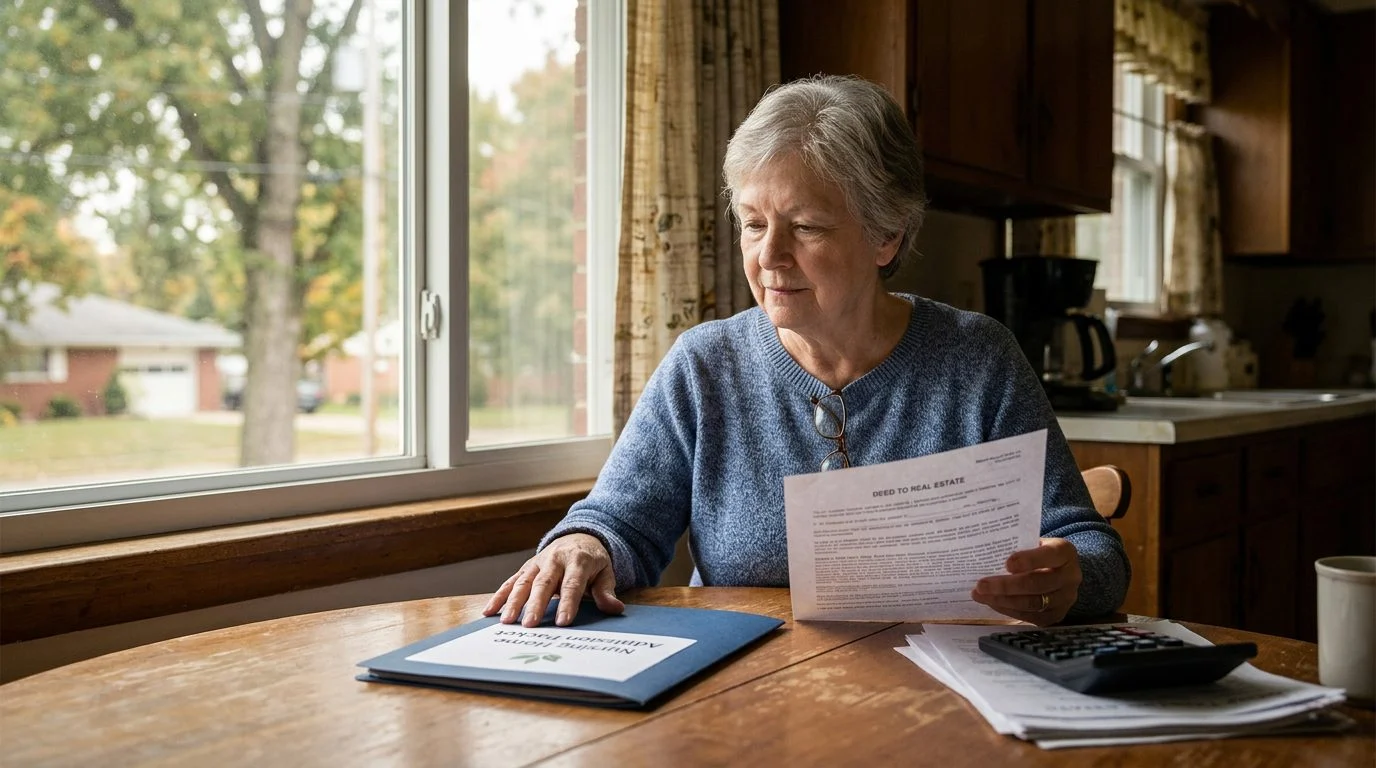
Start by collecting the papers that show what you own, what you owe and what money comes in each month.
- Nursing home admission papers and any agreement you were asked to sign
- Bank, retirement and investment statements for both of you
- The deed to your home
- Social Security, pension and other income statements
- Any existing wills, powers of attorney or trust papers
- A written list of gifts, large withdrawals or transfers over the last several years
Write down what each account was for and who owns it, even if the answer seems obvious. Keep copies of everything you sign. A complete, accurate picture from the start makes the later Medicaid application smoother, because reviewers will ask about what you had and what moved.
Protecting the home you live in
Your home can often be protected while your spouse is in a nursing home, and the planning starts with how the home is owned and who lives in it.
The home equity limit is one of the first numbers we check. For 2026, Ohio’s home equity limit is $752,000, and it rises every January.
The home equity limit does not apply to an individual when the individual’s spouse is lawfully residing in the individual’s home (Ohio Adm.Code 5160:1-6-02.1).
For a family in your position, that is a good reason to look at the home first. Careful planning can often help you stay in the house and feel secure there. It can also look ahead to what could happen to the home after your spouse dies, which we cover below.
Protecting income and savings so you can keep living at home
Your income and savings have their own protections, and knowing them early shapes the whole plan.
When the institutionalized spouse is subject to a resource limit, the couple’s combined countable resources must be equal to or less than the community spouse resource allowance, which the at-home spouse is permitted to keep, plus two thousand dollars (Ohio Adm.Code 5160:1-6-04).
That protected amount is called the community spouse resource allowance. For example, imagine a couple, Dale and Joan, with $150,000 in savings when Dale moves into a nursing home. The amount a spouse at home may keep depends on the couple’s combined countable savings and on figures that change over time, so we work from your family’s actual numbers rather than from a single maximum. The 2026 CMS figures set that maximum.
Income matters too. The amount a spouse at home may keep each month is a figure we confirm against current program rules for your family’s situation before any planning decision. Joint bank accounts can be treated differently from accounts in one name, so review them with the attorneys before you change anything. Moving money or property in a hurry is the mistake to avoid.
The Medicaid application: timing, paperwork and what to expect
Ohio Medicaid can help pay for nursing home care, and the application is where your planning gets tested.
Ohio Medicaid’s facility care page explains how your spouse’s income, personal needs allowance and the community spouse’s allowance all affect what care costs the family. Medicaid can help pay for nursing homes, and for many, but not all, assisted living and memory care settings.
When an institutionalized individual or spouse gives away or sells assets for less than fair market value on or after the look-back date, which is sixty months before the individual’s baseline date, the transfer is presumed improper and results in a restricted Medicaid coverage period (Ohio Adm.Code 5160:1-6-06).
Planning started well before care is needed can often shield more assets from the spend-down (the money spent on care before Medicaid helps) and from estate recovery, though what can be protected depends on timing and on each family’s own facts. Families already facing care now can often still protect a significant part of the spend-down amount, and options remain for those who have not spent everything, though what applies depends on each family’s own facts and is something we review together.
The application follows a path: gather the papers, file, answer the agency’s questions, and track any deadlines it sets. Processing time varies, so we plan around each request.
Advocates at Justice in Aging report that spouses are sometimes pressed to pay nursing home bills personally. Bring any such paper to the attorneys before you sign, and report pressure to the Ohio Attorney General’s seniors resources.
After your spouse dies: estate recovery, your documents and probate
Planning now can shape what the state and your family can reach after your spouse dies, and it can help you avoid probate.
Medicaid estate recovery cannot be made against a permanently institutionalized person’s estate while that person’s spouse is alive (R.C. 5162.21).
Careful planning can often change what estate recovery reaches, including the home, so we look at how the home and accounts are titled early.
Probate is the court process for settling a person’s estate, and it can be expensive, slow and stressful for a grieving family. A plan set up and funded correctly can often help a family skip probate, and getting that planning right is our part.
In our plans, we include a financial power of attorney, a health care power of attorney, a living will and a HIPAA release. The financial power of attorney is one of the key asset-protection tools in our planning.
Not sure what your next step is?
Talk it through with Jarvis Law Office — the first discovery call is free, confidential, and carries no obligation.
How Jarvis Law Office helps you through the first 30 days
We guide you one step at a time, so you do not have to sort out the rules alone.
Our first step is an initial conversation about your family’s situation, followed by a strategy meeting where we help you choose a plan. We then set up the plan documents, and we fund and coordinate your assets to match the plan, which takes more than paperwork. When a Medicaid application is part of the plan, we prepare it, and we keep giving guidance as your needs change.
We serve families in every Ohio county from our offices in Lancaster, Dublin and St. Clairsville. Our fee is a flat fee, with no recurring insurance-style fees. Our Care Navigators can help your family find their way through the health care system on your spouse’s behalf when that help is needed. They are not lawyers and do not give legal advice.
Questions you may be asking
Short answers to the questions spouses at home ask most often.
Will I lose my house if my spouse goes into a nursing home?
The answer depends on the facts of your family. Planning can often help protect the home for the spouse who lives there.
What is the Medicaid look-back period in Ohio?
When an institutionalized individual or spouse gives away or sells assets for less than fair market value on or after the look-back date, which is sixty months before the individual’s baseline date, the transfer is presumed improper and results in a restricted Medicaid coverage period.
Our attorneys walk through the timing with you, since small details change the picture.
What happens to me if my spouse dies first?
Medicaid estate recovery cannot be made against a permanently institutionalized person’s estate while that person’s spouse is alive.
Reviewing your options early is worth the time.
Can I start planning if we have not filed an application yet?
Yes. Planning can begin before anything is filed, and options often remain for families who have not yet spent everything.

Take the next step: a free discovery call
If you’re at home, worried about the bills and the house, and still gathering information, you don’t have to decide anything today. Our free discovery call is confidential and carries no obligation to continue. It gives us a chance to hear your situation and explain what planning could look like for your family.
How Jarvis Law Office helps your family through this move
We listen first
Your family's situation is different from anyone else's. We start by hearing what has happened, what you are worried about and what your spouse wants.
We look after what you have built
Planning can help protect the home and savings for the spouse who stays at home, so that the move does not leave that spouse without security.
We set up the right documents
Powers of attorney, a living will and a HIPAA release are part of every plan we prepare, so that the people you trust can act when they need to.
We keep up with the rules
Staying on top of changing rules is our job, not yours. We guide you step by step as your needs change.
Care Navigators when you need them
Our Care Navigators can help you find your way through the health care system on your spouse's behalf, while our attorneys handle the legal side.
Talk with us before you move money
Before you transfer a house, sign over savings or make gifts to family, please speak with us. Some moves can change how Medicaid looks at your family's assets, and we would rather walk through your options with you first.
The first weeks, one step at a time
Gather the papers
Pull together your marriage certificate, deeds, bank and retirement statements, and the nursing home's admission paperwork. You do not need to organize everything perfectly.
Ask about the house and the bills
Find out what the nursing home is asking you to sign and what it expects to be paid. We can help you read those agreements before you commit to them.
Plan the documents
We look at whether your powers of attorney, will and trust match your wishes now that one of you needs care.
Choose what comes next
In a strategy meeting we review your options, from keeping the home to applying for Medicaid help with care, and decide together on a plan.